At a time when the Yemeni Armed Forces have successfully imposed a naval blockade on the Zionist entity, creating a suffocating crisis for the Israeli economy, an alternative lifeline has emerged to sustain and support the Israeli war machine. This investigation — through multiple parts, using open-source maritime data and credible reports — uncovers suspicious rescue roles that surpass political decisions of Arab and Islamic states, leaping over decades-old principles of struggle with the Israeli entity. Almost all of these actions unfold under the banner of normalization agreements, regional “stability,” and the latest façade: the so-called “Abraham Accords,” which grants the Israeli entity existential legitimacy while justifying its continued aggression and unending crimes.

Open-Source Evidence: How Egypt and Turkey Help the Enemy Circumvent the Yemeni Blockade
Maritime tracking data has revealed a complex network of deception in which Egyptian ports function as strategic transit hubs. These routes are designed to break the Yemeni blockade and guarantee the continued flow of goods to the Zionist occupation, particularly at a moment when the entity is deeply entangled in its ongoing war crimes in Gaza. Zionist media outlets describe this circumvention as an “adaptation of maritime transport methods” to bypass the Yemeni threat, boasting about the entity’s success in exploiting its geographic proximity to Egypt to sustain its economy.
Key observations include:
• Since the beginning of Yemen’s naval operations, a significant portion of vessels arriving at occupied Palestinian ports have come from Egypt, Turkey, Cyprus, and Greece.
• While Turkey is a major trade partner of the Israeli entity, Egypt’s direct trade with the Israeli enemy remains limited — mostly revolving around Egyptian purchases of Israeli gas.
• In contrast, major trade partners of the Israeli entity, such as China, India, Australia, and South Korea, have shown relatively low shipping activity during this period, suggesting reliance on regional transit ports instead.
The Transit Strategy: How Shipping Lines Bypass the Blockade
In December 2023, the Zionist Channel 12 aired a report titled: “The Drill Organized by Shipping Companies to Overcome the Houthi Blockade.” The report described preparations by global shipping firms to adopt alternative routes by offloading containers at intermediary ports — including Greece, Cyprus, and Egypt — before transferring them onto smaller vessels for delivery to the Zionist occupation within four to five days.
The report further explained that cargo originating in East Asia would be issued shipping documents listing these transit ports as final destinations. Once unloaded there, the containers would be reloaded onto smaller vessels bound for Zionist-controlled ports. For example, a ship departing China with goods for the Zionist entity might be documented as heading for Piraeus, Greece, only to have its cargo later transferred to a smaller vessel destined for occupied Palestine.
Zionist customs agent Yilad Gor Aryeh acknowledged that, despite added costs, this system remains far preferable to the long detour around Africa’s Cape of Good Hope. Open-source tracking data confirms a rise in shipping activity between these designated transit hubs and Zionist-controlled ports, underscoring the implementation of this strategy with the facilitation of states controlling those ports.
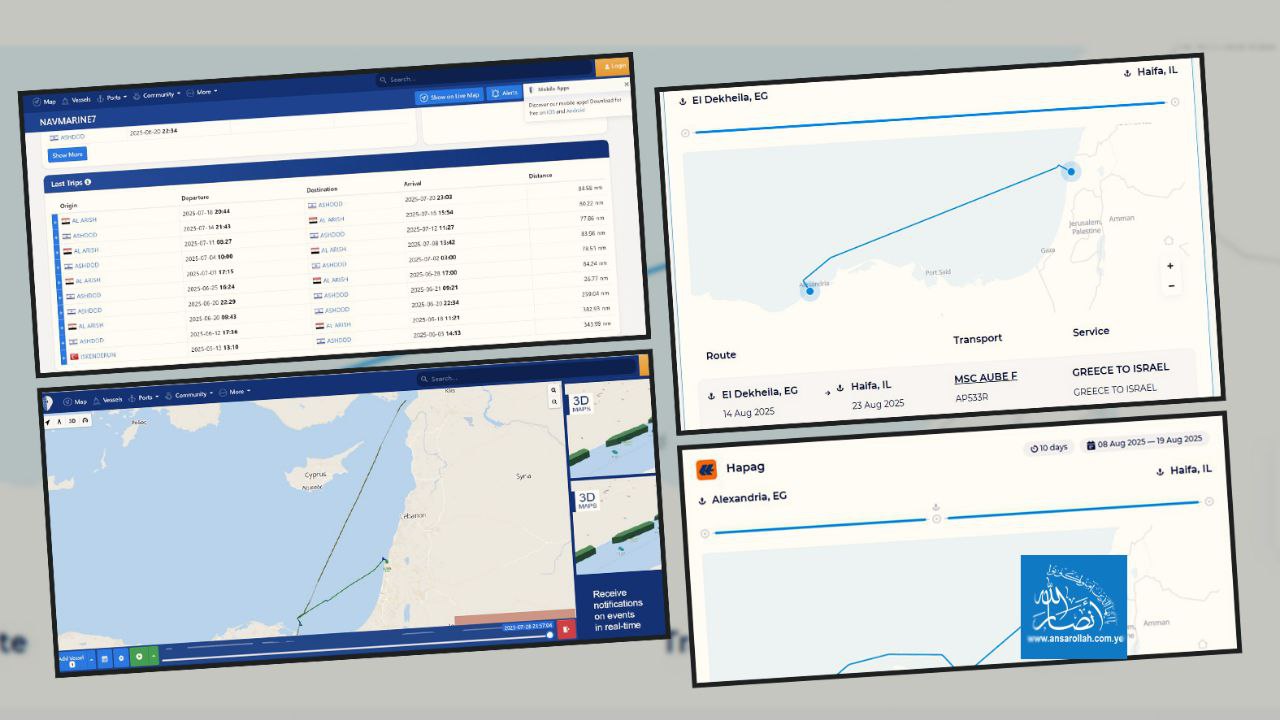
Egyptian ports rank foremost among these hubs due to their clear advantages: proximity to occupied Palestine and rapid turnaround times. Tracking data indicates that at least one or two ships depart daily from Egypt toward Zionist-controlled ports.
The “Maritime Adaptation” Strategy: Deception with Official Approval
The Zionist enemy anticipated this crisis early and prepared a detailed plan. By December 2023, as the Yemeni blockade began, Zionist media outlined strategies by Zionist shipping companies to rely on intermediary ports. Zionist customs officials themselves admitted that, despite higher costs, this system was more efficient than sailing around Africa.
The deception relies on several tactics observed repeatedly in maritime activity:
• Changing cargo destinations: Goods from Asia and beyond are rerouted to Egyptian ports.
• Falsified shipping documents: Bills of lading are altered to obscure the true final destination.
• Transfer to smaller vessels: Cargo is shifted onto smaller ships for short, rapid trips to occupied Palestine.
• Disabling AIS systems: Ships deliberately turn off automatic identification systems to evade tracking.
Egyptian Ports: The Nearest, Cheapest Lifeline to the Entity
Egyptian ports — particularly Port Said, Alexandria, Damietta, and Al-Arish — have become ideal logistical options for the Israeli enemy.
• Geographic proximity: The distance from Al-Arish to Ashdod is only 250 kilometers, less than nine hours by sea. From Port Said to Haifa, the distance is approximately 360 kilometers. This short distance cuts costs and ensures rapid supply flows.
• Integrated infrastructure: Cement factories and construction material hubs located near Egyptian ports facilitate direct exports of these essential supplies to the Israeli enemy.
Tracking data confirms this reality: at least one or two ships sail daily from Egyptian ports to occupied Palestinian ports, while direct sailings from Asian partners like China and India are minimal despite their significant trade ties with the Israeli entity.
Numbers That Expose Collusion
Between June and July 2024:
-
Asdud Port received:
-
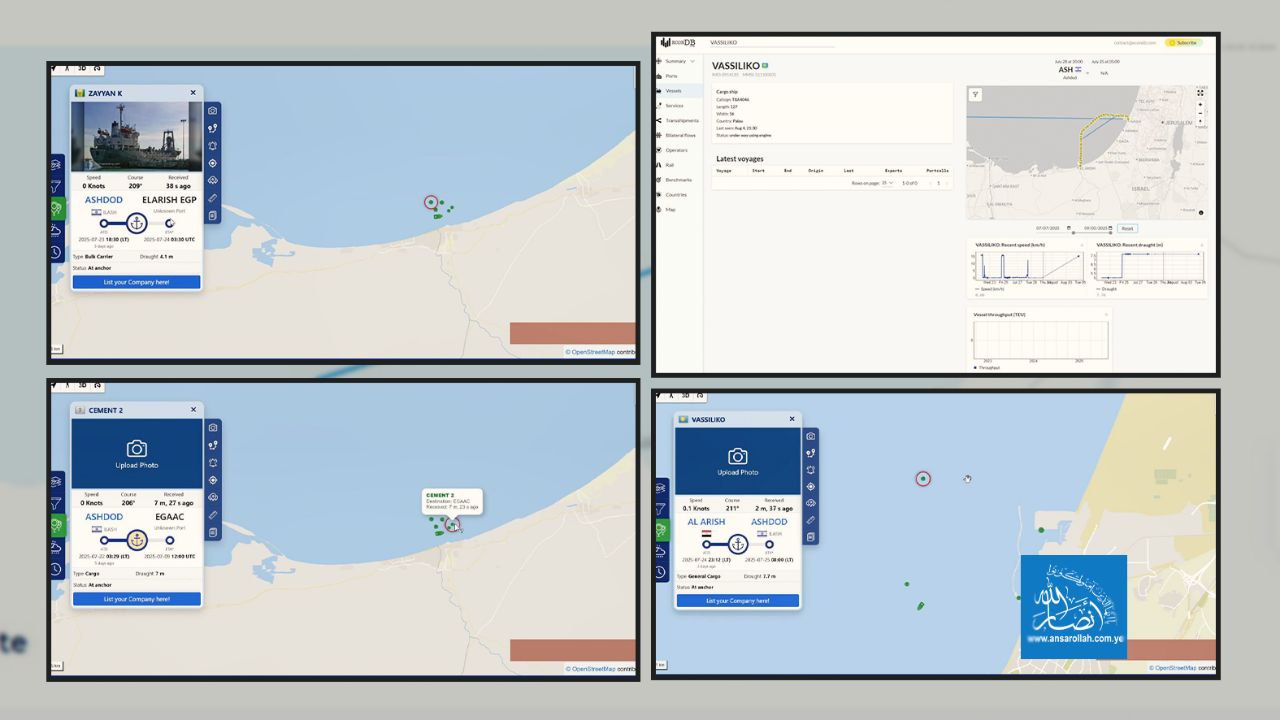
38 calls from VASSILIKO and 32 from ZA Y YAN K (all from Egypt).
-
35 calls by SHIRA-E, 31 directly from Al-Arish.
-
Over 100 calls combined from cement carriers CEMENT 1 and CEMENT 2.
-
-
Haifa Port received:
-
37 calls from NOVA CORALIA, 23 from Egypt.
-
51 calls from HALO.
-
These ships carried a wide range of goods, including general cargo, cement, coal, fuel, and food. Reports also show Egypt ranked second only to the UAE in product categories exported to Israel during the Gaza war.
Trade Spike: Beyond Normal Business
Zionist data confirms the trend:
-
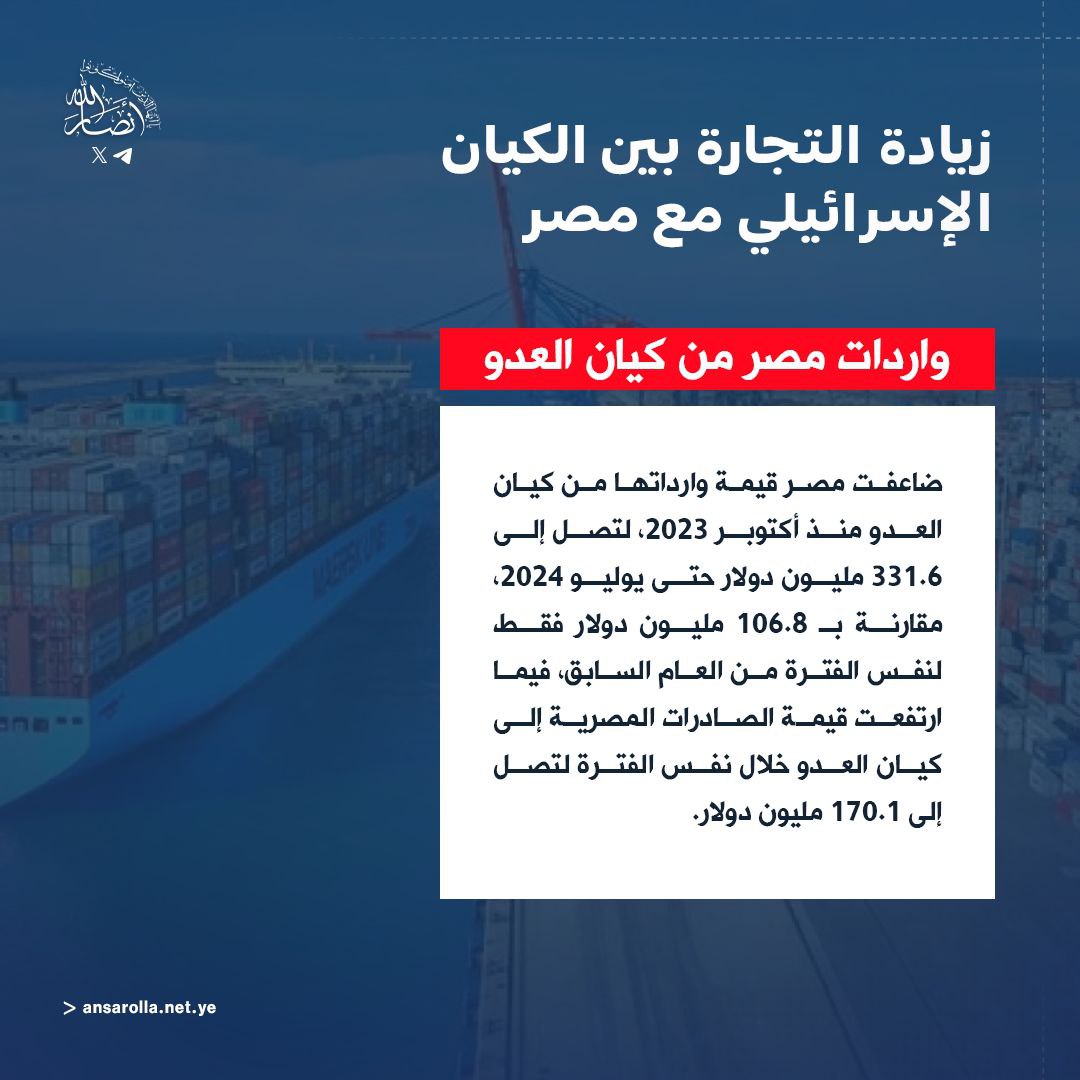
Egyptian imports from the Israeli enemy doubled from $106.8M (Oct–Jul 2022/23) to $331.6M (Oct–Jul 2023/24).
-
Egyptian exports to the Zionist entity rose to $170.1M over the same period.
This surge indicates more than commerce — it reflects a structured, wartime economic lifeline.
Legal and Moral Implications
By enabling the Israeli enemy’s war economy during a documented genocide in Gaza, Egypt, and other transit states may fall under international legal scrutiny.
-
Rome Statute, Article 25: defines facilitating war crimes as complicity.
-
Arab League charters: explicitly prohibit such collaboration with the Israeli enemy.
While Cairo insists its trade with the Zionist entity remains “limited,” the data tells a different story: systematic collusion that betrays both Palestine and Yemen.