Ansarollah Website Official Report
Published:Rabiʻ I 7, 1447 AH
A wave of fear continues to sweep through Zionist entity following the launch of a new multi-headed Yemeni missile, whose details were revealed by enemy’s Channel 12 after receiving permission for publication from what it called the military censor.
According to the report, the missile fired toward the Zionist entity was an advanced cluster missile carrying a warhead that contained 22 explosive submunitions. This marked an unprecedented threat to the enemy’s air defense systems. The disclosure is the first of its kind, as the Yemeni Armed Forces have not released any details regarding the new missile.
In light of this escalation, a senior officer in the enemy's Air Force admitted:
“Yemenis are not the enemy we thought at the beginning of the war. Today, we fully understand that there is a real threat.”
He described operations in the Yemeni arena as “a long and extremely complex journey, not easy to carry out,” and stressed: “As a head of department in the Air Force, I cannot live with this threat.”
The officer further acknowledged that Yemenis are “a strong enemy who learns quickly, develops its capabilities independently, and does not rely entirely on the Iranians,” warning that “the threat will multiply in the future. If we do not respond and eliminate this threat now, we will face hundreds of advanced missiles in the coming years.”
Channel 12 reported that the Zionist military has intensified its efforts in the Yemeni theater, conducting extensive investigations and launching operations through various means to confront this emerging danger. It described Yemenis as “a different enemy with whom peaceful coexistence is impossible” after years of fighting alongside Saudi Arabia and the United States, noting that the Zionist army is exerting major efforts to understand this enemy and adapt to the realities of confrontation.
.jpg)
Zionist Military analyst Or Heller stated:
“For the first time, Yemenis launched a missile with cluster munitions, and even our most advanced interceptors, such as ‘Arrow 3’ and ‘Iron Dome,’ failed to intercept it.”
He added: “The attack caused significant damage and expanded the impact zone,” exposing the depth of the enemy's air defense vulnerabilities.
A Zionist missile expert warned:
“We have seen that the damage from a single missile that is not intercepted can be enormous, even if no one is directly hit.”
He explained that the Yemeni missile that struck “Ben Gurion Airport” nearly severed all communication with the world through foreign airlines, emphasizing: “The price of our interceptor’s failure can be extremely high.”
Zionist outlet Haaretz reported that the Zionist army is considering a number of scenarios to halt Yemeni missile launches, including diplomatic arrangements involving regional actors or Hamas. However, specialists argue that Yemenis pose a threat that cannot be easily stopped.
A military official admitted:
“There is an enemy not to be underestimated. Their operations are overseen by skilled Yemeni experts who have developed their abilities to improve accuracy and impact.”
The accumulation of statements and analyses in recent weeks following the missile launch confirms that the Yemeni Armed Forces have achieved a qualitative leap and profound technical progress in multi-headed cluster missiles. This weapon has become a growing strategic threat reaching deep into Zionist territory, complicating the army’s ability to provide protection, all within the context of the Promised Victory and Sacred Jihad Battle in support of the Palestinian people in Gaza.
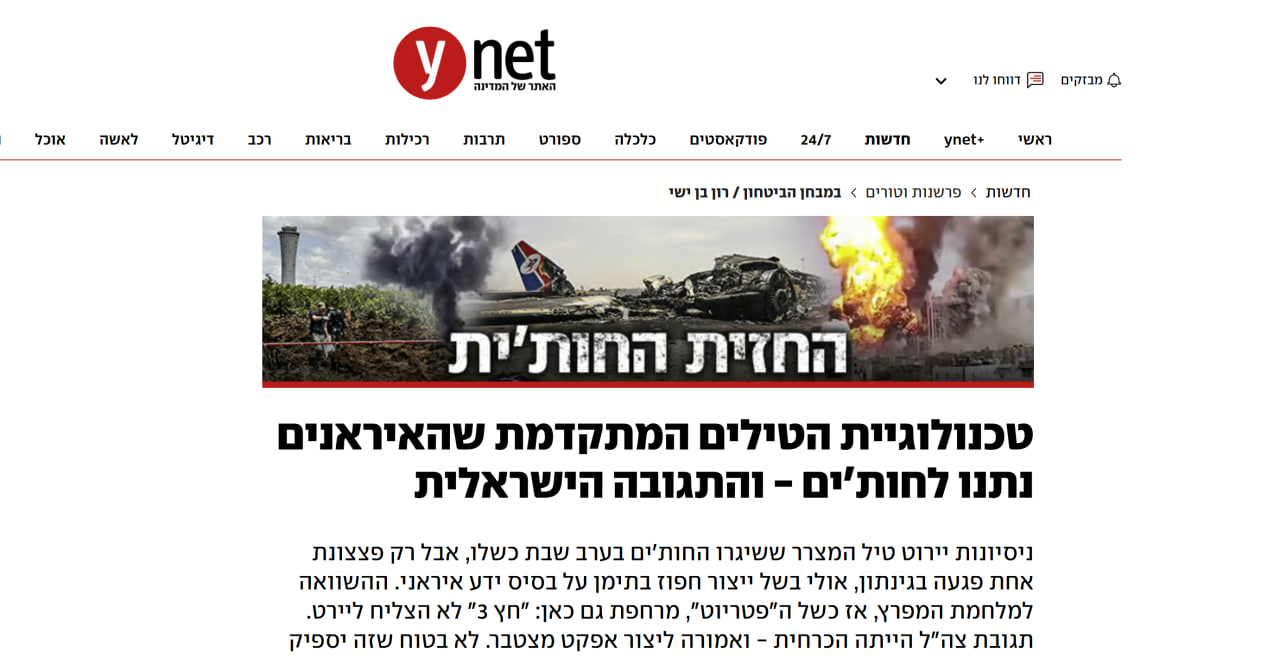
Zionist military analysis has concluded that the confrontation with Yemen is not a conventional one, but a long and complex military campaign requiring radical changes in Zionist strategy. Analysts warned that without a decisive and sustained response, the threat will escalate into hundreds of advanced missiles in the near future.
It has become evident that multi-headed cluster missiles are a turning point in the trajectory of the conflict, forcing the Zionist army to rethink its air defense system and overall confrontation strategies.
These statements and analyses broadcast by Channel 12 and other Zionist media reflect the reality of the strategic crisis facing the Zionist entity. They reveal the growing scale of fear within the entity and underscore that the military performance of the Yemeni Armed Forces involves complex developments that have compelled the Zionist army to acknowledge the existence of a qualitative threat.
This recognition points to the necessity of restructuring the enemy's air defense file and preparing for a prolonged war of attrition with shifting features—one in which Yemeni action will remain present across all fronts and in all future rounds.