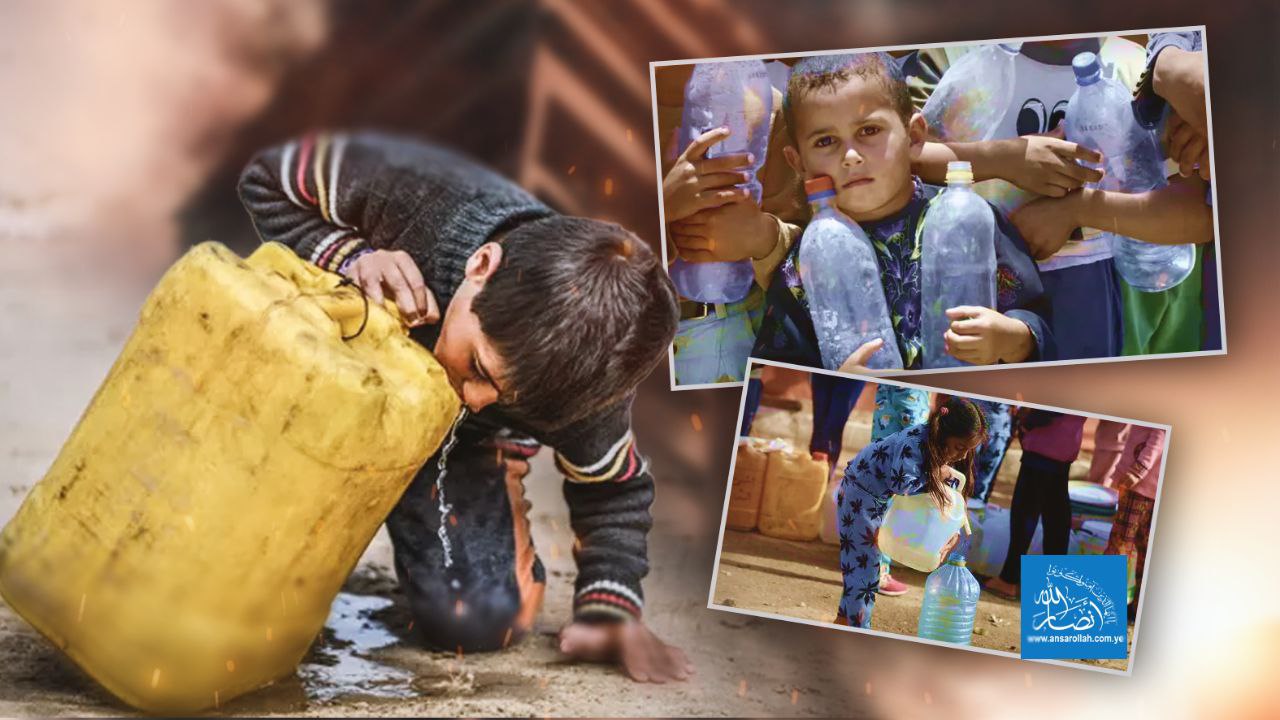
“Water is the essence of life,”—but in the West Bank and al-Quds, under the will of the enemy driven by its brutality, it becomes a tool of displacement and a weapon to expel Palestinians from their land.
Latest UN data reveals an escalating, deliberate campaign to target Palestinian water resources in the West Bank, carried out both by the Zionist army and by Jewish-"settler" invaders. The UN Office for the Coordination of Humanitarian Affairs documented 62 incidents of settlers sabotaging wells and irrigation networks during the first six months of this year.
A recent report by the Palestinian Land Research Center exposed a systematic policy pursued by Zionist authorities against Palestinian water sources, describing it as a policy of forced thirst, designed to push Palestinians toward forcible transfer.
The most recent wave of attacks occurred between July 15 and 21, targeting water tanks in Ramallah, the Jordan Valley, Nablus, Tulkarm, Jenin, and al-Quds.
Official figures indicate that in the last ten years, Zionist forces and settlers destroyed 1,986 wells, reservoirs, and cisterns across the West Bank. Of these, 1,304 were demolished by the army, 443 were sabotaged by settler-invaders, and 239 cisterns were confiscated. The destruction devastated vast farmlands: 19,550 dunams were damaged by army operations, and over 10,400 dunams by settlers—endangering food security for hundreds of Palestinian families.
The brutality of this policy was starkly visible on August 5, 2025, in the southern al-Khalil town of al-Dhahiriya. A large Zionist military force, equipped with massive cement pumps, stormed the land of farmer Mohammed Abu Sharakh.
Abu Sharakh recounted: “The army sealed seven artesian wells I had drilled hundreds of meters deep two years ago, into which I had invested huge sums. They filled them with cement.”
The result was the annihilation of a farm spanning 10,000 square meters, depriving 40 family members of their direct livelihood. The target was not just wells, but the very will to survive and resist.
The army’s terror merges seamlessly with the settlers’ terror. Together, they not only destroy wells and springs but seize them outright. Around springs such as al-Sakut and Ein al-Hilweh, settlers have established pastoral outposts, barring Palestinians from accessing waters they had relied on for generations. In July 2025, settlers seized a vital spring in the village of Farkha, west of Salfit.
Days later, settlers took control of Ein Samia spring, which supplies 33 communities and benefits 110,000 Palestinians. Settler attacks have become a deadly routine, part of the intensifying displacement policy.
Abdullah Bairat, 60, from Kafr Malik overlooking the spring, described: “Settlers break into pumping stations, smash them, remove cameras, and cut off water for hours. They are targeting the lifeline of 70,000 people.”
Earlier, in May, settlers dried up the Auja spring north of Jericho, forcing Bedouin communities—dependent on livestock—to seek costly alternative water sources or abandon the area altogether.
Kareem Jubran, head of field research at B’Tselem, told Reuters: “Settlers have taken over most of the natural springs in the West Bank in recent years, preventing Palestinians from accessing them.”
Jenin leads the list of most targeted governorates with 343 wells, springs, and reservoirs destroyed. Al-Khalil follows with 282, then Tubas with 219, and Ramallah and al-Bireh with 106—indicating deliberate escalation in specific regions.
The UN confirmed these patterns, noting that on July 31, Zionist authorities closed two artesian wells in Area B east of Nablus, serving Beit Dajan and Beit Furik. The closure reduced water availability by 20%, impacting 23,000 residents.
The PLO’s National Bureau for Defending Land reported that the Zionist entity controls over 84% of West Bank water resources, leaving Palestinians with only 16%—a policy aimed at deepening the crisis.
In Ein Samia, east of Ramallah, five wells ranging from 100–500 meters deep, producing 12,000 cubic meters daily, serve 33 communities with 110,000 residents. They face near-daily settler assaults.
Reports show that 2023 and 2025 witnessed the largest Zionist campaigns against water sources: 448 wells, reservoirs, and cisterns were destroyed in 2023, and 248 in the first half of 2025—underscoring systematic escalation threatening Palestinian survival.
In the northern Jordan Valley, the Zionist enemy continues issuing drilling permits for settlement projects, including a 600-meter-deep groundwater well for the Zionist company "Mekorot". Meanwhile, the al-Baydar organization documented the destruction of 40 wells and springs in the first half of 2025.
These policies, coupled with livestock theft, directly undermine Palestinian resilience. Bedouin communities, relying on these wells to water livestock and irrigate 3,000 dunams, face collapse.
At the same time, Zionist authorities continue drilling new wells for settlements, while cutting Palestinian supplies. This summer, the Zionist enemy reduced al-Khalil’s water intake by 55% and cut 30,000 cubic meters from Ramallah and al-Bireh—depriving 60,000 Palestinian homes of water.
Rights experts warn of grave humanitarian consequences in the medium and long term, particularly for agriculture, the livelihood of thousands of Palestinian families.
Observers agree that this war on water serves a larger political goal: annexation of the West Bank. Since October 7, 2023, settler violence has surged uncontrollably. The UN recorded 925 settler attacks in the first seven months of this year, coinciding with explicit calls from Zionist authorities for annexation—translated into accelerated settlement expansion. Zionist so-called Finance Minister Bezalel Smotrich summarized: “They recognize a Palestinian state, while here we are building our state, extending it further with more settlements.”
Meanwhile, Palestinians face hollow accusations of “water theft.” Families are forced to travel long distances or pay exorbitant prices to secure water for survival.
Wafiq Saleem, preparing to leave his village with what little water he could carry, summed up the tragedy: “If the settlers stay, we will leave. This will become a conflict beyond occupation. The most important thing is water.”
The policy of “scorched earth” through drying up the sources of life is a direct attempt to make Palestinian existence impossible—to force migration and voluntary displacement. When the occupiers destroy a farmer’s well, steal a shepherd’s water, and cut off supplies to an entire village, it is not only the destruction of an economy, but the deliberate dismantling of a society—killing its very ability to remain on the land.