Published: Rabiʻ II 4, 1447 AH
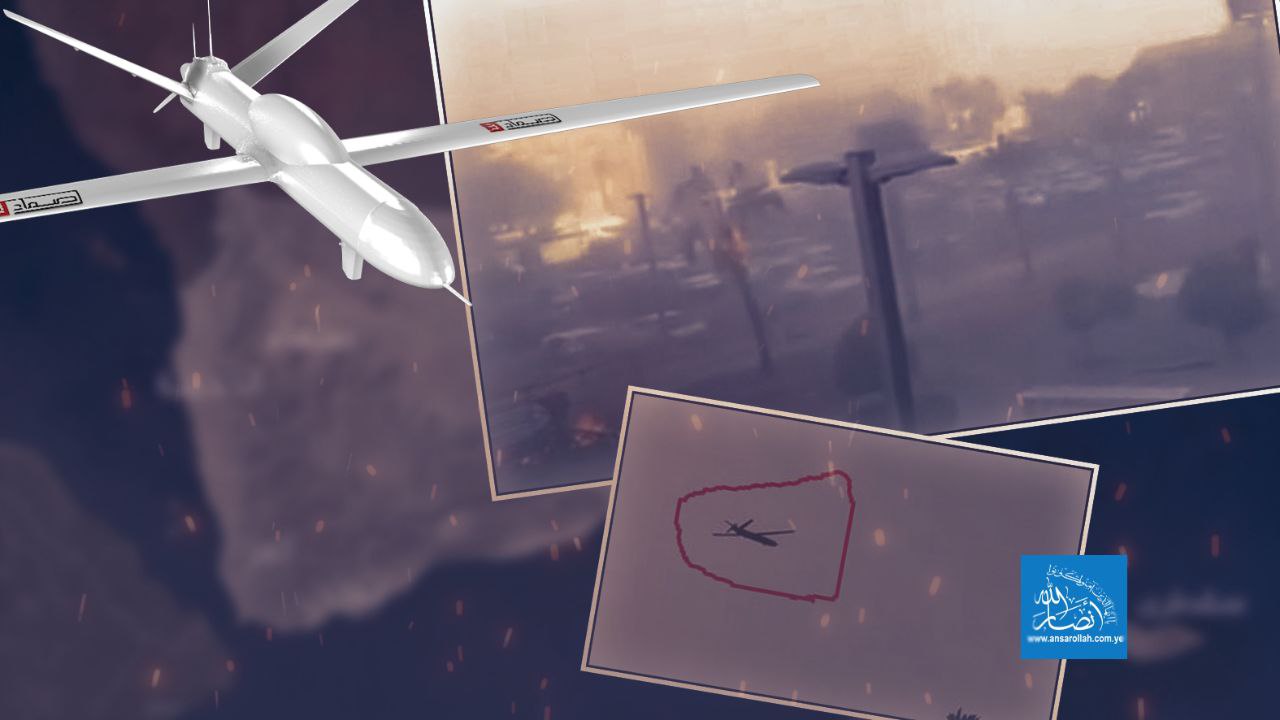
In a precise and unmistakable operation — consistent with observers’ assessments of Yemen’s evolving military-technical capabilities — the Yemeni Armed Forces have demonstrated an ability to penetrate the latest defensive systems of the Israeli enemy. A sophisticated unmanned aerial vehicle was launched toward the city of Umm ar-Rashrash (Eilat) in southern occupied Palestine, igniting a strike at a high-end tourist resort, causing multiple injuries and raising questions about the level the conflict has reached in what military experts describe as a “bone-breaking” confrontation.
The Israeli enemy’s contradictory reactions exposed a catastrophic failure to contend with the new threats emanating from Yemen. This strike is not a passing incident: the operation is presented as conclusive evidence of the development of Yemeni military capabilities in the context of tangible support for the Palestinian cause, amid the Israeli enemy’s continued commission of the genocide in Gaza since 7 October 2023, in defiance of international appeals and international court orders.
Breaching Defenses with Technical Sophistication
Military analysts, in their reading of the operation, asserted that Israeli defenses failed to detect the Yemeni drone despite the long distance — approximately 2,100 kilometers. The drone reportedly flew at low altitude over the sea, placing it outside the detection envelope of conventional systems; according to the analysis, it is the lowest a Yemeni aircraft has flown. Israeli reports acknowledged that at least 50 occupiers were injured, several in critical condition, following the drone’s impact in a tourist area of Umm ar-Rashrash. The Zionist enemy's police admitted to injuries and material damage, and conducted a field assessment, and the Zionist enemy's army radio noted that the drone’s low flight altitude complicated interception by the “Iron Dome” system.
Strategic analysts highlighted that Umm al-Rashrash’s coastal geography is entirely different from the occupied northern areas, where previous drones were launched from Lebanon over short distances and rugged mountain terrain. The Yemeni drone took a different route over the sea, reportedly avoiding Saudi and Egyptian airspace, which increased the difficulty of detecting it by the early-warning systems deployed in the area that serve the enemy. Experts said the failure to counter the Yemeni drone extended beyond early detection; it included overreliance on the Iron Dome without employing a range of measures such as fighter jets or helicopters, allowing the drone to reach its target even after later detection — a point that will feature in ongoing investigations.
Specialists who discussed the incident on several television channels dismissed Israeli claims that the Iron Dome’s success rate reaches 95 percent, asserting instead that historical statistics from past wars indicate its effective rate is between 65 and 70 percent against rockets alone, and that this rate has declined markedly when facing modern unmanned aerial vehicles that use advanced maneuvering techniques, as is the case with Yemeni drones.
Assessments of Yemeni Drone Technology
Tracing expert assessments of the operation, analysts estimated the trajectory and capabilities of Yemeni drones, suggesting that modern UAVs rely on two advanced systems: an autopilot (the onboard flight-controlling computer) and a ground pilot (the guider or controller). This configuration allegedly enables them to perform sharp maneuvers that complicate interception even by advanced defenses. Regarding the development of the Yemeni Armed Forces’ capabilities, experts noted accumulated experience since 2015 in using drones and missiles, with continuous improvement since 7 October — particularly in developing the “Sammad” series of drones, now at a fourth iteration, which are enabled to overcome the Zionist enemy's radar systems.
Scientific analysis presented in the coverage argued that the Yemeni drone demonstrated accuracy in planning and execution, selecting a target of symbolic touristic and economic value to the Israeli enemy — evidence, analysts said, that the Yemeni Armed Forces fully understand Israeli vulnerabilities and exploit them intelligently. Analysts hosted on Al-Masirah channel also reported that attempting to intercept the drone required the launch of two interceptor missiles, both of which failed to down it — a development they said reveals the enemy's technology remains unable to keep pace with rapid Yemeni advances that continually seek and exploit weak points in the enemy’s defense systems.
The strike coincided with the Israeli enemy’s continued practices in Gaza — a genocide in act through systematic killing, starvation, deliberate destruction, and forced displacement — while the Israeli enemy continues to ignore international court rulings calling for a halt to military operations. In this context, Yemeni support operations persist vigorously along a morally elevated trajectory, one affirmed by international law and, before that, by the faith-driven impetus that represents the primary drive of the Yemeni people. This is reflected weekly in the Friday Million rallies that are held in more than a thousand squares across various Yemeni governorates.
Masking Failure Under the Guise of Investigation
In an effort to salvage its military prestige, the Israeli enemy announced the opening of an investigation into the failure to intercept the drone. But, the coverage argues, this step does not conceal the reality that prior investigations produced no tangible results. A week earlier, the enemy's army reportedly conducted a similar probe after another Yemeni offensive operation but concealed its findings under military secrecy, signaling, according to observers, that the Israeli system suffers from an internal crisis of confidence in its defensive capabilities. Repeated enemy official statements framing the incident as “dealing with an infiltrating hostile target” are characterized in the source as a humiliating attempt to hide the truth that their defense systems have become incapable of confronting Yemen’s technical developments, whether in missiles or unmanned aerial vehicles.
Observers of the conflict place the Yemeni strike on Umm ar-Rashrash among indicators of a strategic shift: repeated successful penetrations of the Israeli enemy’s most advanced defense systems compel a reassessment of its security strategy. The result, the analysis contends, is a novel dilemma for the enemy — contracting options to restore deterrence while Yemeni military capability and its painful strikes continue to grow.