Ansarollah Website Official Report
Published: Rabiʻ II 13, 1447 AH
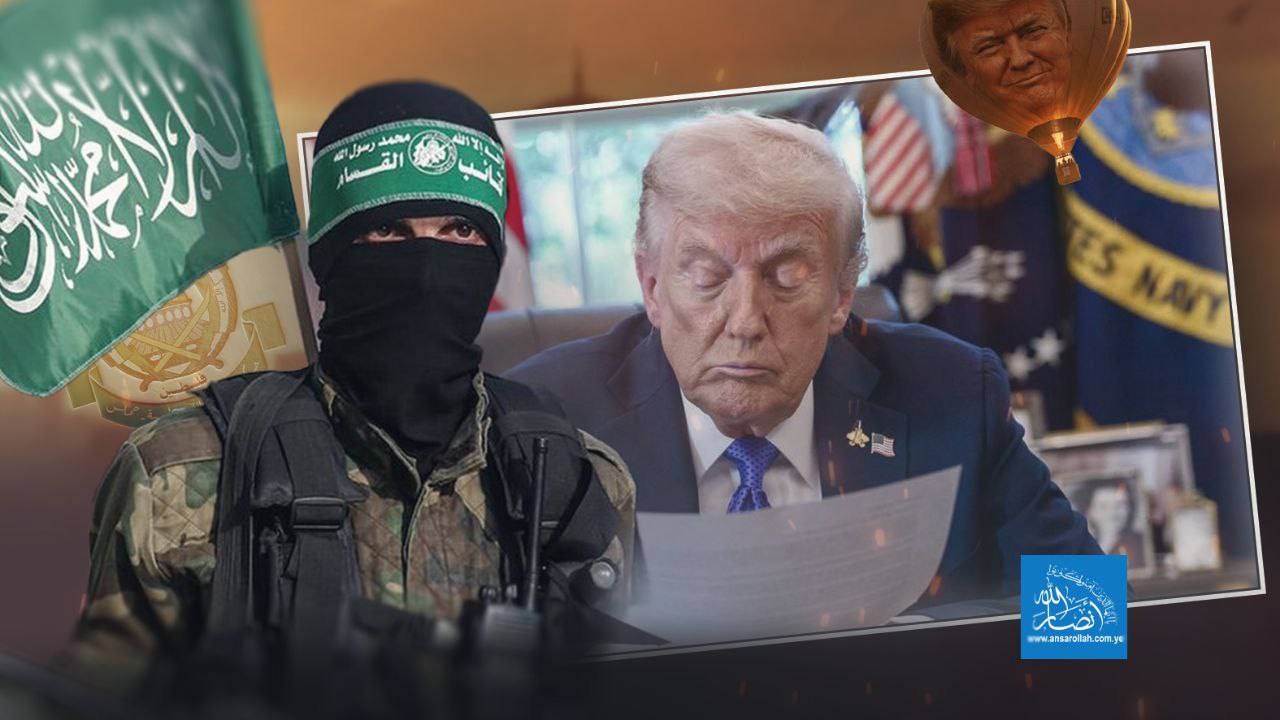
At a critical moment in the ongoing escalation in the Gaza Strip, and with the deadline set by U.S. President Donald Trump approaching—a deadline that demanded Hamas respond to his plan, which included a ceasefire, prisoner exchange, and disarmament under what resembled an imposed surrender—the movement issued a strategic statement that surprised many in both timing and content. Hamas succeeded in absorbing the pressure and threats from Washington and Tel Aviv, and turned the initiative into a political opportunity that strengthened its position both domestically and internationally.
Hamas’s response was not a conventional one. It was carefully crafted, both in language and in its implicit messages. The statement prioritized halting the aggression and the genocidal war on Gaza’s people, while also reinforcing its legitimacy within the broader Palestinian national framework. The movement emphasized that it had conducted “extensive consultations with factions and mediators,” underlining that the response was not just Hamas’s stance, but a reflection of a wider Palestinian position. Statements of support from other factions later confirmed this.
The movement’s response was largely positive. Hamas welcomed “Arab and international efforts” and even Trump’s “proposal,” expressing readiness to engage with it. However, it tied implementation to detailed negotiations and “field guarantees,” thereby preventing hasty interpretations or externally imposed timelines. This degree of conditional openness prompted Trump to celebrate the statement, reposting it on his social media and the White House page, while also eliciting welcoming reactions from mediator states and Western countries.
Hamas’s acceptance of a prisoner exchange, contingent on the release of “all enemy captives, alive and deceased,” was not new. The resistance has long expressed willingness to exchange all prisoners, but Netanyahu’s intransigence and his pursuit of unrelated political goals—backed by unconditional U.S. support and Arab silence—had obstructed agreements in the past. By agreeing to this clause, Hamas projected humanitarian flexibility without offering free concessions.
The movement reiterated that the future of Gaza and the rights of the Palestinian people can only be discussed within a comprehensive national framework. This was a clear rejection of attempts to isolate Gaza from the West Bank or to impose unilateral solutions undermining Palestinian self-determination.
Hamas also expressed readiness to hand over Gaza’s administration to an independent Palestinian technocratic body formed through national consensus. This is not a new idea; similar proposals had been part of earlier talks with the Palestinian Authority in Egypt. The move represents a political repositioning—without relinquishing its resistance role or field influence. By insisting that the body be formed through consensus and supported by Arab and Islamic backing, Hamas secured both regional cover and leverage in any future arrangements. The approach balances political openness with retaining power on the ground.
The U.S.-Israeli threats assumed that Hamas would reject or stall the proposal, providing a pretext for a wide-scale assault on Gaza, particularly Gaza City. Yet Hamas’s carefully worded response stripped away that pretext, casting its adversaries as the ones obstructing progress. Simultaneously, the statement bolstered Hamas’s image before Palestinian and Arab public opinion, portraying it as a responsible actor committed to Palestinian lives while upholding its national principles.
Importantly, Hamas gave no indication of surrendering its weapons or dismantling its security infrastructure. Instead, it kept its focus on ending aggression and ensuring a prisoner exchange, preserving its identity as a resistance movement even while managing political negotiations.
In this way, Hamas managed to turn Trump’s threats of “hell” into an opportunity to re-isolate Israel internationally and to impose a new political equation in Gaza—one in which resistance is a recognized political actor, not merely a military target. Through a carefully calibrated response, Hamas positioned itself as open to solutions, but strictly on its own national terms, thereby placing its adversaries in a politically and regionally awkward position and resetting the political balance Trump sought to disrupt.
In the midst of this complex confrontation, Hamas effectively defused the escalation originating from Washington and Tel Aviv. Rather than descending into war, it opened the door to conditional negotiations, pulling the rug out from under Trump and Netanyahu without relinquishing its levers of power.