Published: Rabiʻ II 14, 1447 AH
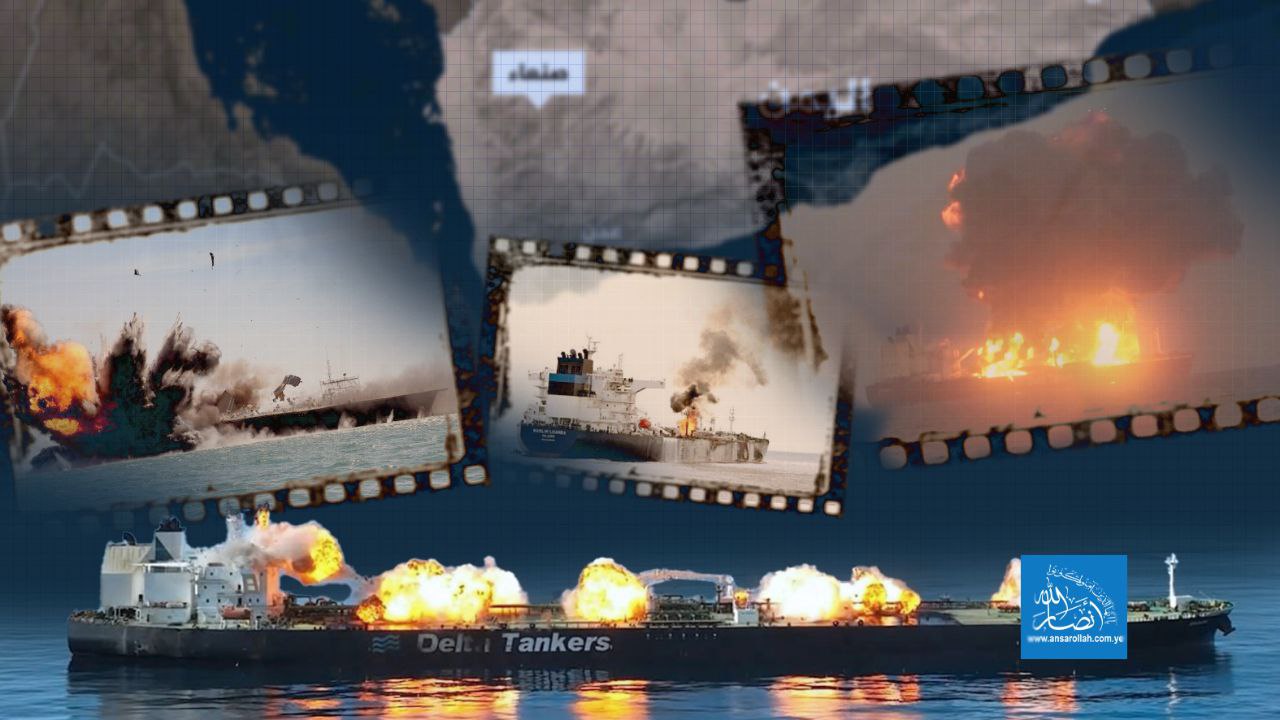
In the Red Sea, where wave meets wrath, a new face of rising Yemeni power has emerged. Where invading vessels once plied the waters with confidence, Yemen has declared plainly: this sea is forbidden to those whose hands are stained with the blood of Gaza. With each new dawn, Yemen’s sovereign decision to impose a maritime blockade on the Israeli entity in the Red and Arabian Seas has been turned into a tangible reality — sometimes by a cruise missile, sometimes by a remotely piloted boat — until ships that defy the ban find themselves facing an inescapable fate: sinking or burning.
The leader of the revolution, Sayyid Abdul-Malik Badruldeen al-Houthi, said in his address last Thursday that the number of ships targeted in operations supporting Gaza has risen to 228.
"This number testifies to the seriousness of the Yemeni position, its effectiveness, and impact, and at the same time, it affects the Israeli enemy. It is known internationally that this has achieved a very important result in disabling the port of Umm ar-Rashrash — which the enemy calls — which has resulted in heavy losses for the Zionist enemy economically, in terms of revenue, financial gains, and economic interests. In addition, there is a significant strategic indication in preventing the Israeli enemy from navigating through the Red Sea to Bab al-Mandeb and the Gulf of Aden — a stance of great strategic importance acknowledged by the world: research centers, officials, studies, and even statements by the Zionists themselves.”
In a scene that sums up the meaning of free will, the Yemeni armed forces announced — at the end of September — a new precision operation that targeted the vessel MINERVAGRACHT in the Gulf of Aden after confirming its dealings with Zionist controlled ports.
A cruise missile launched from Yemeni territory covered 128 miles to strike its target with a direct hit that ignited onboard fires and left the ship on the verge of sinking. The official spokesperson for the armed forces, Brigadier General Yahya Saree, said the operation was a victory for the oppressed Palestinian people and a confirmation of the continuation of the maritime blockade imposed on the entity in the Red and Arabian Seas.
The European mission “Aspides,” tasked with protecting the Israeli enemy's navigation, announced that the MINERVAGRACHT — which was attacked recently in the Gulf of Aden — was now adrift after fire caused by the strike. Aspides noted that the ship’s crew had been evacuated without human casualties, and that rescue and evacuation operations were carried out successfully amid difficult sea conditions.
Activists and international media circulated video clips showing the ship as it sank and the evacuation of its crew by helicopter.
The Associated Press described the attack on the vessel in the Gulf of Aden as the most serious in years in the region, reporting that the international company owning the vessel suffered severe damage that could make its loss a major financial blow — an outcome likely to compel other companies to comply with the Yemeni armed forces’ ban on navigation for the Israeli enemy and to expand operations against anyone who supports or deals with it.
AP also quoted the shipowner as saying that a helicopter evacuated the 19-member crew after the attack and transferred them without injuries, according to the company’s statements. By calling the operation the most dangerous in years, the agency underscored the scale of damage and the new capabilities demonstrated by the Yemeni armed forces.
The MINERVAGRACHT episode was only one chapter in the naval saga the Yemeni navy waged during September. It followed an earlier strike on the Israeli oil tanker SCARLET RAY by a ballistic missile north of the Red Sea, some 1,200 kilometers off the Saudi port of Yanbu.
Lloyd’s List in Britain stated that Yemen’s attack on SCARLET RAY was “the furthest north” in Yemen’s maritime operations record. The maritime affairs site The Maritime Executive revealed that Automatic Identification System (AIS) data showed the vessel was off Yanbu and that its navigational signal had been scrambled for weeks in an apparent effort to conceal its route, but that did not prevent the Yemeni missile from striking it accurately. The same site noted that the distance between Yemen and the strike location exceeded 600 nautical miles (1,111 kilometers), a grave indicator of the expanding reach of Yemeni capabilities to cover any point in the Red Sea and beyond. British maritime outlet Seatrade Maritime News assessed the Yemeni threat to ships linked to "Israel" as “extremely serious,” quoting Middle East specialist Gary Hurd, who said the missile strike on the Israeli tanker “shows the extent of the expanded threat posed by the Yemenis.” Seatrade cited the Joint Maritime Information Center (JMIC) warning the shipping industry that Yemenis possess the ability to target commercial vessels tied to "Israel" deep into the Red Sea and the Gulf of Aden.
On September 2, the vessel MSC ABY was struck north of the Red Sea for violating the ban on entering the ports of occupied Palestine and for its ties to the Israeli enemy. The strike, carried out with two drones and a cruise missile, hit the ship directly. Zionist outlet "Haaretz" reported that the MSC ABY, owned by "Israelis", was damaged in the Yemeni attack north of the Red Sea.
Despite massive U.S.-Western mobilization in the Red Sea — destroyers, submarines and drone aircraft — the facts show those powers have failed to protect vessels associated with the entity. Large alliances have emerged defeated from an unequal battle, because the power here is not measured by the size of iron, but by the firmness of decision.
As military expert Brigadier General Omar Marbooni said, "the Yemenis do not speak much; they do what they say, and they execute with the precision of those who know the way to victory.” Even Israeli aviation was compelled to retreat before Yemeni air defenses, which have proven to possess advanced deterrent systems that have made Yemen’s skies forbidden to aggressors, just as the Red Sea has been made forbidden to Israeli ships.
In Tel Aviv, the confusion is no longer concealable: "Yedioth Ahronoth" acknowledged frankly that the enemy’s army has established two new intelligence units to follow the “growing Yemeni threat.” The newspaper spoke of a “qualitative shift” in Yemen’s defensive and offensive capabilities, and of “advanced local manufacture of drones and precision missiles that can reach deep into the Mediterranean if desired.”
Thus, the enemy speaks with its own tongue, acknowledging that Yemen today is a formidable factor that cannot be overlooked, and that the Red Sea is no longer a safe passage for its fleets or its interests.
What Western capitals have yet to grasp is that the battle is no longer only military. Yemen’s maritime blockade has struck the Israeli entity at its economic core. Major shipping companies have withdrawn from the Red Sea; marine insurance premiums have soared to astronomical levels; the enemy has been forced to reroute its goods around the Cape of Good Hope on longer, costlier journeys — leaving Zionist trade bleeding hard currency as Gaza bleeds blood.
The port of Umm ar-Rashrash has been completely halted, and heavy losses have been registered across the Israeli enemy's supply chains and industries. Even the shekel has begun to stagger under the weight of a sea that no longer smiles upon the enemy.
The U.S.-led naval coalition left the Red Sea burdened with losses: destroyers firing million-dollar interceptors at drones that cost only a few thousand. Economies of attrition have become a perennial nightmare; every attempt to deter Yemen spawns tens of financial, military, and political burdens. These battles have proven that one who possesses determination cannot be defeated, even if all the world’s armies stand before him.
Yemen today speaks in the language of grand equations: an equation that says continued aggression against Gaza will be met by an expansive and painful Yemeni escalation, and that the Red Sea is no longer open except to those who respect the blood of the innocent. Sanaa has become a regional decision-making center, a force that imposes itself not by bragging but by action. More than 227 naval operations have been carried out, while Washington stands helpless before a power that crafts victory from inside a siege.
Today, the Red Sea is no longer just a waterway; it is an open field of sovereignty and liberation messages. Sanaa tells the world with the language of force and fire: “Whoever wishes to pass must carry the banner of humanity, not the banner of the entity.” Thus, Yemen is writing a new page in the nation’s history, a page titled: From here the free passed — and here the entity sank.