
The Republic of Yemen today unveiled its National Report on the U.S.-Israeli-Western Aggression, covering the period from January 2024 to September 2025. The document attributes the military campaign to Yemen’s religious and humanitarian stance in support of the Palestinian people in Gaza.
According to the report, the aggression—which involved 2,801 airstrikes—resulted in 1,669 civilian casualties, including 441 martyrs and 1,228 injured. Among the martyrs were 38 children and 23 women, while 197 children and 96 women were among the wounded.
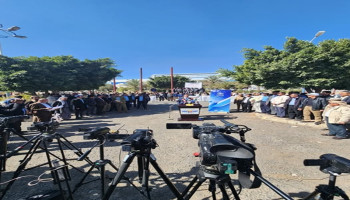
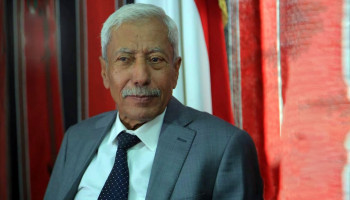
During a press conference held by the National Commission for Human Rights, the Commission’s Chairman Ali Taysir stated that Yemen’s steadfastness and unwavering support for Palestine had “reshaped the global balance of power and altered military doctrines,” after successfully confronting what he described as “the most powerful empires on earth.”
Taysir explained that the report seeks to present the true dimensions of the aggression to the international community, countering the vast Western media machinery that has sought to distort Yemen’s humanitarian and principled position. He stressed that the two-year-long campaign represents a continuation of the U.S.-Saudi-Emirati war on Yemen, aiming to deter the country from backing the people of Gaza, who are enduring what he called “the most heinous genocide in modern history.”
He emphasized that all coalitions led by the United States to prevent Yemen’s support for Gaza have failed in the face of the Yemeni people’s steadfast will. Despite enormous mobilizations—including aircraft carriers and advanced lethal weaponry—“the aggressors ended up politically and militarily bankrupt,” he said.
Taysir accused the U.S.-Israeli-Western coalition of committing “fully-fledged war crimes,” targeting civilians and vital infrastructure—including cemeteries—in blatant disregard of international law and basic human values. He reaffirmed Yemen’s unwavering commitment, under the leadership of Sayyed Abdul-Malik Badr al-Din al-Houthi, to stand by Gaza, despite the heavy sacrifices made for that cause. He also announced that legal proceedings are being prepared to prosecute those responsible for the aggression before Yemeni and international courts.
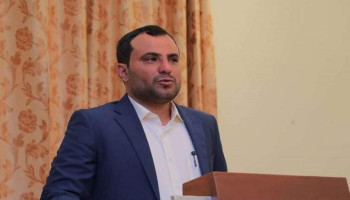
During the event, Hamid al-Rafiq, Legal Adviser at the Ministry of Justice and Human Rights, presented the findings of the report, which document the 2,801 airstrikes and 1,669 civilian casualties. The report highlights major crimes committed by the coalition, including the assassination of the “Government of Construction and Change,” and the targeting of ports, airports, residential neighborhoods, hospitals, and other essential civilian infrastructure such as telecommunications, electricity, and economic facilities.
It further details the political, military, and economic dimensions of the assault, as well as the types of American, British, and Israeli weapons used. The report stresses that the campaign was not a series of limited military operations, but rather a systematic attempt to destroy the Yemeni people, their land, and their infrastructure — in flagrant violation of international humanitarian law, the United Nations Charter, and the Fourth Geneva Convention.
Ali Jassar, Director of the Office of Rights and Freedoms at the Presidency, outlined the report’s recommendations, which call for an independent international investigation committee under the supervision of the UN Human Rights Council or the UN Security Council to investigate the crimes committed by the U.S., Britain, and Israel in Yemen. The report also urges the referral of the perpetrators to the International Criminal Court under the Rome Statute to ensure accountability and justice.
Moreover, the document calls upon the United Nations and global human rights organizations to document the humanitarian and economic damages inflicted on Yemen and to establish an international compensation fund to provide reparations for the victims. It further condemns the economic blockade and punitive measures imposed by the United States, Britain, and Israel, describing them as acts of collective punishment prohibited under international law. The report demands the lifting of all restrictions on humanitarian aid to ensure its fair and apolitical distribution to those in need.
Finally, the report encourages the launch of international solidarity campaigns to support the Yemeni people, lift the blockade, and strengthen partnerships with international human rights organizations to document violations and bring the voices of Yemeni victims to the global stage.