Published: Jumada I 24, 1447 AH
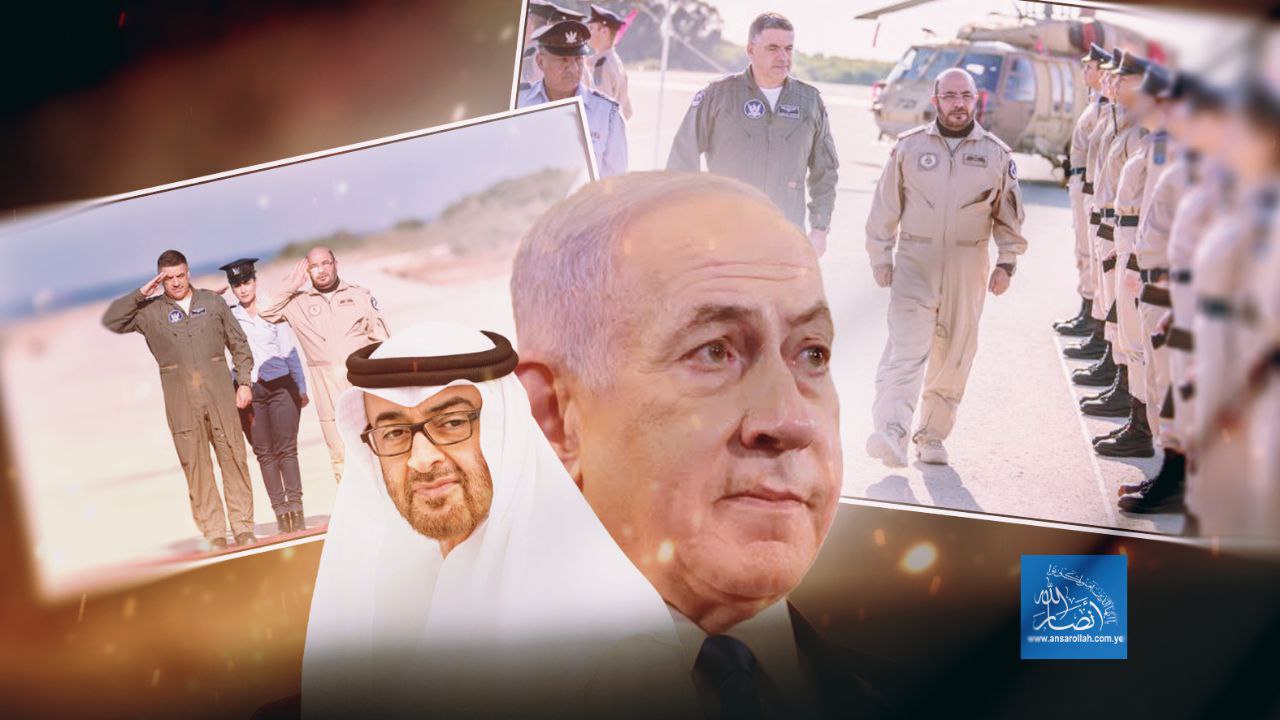
Since the United Arab Emirates formally entered a public phase of relations with the Israeli entity through the “normalization” agreements on August 13, 2020, the UAE has spared no effort in serving the entity without red lines or regard for sovereignty, religion, or ethics. The declaration of loyalty to the Israeli enemy under the label of normalization was merely an official announcement of a relationship that had been operating in secrecy for many years. Rather than opening a new chapter, this announcement lifted the curtain on a comprehensive project that turned the UAE into an Arab gateway for the influence of the Israeli enemy in the heart of the region. The UAE has become both financier and executor of Israeli schemes.
The relationship has gone far beyond diplomacy and entered a zone of complete alignment in vision and goals. The founder of the “Friends of Zion Heritage Center,” Mike Evans, even described Mohammed bin Zayed as more supportive of the Zionist entity than many Jews.
From Yemen to Sudan, Libya, and Gaza, the UAE’s reach has extended to plant armed proxies that destabilize nations and serve the objectives of the entity. Emirati money has transformed chaos into a geopolitical tool through which the Israeli agenda is advanced — fragmenting the Arab region and plunging it into internal conflicts that divert it from confronting its real enemy.
Backing the Enemy Amid Blockade
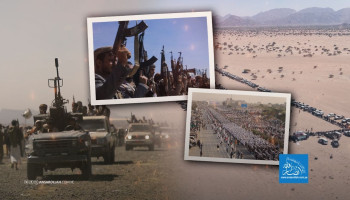
When Yemeni armed forces besieged Israeli navigation and halted traffic toward the port of Umm ar-Rashrash, the UAE was the first to rush to the entity’s aid through a land route passing through Saudi Arabia and Jordan, stretching over 2,000 kilometers, and operating more than 300 trucks per day toward the occupied territories.
A pressing question arises: What does it mean that, during the most existential crisis faced by the Zionist entity, the first ally rushing to its side after the United States is the UAE? The matter undoubtedly exceeds mere normalization and has deep historical roots, as revealed by the al-Aqsa Food Battle, which exposed many previously concealed faces.

Emirates Airlines Covers the Enemy’s Deficit
When global airlines shut down airports in occupied Palestine following Yemeni strikes, only Emirati aircraft continued filling the skies over the occupied territory.
The UAE effectively became an aerial support hub, with hundreds of flights taking off toward “Ben Gurion” Airport, transporting passengers and goods at the height of the assault on Gaza and Lebanon — reaffirming that its bridges to the Zionists were not cut even in times of bloodshed.
According to official data, the UAE’s role was not limited to supplying the Zionist enemy with food; it also replaced global airlines that suspended their flights to “Ben Gurion” due to Yemeni military operations, particularly the May 4 strike that directly hit the airport, creating a 25-meter-deep crater. While international carriers withdrew, the UAE filled the gap, bearing significant material and moral consequences for such a step during the peak of the war on Gaza.
Emirati airlines doubled their flights to the enemy’s airports and continued to do so, easing the crisis on affected Zionist sectors while expanding promotional offers for Zionist passengers. While airlines such as Lufthansa, British Airways, American Airlines, and Air France-KLM suspended operations, UAE-based “Flydubai” and “Etihad Airways” saw major increases in passenger numbers through “Ben Gurion.” Flydubai recorded a 49.86% increase, while Etihad registered a fourfold rise compared to the previous year.
Days after the Yemeni missile struck “Ben Gurion,” a large banner hung at the entrance of Haifa reading: “Travel to over 100 destinations via Abu Dhabi”, displaying the name of the UAE’s national carrier, "Etihad Airways".
A report from the "Knesset" revealed a 60.8% increase in Flydubai passenger numbers between January and September 2024, while global carriers suffered declines exceeding 60%. Remarkably, Emirati airlines outperformed even Zionist companies such as “El Al,” which recorded a 15.9% increase.
Cargo shipments via Flydubai also surged in 2024, while foreign companies sharply reduced operations following European Union Aviation Safety Agency (EASA) recommendations against flying in the Israeli entity's airspace.

From Land Bridge to Air Bridge
Beyond the land corridor supported by the UAE to bypass Yemeni restrictions, the country opened an aerial bridge to deliver supplies to the Israeli entity during the height of the war on Gaza and Lebanon.
An investigation by the UK-based "Refutation of fact-checking and data journalism” found that the UAE had become a crucial air-support station for the entity after many global airlines halted flights to “Tel Aviv.”
Statistics show that:
-
In 2022, there were 5,551 passenger flights between the UAE and the entity.
-
In 2023, the number reached 4,892.
-
In 2024, despite the war, flights totaled 4,793 by the end of November.
The most notable finding is that while Israeli airlines reduced flights to the UAE during wartime, Emirati airlines increased them.
Five airlines dominate these routes:
Arkia, El Al, Israir (Israeli), and flydubai, Etihad Airways (UAE), with Flydubai holding the largest share, especially after the war.
Air cargo connections were also activated immediately after the Zionist assault on Gaza began. Ten permanent cargo flights were established, with 233 flights recorded by November 2024, including 149 from Dubai to occupied Yaffa.
Flight records indicate the UAE not only established a supply corridor for the entity but also captured a significant portion of the international air freight market to and from “Israel” — a role that grew considerably during the war.
Data tracking from Challenge Group shows that the UAE became a transit hub for cargo routes between Hong Kong, India, and “Israel,” using large Boeing 747-412F aircraft due to the high-volume demands.

Participation in War — and in Defeat
Just as the UAE participated in the genocidal war on Gaza, its full alignment with the Israeli enemy naturally meant it would share in the aftermath following the cease-fire agreement achieved under the terms of the Palestinian resistance.
While one might expect a unified Arab discourse praising Palestinian resilience and the humanitarian breakthrough, the UAE instead echoed Israeli narratives. Emirati media launched an unprecedented wave of mockery, distortion, and incitement against the Palestinian resistance, attempting to invert truths and whitewash the image of the Israeli enemy at a moment widely viewed as a political and humanitarian victory for the resistance after the genocide.
The al-Aqsa Flood Battle exposed the faces long hidden behind masks, stripping away the façade of a “welfare state” and revealing it as a forward base for a Zionist project encircling the region from within.
From sky to sea, from ports to media channels, the UAE today appears as a Zionist arm executing the enemy’s agenda with Arab language, Arab money, and Arab weaponry — all directed toward the chests of Arabs themselves.