Ansarollah Website Official Report
Published: Jumada II 1, 1447 AH
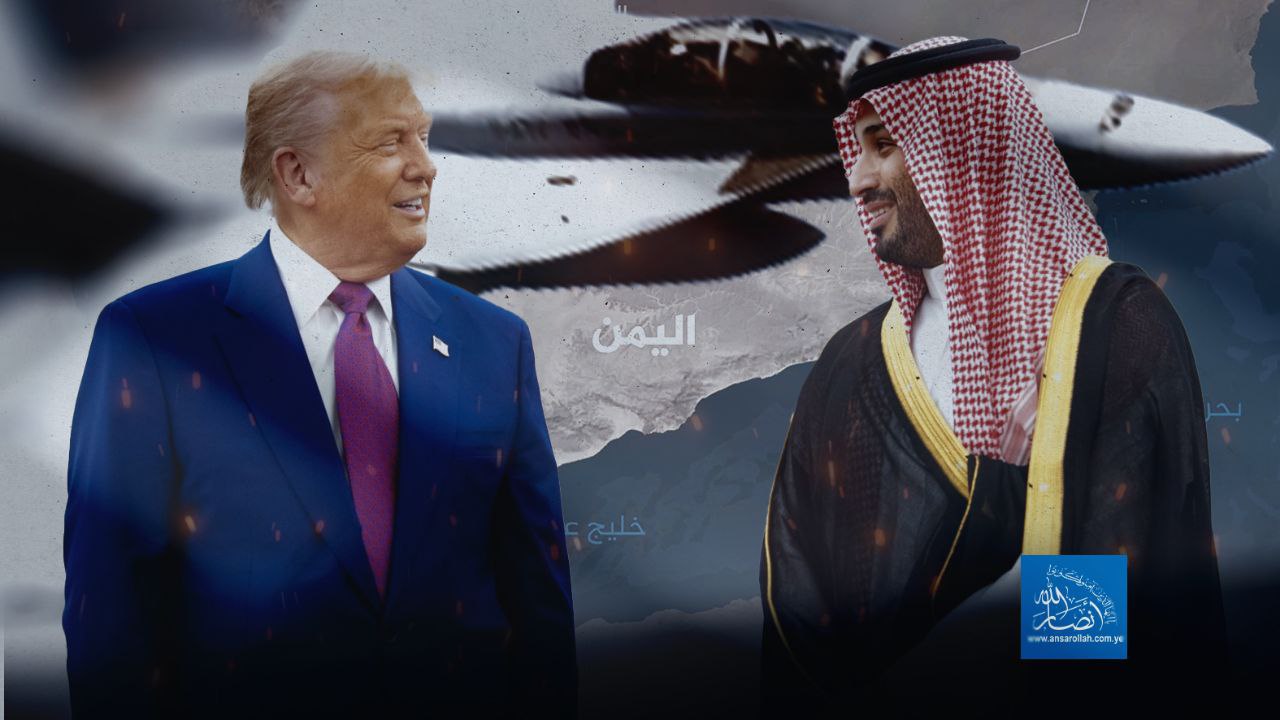
The visit of Saudi Crown Prince Mohammed bin Salman to the United States reveals a shift in Saudi–American relations toward a deeper level of strategic alignment under American hegemony and Saudi dependency. This alignment is based on integrating Riyadh into the American war apparatus in the region and linking the future of “Vision 2030” to American technological and economic centers, in exchange for an expanded Saudi offensive role in Yemen and the Red Sea, in the arrangements for the post-aggression phase in Gaza, and in the file of Saudi normalization with the Zionist entity.
General Context and Strategic Dimensions of the Visit
The visit represents a pivotal moment in Saudi–American relations, coming amid intense regional turmoil following the Zionist aggression on Gaza, rising international competition in the Red Sea, and heightened rivalry between Washington and both Moscow and Beijing. Information published by American media outlets, including Reuters, the Associated Press, The Washington Post, and the Washington Institute for Near East Policy, indicates that the visit was not ceremonial but an advanced step in redefining the relationship within a long-term framework of defense, economics, and technology.
The Defense Track: Saudi Arabia as a “Major Non-NATO Ally”
A key outcome of the visit was granting Saudi Arabia the status of “Major Non-NATO Ally,” a designation offering strategic advantages such as access to advanced military technology, improved defense systems, and enhanced intelligence cooperation.
According to Reuters, discussions included reopening the file of F-35 fighter jets. Initial statements by Trump suggested the deal would proceed, but previous experiences show the sensitivity of the issue. Talks also covered the possible integration of Saudi Arabia into the American air-defense network linked to U.S. Central Command, along with upgrading southern-border radars and improving missile and drone interception capabilities.
American analytical centers argued that this defense track aims primarily to “contain the aerial and missile capabilities of Sana’a” and rebuild a “deterrence belt” protecting Saudi energy facilities and economic projects now tied to significant American investments.
The Economic–Technological Track
The Associated Press and The Washington Post revealed that Saudi Arabia committed to investments exceeding one trillion dollars inside the United States over the next decade, the largest economic commitment in the history of the relationship.
Reuters reported that Saudi Aramco signed more than $30 billion in Memoranda of Understanding with American companies in fields including liquefied natural gas, advanced industries, composite materials, and clean-energy infrastructure.
The visit also featured broad partnerships in artificial intelligence, the construction of Hyperscale Data Centers, and the establishment of a joint digital cloud between American and Saudi firms. Discussions also included creating a joint system for producing rare earths necessary for chip and battery production.
According to Reuters, the results indicate that “Vision 2030” is entering a structural integration phase with American technological centers, as Saudi investments shift from traditional oil to sensitive sectors such as artificial intelligence, hyperscale data centers, vital mineral chains, semiconductors, batteries, and composite materials.
This deep economic linkage makes the future of the Vision dependent on regional stability, particularly maritime security in the Red Sea and Bab al-Mandab, since these sectors rely on secure flows of undersea cables, semiconductor shipments, specialized equipment, and long supply chains passing through international waterways.
The Red Sea has therefore become a core component of the new economic architecture behind the Vision, increasing Saudi sensitivity to maritime threats connected to the Zionist entity and heightening the need for an American security umbrella to protect vital supply chains. This shift explains the growing U.S.–Saudi interest in re-internationalizing Red Sea security and reducing Sana’a’s ability to impose deterrence equations affecting these strategic networks.
The Political–Regional Track
The Saudi–Zionist normalization file appeared in the visit’s discussions, though no progress was publicly announced.
The talks also addressed Saudi Arabia’s role in Gaza after the Zionist aggression, focusing on reconstruction, restructuring Palestinian Authority institutions, sidelining Hamas and disarming it, and using Saudi Arabia to help build a “new regional order” that serves American and Zionist interests.
Yemen’s Position in the Visit
American sources—especially Reuters and the Washington Institute—indicate that the Yemen file was handled solely from a security perspective, not a political or negotiating one. This is clear from the nature of the issues discussed and the language describing “regional threats” and “Red Sea risks.”
Two main Yemen-related tracks emerged:
-
Strengthening Saudi defenses against capabilities classified as “regional threats,” including system upgrades, expanded radar coverage, and linking early-warning systems to U.S. Central Command.
-
Expanding intelligence cooperation for monitoring activities in the Red Sea and Bab al-Mandab, inferred from the focus on maritime security and interest in multinational navigation-protection arrangements.
No political or negotiating pathway regarding Yemen was mentioned in any American report, reinforcing the perception that Yemen is treated strictly as a security issue to be contained rather than a political crisis requiring resolution.
The Red Sea: Toward New American–Saudi Maritime Arrangements
Reuters noted that part of the new defense understandings aims to enhance Saudi Arabia’s role in strategic maritime passages, especially the Red Sea and Bab al-Mandab. Washington seeks to:
-
Create a new Western–Arab naval force replacing older coalitions.
-
Integrate Saudi Arabia as a regional leader in these arrangements.
-
Limit Sana’a’s ability to impose maritime deterrence equations.
The discussions focused on ensuring the uninterrupted flow of American and Zionist trade—particularly U.S. energy exports and technological goods—through Bab al-Mandab. As a result, the Red Sea is becoming a primary arena of geopolitical confrontation, with an expected rise in international pressure to restrict Yemen’s influence over the waterway.
Implications for the Saudi–Yemeni De-Escalation Track
Indicators suggest Riyadh prefers to maintain the current no-war/no-peace state, as renewed conflict with Yemen would undermine the investment environment required for Vision 2030, and Washington needs maritime stability to protect its commercial and technological interests.
However, Saudi Arabia will continue a security-first approach toward Yemen, using the new defense partnership to strengthen its capabilities in areas of Yemen under the control of the Aggression Coalition, expand its naval capacity, and potentially restrict Sana’a’s activity in the Red Sea through joint security arrangements with the United States.
Saudi Arabia is therefore unlikely to pursue a comprehensive political settlement, instead balancing between de-escalation and security containment, prolonging a state of neither peace nor war.
Overall Assessment
The visit shows that the United States is repositioning Saudi Arabia as a principal actor in what it calls “the security of the Red Sea and Bab al-Mandab.” Future maritime arrangements will likely seek to limit the impact of Yemen’s naval and missile capabilities. Yemen is expected to be addressed in the coming year through the lens of risk management rather than conflict resolution.
This phase requires Sana’a to adopt a strategy based on:
-
Strengthening maritime deterrence,
-
Enhancing intelligence readiness across international waters,
-
Rejecting the internationalization of the Red Sea,
-
Advancing the de-escalation track with Riyadh toward a comprehensive settlement without allowing it to become a U.S.–Saudi pressure tool.
Yemen’s deterrence capabilities—especially maritime—remain the decisive factor in preventing the Red Sea from becoming an American–Saudi sphere of military influence.
Footnote
The “Major Non-NATO Ally” designation is granted by the United States to a limited number of countries to enhance military and security cooperation without NATO membership. It does not entail automatic U.S. defense commitments but provides broad privileges, including access to advanced weapons, participation in sensitive military programs, and expanded intelligence coordination, placing the country under the American strategic umbrella without formal NATO inclusion.