Ansarollah Website Official Report
Published: Jumada II 4, 1447 AH
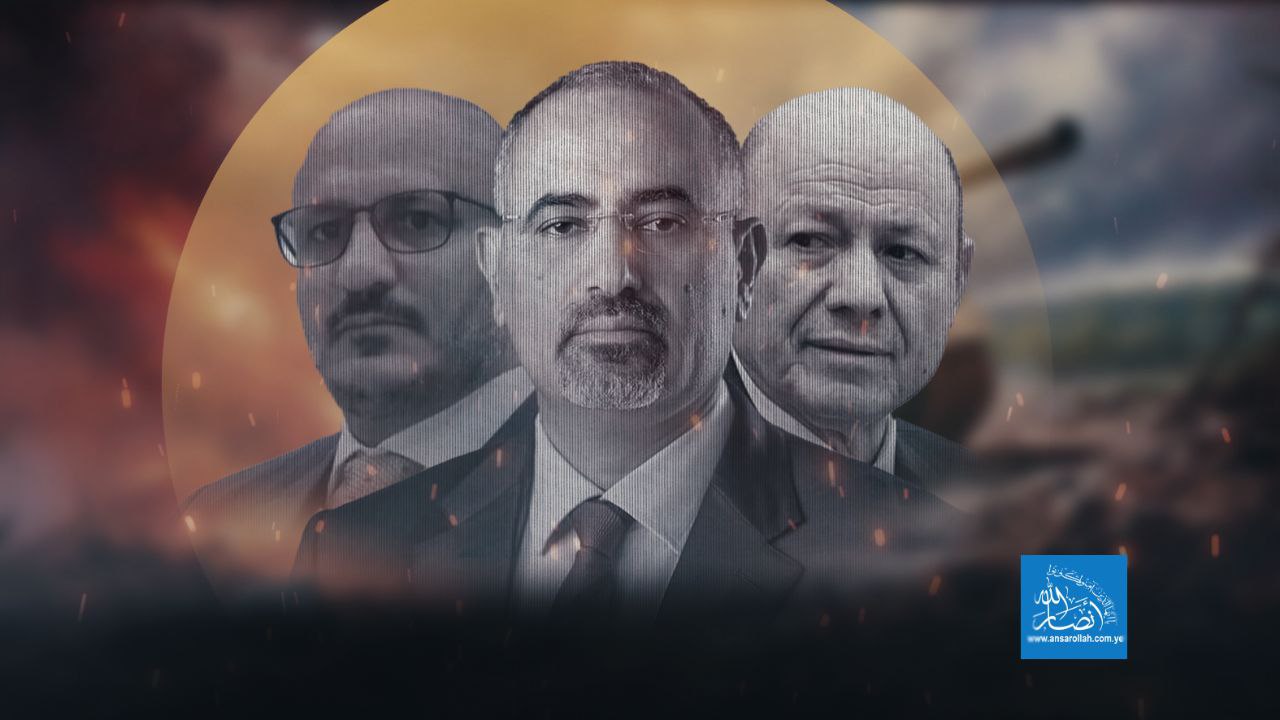
In a tragic scene lived daily by Yemenis in the provinces under the Saudi-Emirati occupation, where economic collapse devastates the population and the national currency turns into worthless paper, a dirty game unfolds in the dark corridors of the coastal regions. There, “war princes” race to offer the country as a sacrifice upon the altar of American and Israeli interests. While citizens in Aden, Taiz, Marib, Hadramout, and other occupied areas drown in a swamp of absent services, skyrocketing prices, and widespread unemployment, the mercenaries Tariq Afash, Aidarus al-Zubaidi, and the militias of the Party of Treason and Servitude—"Islah” inaugurate a new phase of absolute dependency on foreign powers. In this process, Yemeni coastlines—once a lifeline—are transformed into advanced military outposts run by CIA officers and the Israeli enemy.
Growing Israeli interest in the Yemeni militias created by the UAE is emerging as part of expanding coordination between Abu Dhabi and the Zionist entity, aimed at influencing the balance of power in Yemen and around Bab al-Mandab and the Gulf of Aden. This is highlighted by a report authored by researcher Giorgio Cafiero for the U.S.-based Arab Center in Washington, D.C., which reveals detailed information about political and security communications between these parties, the presence of the Israeli enemy in strategic Yemeni areas, and the impact on regional tensions and vital maritime routes in the Red Sea and Gulf of Aden.
The Center stresses unequivocally that the mercenary Tariq Afash and the “Transitional Council” militias are increasingly seeking to open “direct” communication channels with "Israel". This assessment is based on earlier statements by the mercenary Aidarus al-Zubaidi—head of the so-called “Transitional Council”—during meetings of the UN General Assembly, where he expressed openness to normalizing relations with the Zionist enemy should an “independent southern state” be established. This is compounded by the mercenary Tariq Saleh’s continued courting of the Israeli enemy and the United States throughout Yemen’s period of support for Gaza and up to the present day.
The report sheds light on the reality of long-standing cooperation between Abu Dhabi and the Israeli entity to establish military and intelligence installations in Yemeni islands and the Socotra Archipelago. It points to the transfer of Israeli officers and soldiers to the island and their participation in naval exercises that included Emirati, American, Bahraini, and Israeli forces. According to the report, this cooperation strengthened the Israeli enemy’s ability to monitor maritime activity in the Arabian Sea and Gulf of Aden, especially following operations carried out by Yemeni Armed Forces in support of Gaza since November 2023.

Just days ago, Hamish Falconer, the UK Minister for Middle East Affairs, visited occupied Aden to rally the mercenary militias for integration into the Western naval coalition, whose goal is to curb Yemeni military capabilities—after the Yemeni Army succeeded in imposing a complete blockade on Israeli shipping.
According to The National, Britain renewed previously unfulfilled promises to support the coalition-aligned government with naval vessels and millions of dollars, aiming to establish a local defensive line to counter the Yemeni Armed Forces in the Red Sea. During his visit to occupied Aden, the British minister emphasized the importance of boosting maritime security against what he called “Houthi threats.”
Falconer stated, during a visit to a Coast Guard center in Aden, that British assistance “will help provide greater protection for one of the world’s most important waterways” and ensure “freedom of navigation in the Gulf of Aden and Red Sea.” He added that Britain would support the Coast Guard of the mercenary government with $4 million for modern naval boats to “partially secure navigation” in the region.

In late September, the 26 September newspaper reported that the Israeli enemy established radar and early-warning systems on Yemen’s Zuqar Island overlooking the southern Red Sea, with direct Emirati support.
The report explained that Abu Dhabi has created, over the past two years, multiple military installations on the island—including bases for its own forces, a training camp for the mercenary Tariq Afash and the UAE-loyal Transitional Council, a 185-meter seaport, an advanced naval radar, air-defense systems, and helicopter landing sites.
According to the paper, the Zionist enemy began using these facilities as a forward base for monitoring and early warning against the Yemeni Army in Sanaa. It established a specialized center to detect missile and drone launches from Yemen toward occupied territories and to monitor military movements in the Red Sea tied to Yemen’s support operations for the Palestinian people and their resistance.
The report also revealed that the Emirati occupation recently completed a 2.1-kilometer airstrip in southeast Zuqar Island, begun in March, designed to receive large cargo and military aircraft. It is believed that the Israeli entity will use it as a launch point for future attacks against Yemen.

Training Camps Under Zionist Supervision
These developments are no longer speculation but tangible realities confirmed by field movements. Evidence points to the transformation of Mocha and Aden into closed training hubs receiving American officers and Zionist military experts. Their mission: to reengineer local armed formations and elevate the readiness of Tariq Afash’s militias and the “Transitional Council” militias, preparing them as fuel for a potential war Washington seeks to ignite—after its aerial aggression, intensified since mid-March 2025, failed to halt Yemen’s support operations for Gaza.
This coordination, acknowledged even by Hebrew media, places the mercenary Tariq Afash at the spearhead of the U.S.-Israeli project. Not only does he open his camps, but he also plays the role of “security coordinator,” ensuring the enemy’s safety through the Yemeni gateway.
Dollar-Paid Proxies
In this accelerating march toward military normalization, Tariq Afash’s recent moves removed all doubt. Following a “decisive” meeting with U.S. Ambassador Steven Fagin and the groundwork laid in Washington by Saghir bin Aziz, who falsely claims the title of Chief of Staff, Afash rushed to implement American directives on the ground. This was reflected in his meeting with Djibouti’s ambassador in Riyadh, Dhiauddin Bamakhrama, under the pretext of “protecting navigation,” which in reality constitutes logistical alignment connecting the Yemeni coast with the American surveillance network in the Horn of Africa.
Afash then secured an operational “green light” from the Coalition of Aggression, represented by a high-ranking Saudi military delegation visiting Mocha led by Brigadier General Hussein al-Harbi, to officially launch “maritime guarding” missions. He bypassed even his allies in the Transitional Council, imposed degrading inspection procedures on Yemeni fishermen, and deployed American defense systems—seeking to prove to Washington that he is the “exclusive agent” capable of safeguarding its interests.
While millions are spent on militarizing the sea and purchasing loyalties, civilians in occupied areas endure unbearable hardship. The accelerated currency collapse and insane price hikes are no coincidence, but the product of deliberate policies by occupation tools preoccupied with plundering resources.
This stark contrast between the wealth of these “mercenary leaders” and the misery of the people has generated widespread public anger, most clearly manifested in the uprising of the western coast tribes in Taiz, rejecting the exclusionary and exploitative practices of the UAE-aligned Tariq Afash militias.
A close reading of these developments—from U.S. training in Aden and Mocha, to coordination meetings in Riyadh and Djibouti, to efforts to economically choke Sanaa—shows clearly that Washington and Tel Aviv, after losing hope in winning the battle against Sanaa, are pursuing a strategy of “proxy ground warfare.” This plan relies on Yemeni fuel, led by the agents Tariq Afash and Aidarus al-Zubaidi, in an attempt to entangle Yemeni forces in bloody internal conflicts and divert their attention from the central battle in Palestine—an adventure that threatens to ignite what remains of stability in the aggressor states.
The Price of Honor Paid by Sanaa
The feverish military buildup on the western coast and the conspiracies woven by local tools in Aden and Mocha cannot be understood apart from the geopolitical earthquake triggered by Sanaa since the beginning of the “Al-Aqsa Flood.” This is not an internal struggle over influence but a collective punishment and international conspiracy led by Washington and Tel Aviv against Yemen, as retribution for Yemen’s moral, humanitarian, and religious stance that defied the Arab pattern of abandonment and chose direct and active support for the Palestinian people and Gaza.
Yemen’s declaration of the battle of “Promised Victory and Sacred Jihad” formed a strategic turning point that unsettled the Israeli enemy and its supporters in the White House. Sanaa did not stop at conventional condemnations but translated its moral and Arab commitment into ballistic missiles and drones that struck deep inside the Zionist occupation, as well as into a suffocating naval blockade that imposed a new equation in the Red Sea, preventing Israeli ships from passing. Decision-makers in Washington and Tel Aviv saw this as an “existential threat” striking at the heart of their regional colonial project.
The depth of U.S.-Israeli hostility toward Yemen stems from this bold break from American obedience. Despite years of war and blockade, Sanaa placed the central cause of the Ummah above its own wounds, binding its destiny to that of al-Quds. This principled stance pushed Washington to mobilize its domestic pawns in Yemen and activate its mercenary proxies, led by Tariq Afash and Aidarus al-Zubaidi, in a desperate attempt to distract the Yemeni Army with side battles and drain the capabilities dedicated to striking at the Zionist enemy.
The unfolding conspiracy—from economic destruction and currency warfare to military buildup along the coast—is a hysterical retaliation against “free Yemen,” which refused to bargain over Palestine. Through reusing and retraining their local tools under Mossad and CIA supervision, they seek to break the Yemeni will that dared to close Bab al-Mandab to Israeli supply routes. Yet Yemenis, under their revolutionary leadership, are prepared to bear this price willingly—for the sake of the Islamic and moral cause of the Palestinian people.