Published: Jumada II 9, 1447 AH
A decade ago, the Yemeni landscape would not have believed what it has become today. It was a besieged nation, exhausted by war, subjected to an international assault in which money, weapons, politics, and media converged in an attempt to erase its identity and break its spirit. However, something unexpected happened—something that Washington, Tel Aviv, and all institutions of global decline had not anticipated.
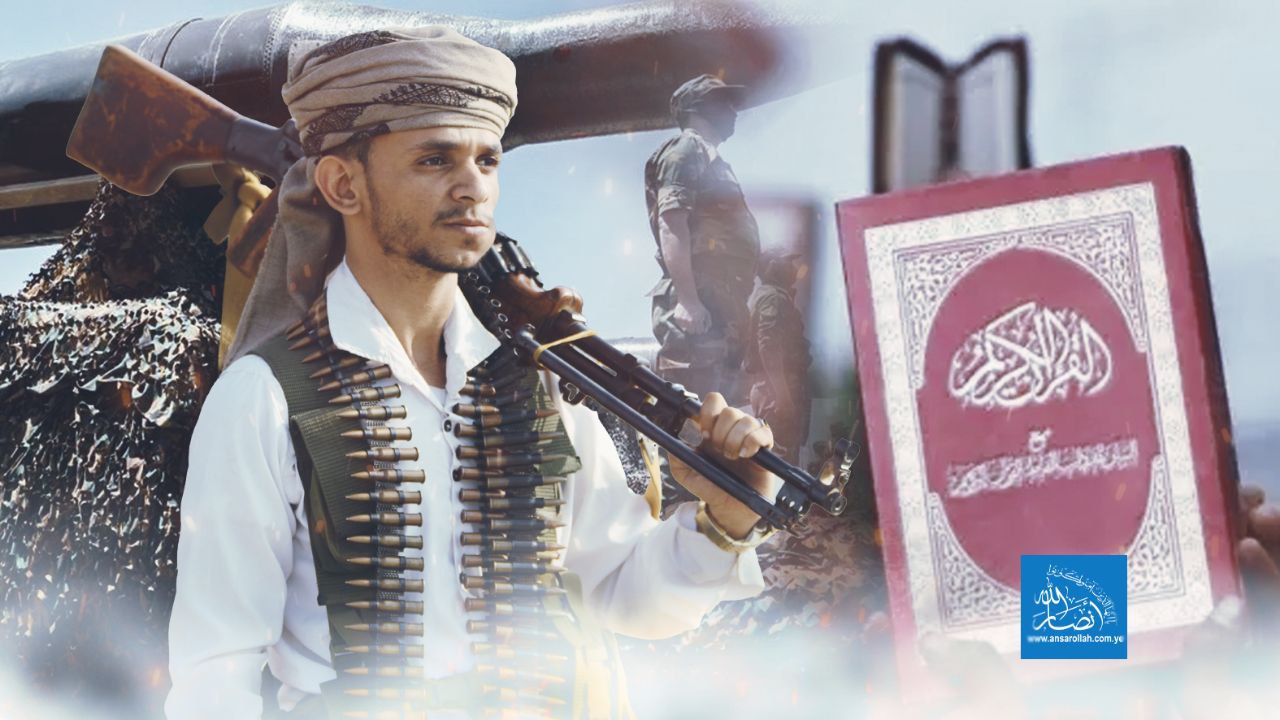
Yemen rose again—not by importing power from abroad or relying on major world powers, but through a Qur’anic project that reshaped the human being before the weapon, consciousness before tools, and faith before capabilities. Through this lens, analysts interpret the growing number of American and Israeli acknowledgments that their once-dominant power is now falling “as autumn leaves.” Yemen is no longer the testing ground for American weaponry; it is the place where that weaponry loses its aura, because Yemen now has men carrying a project that transcends geography and breaks conventional military logic: the Qur’anic project.
The Qur’anic Project Undermines American Military Supremacy
When the United States admits that its F-35 fighter jets—the pride of its military industry and the “crown jewel” of its air arsenal—came under their first direct fire in twenty years over Yemen, it is not merely reporting an isolated military event. It is documenting a strategic shift created by a determined people who know exactly what they want.
The American squadron commander who confirmed that his F-35 stealth jet was fired upon over Yemen likely did not realize he was facing more than radar systems and missiles. He was confronting what Yemeni fighters describe as “a fence of verses and a sword of faith,” invoking the Qur’anic phrase:
“You did not throw when you threw, but God threw.”
That single shot, which frightened a global superpower, was—according to Yemeni commentators—the practical expression of a nation’s consciousness: that all power belongs to Allah, and that dignity belongs to Allah, His Messenger, and the believers.
This “first direct fire of its kind in two decades” represents, in their view, the first Western acknowledgment that technological superiority has collided with the Qur’anic principle:
“Prepare against them what force you can.”
For Yemenis, force is not an end but a means to uphold Allah’s command. They turned the verse into a plan of action and faith into a strategy. The results, they argue, have been remarkable, showing that real superiority lies not in a stealth jet but in the heart that fears Allah alone.
The commander of America’s 34th Squadron did not describe mere harassment; he described an unprecedented threat—one that forced evasive maneuvers and imposed a new equation over the region’s skies. This would not have occurred, Yemeni analysts say, had Yemen relied on scraps of foreign aid or fought with a purely reactionary mindset. It happened because the country adopted a Qur’anic project that taught its people that hegemony is not destiny, and that, however strong tyranny becomes, Allah’s promise is greater.
Yemen has now imposed a maritime and aerial deterrence equation that has made the cost of aggression prohibitively high for the United States and its allies. Yet this deterrence, as framed by the Qur’anic project, is not an end in itself, but a means to uphold Allah’s commands:
“Allah will surely support those who support Him.”
Deterrence is not about boasting or expansion; it is about protecting the Qur’anic project and sending a message that a nation holding firmly to Allah’s Book cannot be defeated:
“Surely We help Our messengers and the believers in this world and on the Day when witnesses arise.”
Thus, when an American pilot flees at the last moment or an aircraft carrier retreats from the Red Sea, Yemeni observers see not only a military setback but a manifestation of:
“Indeed, our soldiers will be victorious.”
America’s collapsing prestige, they say, has fallen before both missiles and faith—the faith that drives young Yemenis to frontline positions declaring:
“Victory is only from Allah, the Almighty, the Wise.”
The Qur’anic project liberated the Yemeni mind from the inferiority complex of power and taught fighters to view the American stealth jet—once a symbol of uncontested dominance—as just a machine that can be brought down when one is armed with the Qur’anic principle:
“How many a small group has defeated a large group by Allah’s permission.”
The Fruit of the Faith-Based Path
Before the new aerial equation emerged, the United States had already suffered a series of unprecedented setbacks in the Red Sea. Five aircraft carriers—Ike, Roosevelt, Abraham Lincoln, Harry Truman, and Vinson—left the region under pressure from Yemeni operations.
The world stood astonished. How could a besieged nation force withdrawals from powers that long ruled the Red Sea without challenge? Analysts argue that the answer was not purely technical and not solely based on drones or precise missiles. It stemmed from the spirit animating these weapons. When the Qur’anic project entered the Yemeni consciousness, it provided a compass: never submit to arrogance, never bow to hegemony, and stand where Allah wants you—not where tyrants wish to place you.
This spirit produced Yemen’s asymmetrical naval power and compelled Washington—for the first time since World War II—to admit it was facing a type of battle it had never trained for.
The U.S. squadron commander’s admission that their aerial encounters over Yemen were the first of their kind in twenty years means that Yemen is no longer a nuisance but a power capable of disrupting global air-superiority systems. Stealth aircraft designed to glide unnoticed across the Middle East are now detected, targeted, and forced to flee. And none of this, analysts say, would have occurred without a faith-based project that elevated the Yemeni fighter’s awareness and gave him a fundamentally different understanding of battle—one that sees true strength not in technology, but in the human being attached to Allah and the society attached to the Qur’an.
Even The Jerusalem Post—one of the most anti-Yemen publications—acknowledged that Yemen is fully independent from Iran, manufactures its own weapons, possesses an astonishing capacity for production and concealment, and operates from an indigenous culture and Qur’anic worldview. It even admitted that Yemenis need no external motivation—their drive is inherently faith-based.
Another outlet, Grand Pinnacle Tribune, reported that Yemeni drones penetrated "Israel"’s advanced air defenses and struck Eilat (Umm ar-Rashrash) and Beersheba (B'ir al-Sab'a), causing military, political, psychological, and strategic disruption. Yemen’s actions revealed the Zionist enemy’s vulnerabilities because, for Yemenis shaped by the Qur’anic project, the enemy is exactly what the Qur’an describes: a fragile entity built on fear that collapses at the first real blow.
A Zionist intelligence official recently stated that Yemen is capable of causing more damage than any other front and that "Israel" has failed to impose deterrence on it—because Yemen’s project does not seek temporary gains but represents a nation reclaiming its historical role, and a Qur’anic project restoring Palestine as an article of faith, not merely politics.
Yemeni Ascendancy
The maritime publication Trade Winds reported that Yemenis have become “masters of the Bab al-Mandeb Strait without rival.” Observers say this is more than naval control; it reflects a project unwilling to leave the region’s keys in the hands of its enemies. This is military sovereignty, but also sovereignty of decision, vision, and principle.
As Europe retreats and U.S. President Trump acknowledges he failed to subdue Yemen, analysts say the Qur’anic project has not only defeated military strength but the imperial will behind it.
The Zionist enemy’s Channel 13 stated plainly: “Netanyahu is living a Houthi nightmare.” Not because Yemen possesses a massive arsenal, but because it possesses a Qur’anic decision that is immune to bargaining—a spirit that does not tremble before threats or falter before great powers. This aligns entirely with the nature of the Qur’anic project: a project that builds a free nation—unyielding, unbroken, uncompromising.
These political and military developments, say Yemeni analysts, are not products of chance or technological gaps. They are the result of a human being reshaped by the Qur’an. The Qur’anic discourse adopted by Yemenis reshaped the fighter’s consciousness, redefined the relationship with the enemy, clarified the meaning of strength, and reinstated the essence of liberation-based jihad. Thus, Yemen succeeded in breaking American dominance at sea, then defeating it in the air, imposing deterrence on the Zionist enemy, unsettling the entire Middle East, and emerging more powerful, more resilient, and more present.
When a divine path enters the heart of a nation, it elevates not only speech but also capability, action, and confrontation. Today, Yemen is the greatest testimony to this: small in geography, great in faith; poor in resources yet rich in its Qur’anic project, which has made it a force resistant to breaking, submission, and defeat. And this is not the end; it is merely the beginning of a new phase in which Yemen holds the reins of the maritime and aerial battlefield—because the Qur’an remains its first and final compass.
What is happening in Yemen is seen as a radiant chapter in Allah’s law of granting victory to believers. The struggle is not geopolitical but a manifestation of divine promise. Yemenis chose to live for the Qur’anic project, and so Allah granted them strength, resilience, and prestige.
The collapse of American maritime and aerial superiority in Yemen’s waters and skies sends a message to the entire Muslim world: the path to dignity and empowerment is not in imitating adversaries, but in returning to the Book and the leaders of divine guidance.
A Qur’anic dawn is rising from Yemen, reminding the nation that Allah’s victory is near:
“Yes, if you remain patient and obedient and the enemy comes upon you suddenly, your Lord will reinforce you with five thousand angels marked for battle.”
They were patient and devout, and their Lord supported them with what defeated tyrants. By Allah’s will, they will remain a testimony that Allah’s word is supreme and that His soldiers are victorious.