Published: 23rd of Jumada al-Thani 1447 AH
At a moment when conflict is escalating across the region, and the interests of regional and international powers are intertwining at the expense of Yemen’s geography, the contours of a dangerous transformation—long engineered quietly behind the scenes—are now emerging into the open. What was once confined to direct military confrontation and traditional struggles for influence has evolved into a multi-layered project, where political interests intersect with security alliances, and where the ambitions of the Zionist entity converge with the tools of regional aggression. The result is a redrawing of the scene in a manner entirely different from what appears on the surface.
From Aden to Abu Dhabi, and from Riyadh to Tel Aviv, the threads of understandings, deals, and projects aimed against Yemen extend far and wide. Some are managed in darkened offices, others are announced openly in speeches that show no hesitation in embracing foreign agendas. At the heart of this complex picture, mercenary forces advance their ties with the Zionist entity, becoming part of a broader system whose objective is to curb the rise of Yemeni power—power that has broken land and sea equations and disrupted deterrence balances across the region.
This is an era of uninnocent alliances, of projects forged in secrecy and casting long shadows over Yemen’s present and future.
This report outlines the features of these intertwined threads: from the steps taken by the militias of the so-called “Southern Transitional Council,” to coordination with the United Arab Emirates and Saudi Arabia, the construction of maritime alliances, and ultimately the Zionist hand operating behind the curtain in search of local agents to safeguard its interests on land and at sea.
From the Emirati Embrace to the Zionist Embrace
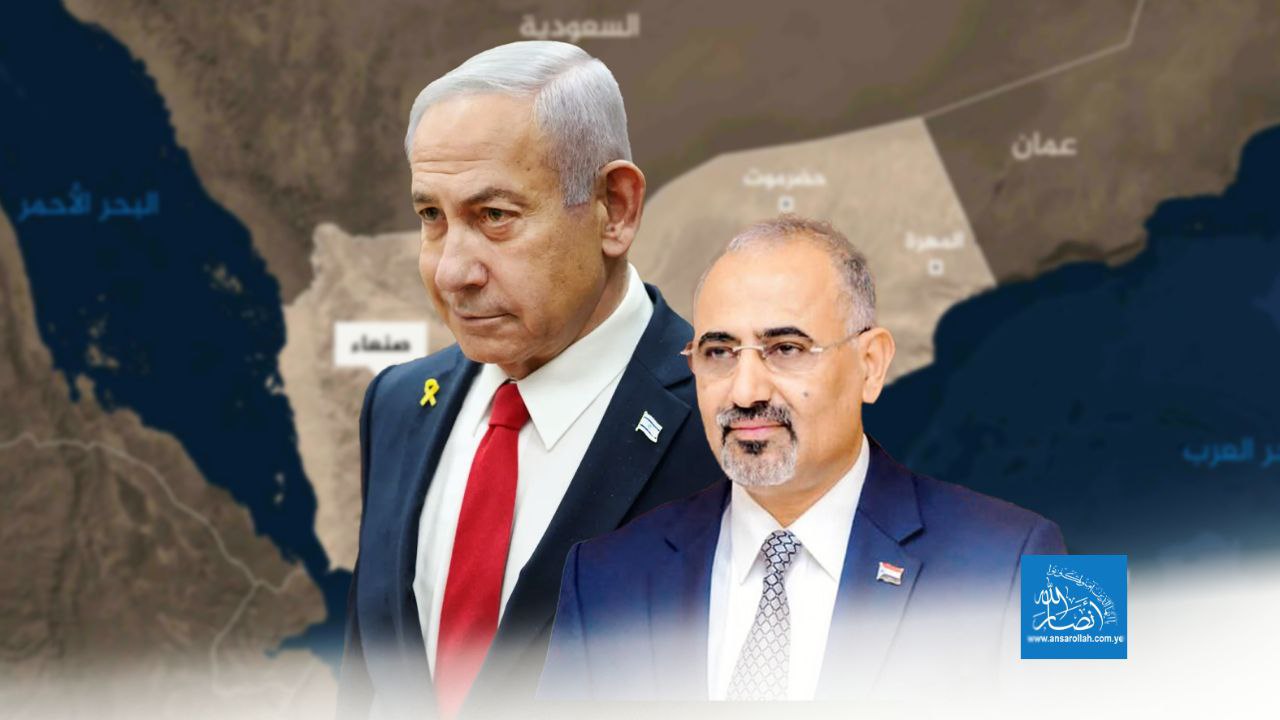
In a scene that exposes a dimension of the dark shifts in the regional alliance map and lays bare a hidden trajectory long forming quietly behind the scenes of the aggression against Yemen, the British newspaper The Times published a report revealing secret deliberations between delegations sent by the Emirati-backed so-called “Southern Transitional Council” and officials from the Israeli entity. The move carried unmistakable signs of political exploitation and pointed to entangled alliances built on shared obsessions and a common enemy, rooted in the aggressive tendencies embraced by both the “Transitional Council” and the Zionist entity.
According to the newspaper, this rapprochement stems from a “single issue” uniting the two sides: confronting the Yemeni army, which over the past two years has succeeded in carrying out qualitative missile and drone operations against the Israeli entity, inflicting significant material and moral losses.
The report adds that the militias of the “Transitional Council” are signaling readiness to formally recognize “Israel” as soon as what they call the “independence of the Arab South” is declared, viewing this card as their most valuable asset for securing foreign support to pave the way for their separatist project. This marks the most dangerous turning point since the launch of the US-Saudi aggression, one of whose objectives was to control international maritime passages and Yemen’s coastal strip to secure Israeli navigation. Throughout the past decade, the “Transitional Council” militias served as the spearhead in hostile operations against the Yemeni army, and they are now lifting the veil on the real motives behind their antagonistic stance.
The Times report revealed deeper layers of the relationship between the Zionist entity and the tools of US-Saudi-Emirati aggression in Yemen. It unequivocally confirmed that “Transitional” delegations sought out Zionist officials on the basis of a “shared cause” against Sana’a, meaning that the political path adopted by the tools of aggression was, from the outset, heading down this slope.
These leaks followed months of hints repeatedly made by “Transitional” leaders, foremost among them the mercenary Aidarous al-Zubaidi, who on multiple occasions stated that he saw no problem with normalizing relations with the Zionist entity if his militias achieved secession. The media and political discourse of the “Transitional” militias has also been strikingly aligned with the Zionist vision regarding Yemen and the region. Moreover, the Emirati occupation apparatus recently brought Zionist delegations to Aden on a visit acknowledged by Hebrew media itself—a precedent that nearly encapsulates the nature of the project being managed there, based on exploiting Yemen’s situation in a way that affects its supportive stance toward Gaza.
Normalization as a Mercenary Bargaining Chip
Perhaps the most dangerous element in the report is the magazine’s confirmation that the “Transitional Council” is seeking to attract support from Donald Trump to expand the circle of normalization, in exchange for recognizing “Israel” immediately upon announcing the alleged “southern state.” This entity seeks to extract legitimacy through external action rather than the will of the people of the land, a bargain that illustrates the extent to which these militias have shed all religious and moral values—an outcome of their attachment to the UAE, the foremost regional arm of the Zionist entity.
This leaves no room for interpretation: the “separation” project promoted by the occupation’s tools has become part of an externally engineered design led by powers at the forefront of which stands the Israeli entity. “Normalization” has been transformed into a political mercenary card, waved to obtain international recognition for an entity lacking popular legitimacy or historical right.
What The Times revealed moves the issue from suspicion and possibility to a fully substantiated reality, showing that all the flirtatious messages issued by mercenaries over the past years were not passing positions, but part of a deliberate political path aimed at offering security and political services to the Israeli enemy in exchange for protection and support.
Forces of Tyranny Lining Up Behind Zionism
Experts believe that any escalation undertaken by mercenaries in the coming phase will not be local in nature or the result of internal assessments, but rather an escalation serving Israeli interests. The Zionist enemy has come to view Yemen—particularly Sana’a—as a central component in the regional deterrence equation. Recent statements by the criminal Netanyahu have confirmed that the entity is gripped by clear anxiety over the growing Yemeni power and its capacity to influence the Red Sea arena and the surrounding areas.
As Yemeni maritime operations expand and impose strategic losses on American and Western protection of Israeli interests, the entity has begun searching for local proxies to execute its agenda in the south and the Red Sea. Consequently, every military or political move by mercenaries becomes part of a proxy war bearing no relation to protecting Yemen or its people, but directly serving Israeli security.
Observers agree that the relationship between the two sides—the tools of aggression and the Zionist entity—has moved beyond incidental interests to a long-term project based on an exchange of services and ever-deepening coordination, constructed on calculations that completely disregard Yemen’s interests, sovereignty, and unity.
The “Transitional Council’s” pursuit of Israeli recognition for a future “southern state” further exposes the depth of dependence reached by these parties and places the fragmentation project in its true context as part of a broader Zionist-American plan targeting Yemen through its southern gateway.
Accordingly, what The Times has uncovered puts the dots on the letters, confirming that any political or military actions undertaken by mercenaries of the aggression in southern and eastern provinces are not isolated moves, but an interconnected series of actions within a single project whose ultimate aim is to protect the interests of the Zionist entity and entrench its influence through local agents.
Thus, the picture is complete: a secret relationship, overt or covert normalization, security and political coordination managed from external rooms, and an aggressive project whose motives are now unmistakably clear—a Zionist-American plan that takes Yemen’s fragmentation as its entry point, uses the tools of aggression as bridges, and treats normalization as a “passport” toward a larger regional project.
The Archive of the “Transitional Council’s” Ties with the Israeli Enemy
He was no casual visitor who entered Aden under the guise of journalism in mid-September: it was Jonathan Spyer, the Israeli spy who landed in the heart of southern Yemen to meet the “defense minister” of the mercenary government, Mohsen al-Daari. The trip was sponsored by the UAE, with the aim of surveying the terrain, mapping spheres of influence, and testing the feasibility of turning the south into an advanced base for the Zionist project.
The Zionist newspaper The Jerusalem Post later published a report written by Spyer himself, revealing security and political information about the situation in Aden, in a clear display of celebration that the visit marked the foundation of a new phase of cooperation with mercenaries.

Mercenary Aidarous al-Zubaidi, head of the “Transitional Council,” no longer sees a barrier between himself and the Israeli entity. In remarks to the Zionist newspaper Maariv in late September, he said: “We have no problem with normalizing relations with Israel if southern independence is achieved.” Details of his meetings at the United Nations painted an even clearer picture: “A southern state would be part of the Abraham Accords.” In another report quoting an interview with The National, al-Zubaidi stated that “all the conditions for establishing an independent southern state are in place, and separation from the north will grant the south freedom to formulate an independent foreign policy, including joining the Abraham Accords.”

The American Institute Decodes the Message
A report by the Arab Center, Washington DC in mid-November put matters plainly: “The Transitional Council is the Yemeni faction most open to Israel.” The report linked al-Zubaidi’s statements with growing Israeli interest, confirming that the Bab al-Mandeb Strait has become a strategic target in the “Greater Israel” project, with the “Transitional Council” serving as the gateway.
According to the report issued by the Arab Center Washington DC and prepared by American researcher Giorgio Cafiero of Gulf State Analytics, the “Transitional Council” is increasingly seeking to open channels of communication with “Israel,” drawing on earlier statements by its leader during the UN General Assembly meetings last September, where he expressed openness to normalization with the Israeli entity in the event of establishing an “independent southern state.”
The report highlights the heavy reliance placed on the “Transitional Council,” noting that its statements and initiatives regarding “protecting maritime navigation” have attracted attention in both Washington and the enemy entity, particularly in light of US and Israeli priorities in the Red Sea and the Gulf of Aden.
Cafiero reiterates that the “Transitional Council” is considered the Yemeni faction most open to establishing a “direct relationship” with the Israeli entity in order to bolster its international legitimacy in the path toward secession, in exchange for intelligence and political support. The report also anticipates increased Israeli support for UAE-backed factions in Yemen, foremost among them the Transitional Council and Tariq Saleh’s militias, given the strategic importance of Bab al-Mandeb in ambitious efforts to establish the “Greater Israel” project and dominate the entire region.

An Arab-Zionist Alliance Against Yemen
Parallel to this hidden trajectory between the “Transitional Council” and the Zionist entity, other layers of the scene—no less dangerous—are coming into view. Saudi Arabia and the UAE are advancing with calculated steps on the ground, reshaping maritime and security alliances under various banners that all converge on a single objective: curbing the power of the Yemeni army and preventing it from consolidating a deterrence equation that has disrupted domination projects in the Red Sea and the Gulf of Aden.
The two Gulf powers, acting as regional contractors for the American-Israeli project, continue tight coordination with mercenaries in Aden and along the coasts of Hadramawt and al-Mahra, aiming to create a security cordon serving the interests of the Zionist entity and securing its maritime routes. Military movements thus intertwine with political arrangements to form an integrated network of roles: mercenaries on the ground, Gulf funding, American planning, and Israeli interests at the apex. This interlocking structure makes clear that the proxy war is managed on land and extends to the sea, where all these parties seek to impose an equation that restrains the Yemeni army and curbs its growing presence, in a desperate attempt to support the Zionist project in the region at any cost.