Published: 23rd of Jumada al-Thani 1447 AH
How many Palestinian prisoners have been released from Israeli enemy prisons, only for the occupation to find no hesitation in assassinating them after their release? How many others were freed, only to be re-arrested days later without remorse? Legal experts and human rights observers have come to understand that the issue of Palestinian prisoners does not lie solely in securing their release, but also in convincing the world that the Zionist entity’s continued contempt for the law now demands a serious stand to halt this hemorrhaging of the system of values and principles with which it adorns its statements. This can only be achieved by exerting pressure on the entity to compel it to respect prisoners’ rights guaranteed by international law, foremost among them international humanitarian law.
The inhumane behavior of the entity in violating human values raises pressing questions about the fate of those laws and about the absence of concerned international organizations, foremost among them the International Committee of the Red Cross. It has never been heard that this international umbrella has succeeded in accessing prisons, inspecting detainees, or making any tangible difference in the conditions they endure. It cannot be accepted that these organizations are powerless or lack any authority to compel the enemy to abide by laws agreed upon worldwide. Their international status and their insistence on assessment and issuing statements imply that they possess a certain margin of movement and criticism. Such criticism must necessarily have meaning and effect, lest these organizations lose the very purpose of their existence.
Behind Bars: Abuse Rooted in Ideological Motives
What takes place behind the bars of Israeli enemy prisons is no longer hidden. Widely circulated testimonies have revealed abundant evidence confirming that the enemy’s treatment of Palestinians stems from an “ideological” premise that incites their killing and eradication. Like other Muslims, Palestinians are classified—according to Jewish belief—among the “Amalekites,” who must all be eliminated. Accordingly, Zionist Jews are stripped of all human values in their dealings with prisoners, treating them with extreme brutality: starving them to death, shattering their bones, and denying them necessary medical treatment.
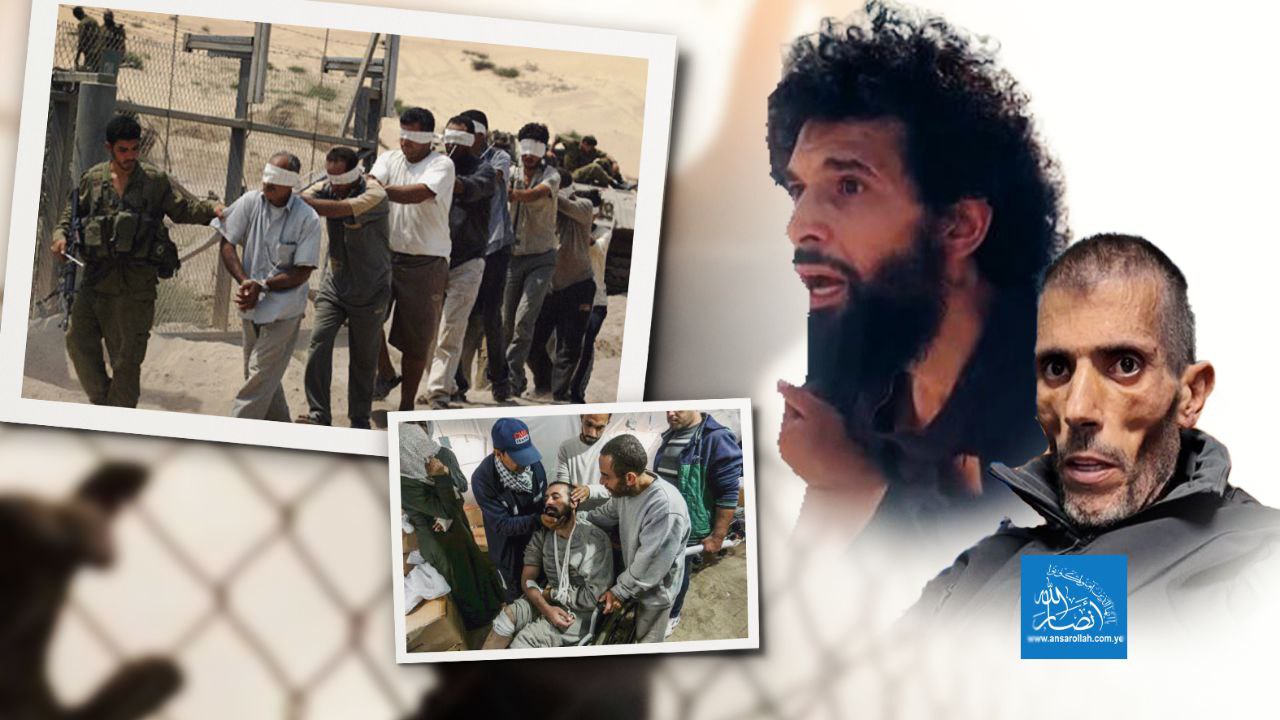
Released prisoners speak of dozens of torture methods they were subjected to, including violent shaking that destroys brain cells and sometimes leads to death, as happened to Palestinian prisoner Abdel Samad Harizat. Among these methods is solitary confinement in what are known as “rooms of disgrace” or “bird rooms,” a newly introduced form of psychological torture. There is also severe beating with chains and iron rods, dragging, forcing bodies against floors and walls, deprivation of sleep and access to toilets, threats of rape, threats to demolish family homes, and treatment that systematically strips prisoners of their dignity.
During the most recent prisoner exchange under the first phase of the ceasefire agreement, media outlets broadcast images of freed Palestinian prisoners appearing pale-faced and emaciated, their exhausted bodies bearing clear marks of brutal torture. One of them, a prisoner named Faisal who had been sentenced to 30 years, said: “What the prisoners endured over the past two years of beatings, humiliation, and abuse—if distributed among half the Muslim nation—would have sufficed them.”
Methods Reflecting Diseased Psychologies
One manifestation of the deep psychological sickness that has consumed the humanity of the Zionists was not limited to the deliberate humiliation during the release of prisoners agreed upon, but extended to what preceded the release itself. One prisoner revealed that shortly before their release, they were “completely isolated from the outside world, without lawyers, visits, or even the Red Cross,” while specialized Zionist torture units beat them continuously as they were taken out of prison sections. Blinded by hatred, they sought to force prisoners to swallow one last dose of suffering before their release—until a future reunion in a new arrest. Some prisoners even wished to return to prison, according to Faisal.
At the same level of psychological depravity, former detainees exposed the medical dimension of abuse, confirming that doctors were often “the first to assault prisoners with beatings and to refuse to give them even a single pill.” This confirms that medical neglect was neither incidental nor temporary, but deliberate and systematic.
Even seemingly simple forms of torture reveal the enemy’s profound moral baseness, such as confiscating mattresses and blankets from prisoners, and even depriving them of clothing, as reported by media outlets quoting freed detainees.
Martyrdom in the Enemy’s Prisons
In its criminal treatment of prisoners, the enemy shows no regard for special health conditions requiring care, as in the case of prisoner Abdulrahman Sufyan Mohammad al-Sabatin. A young man in the prime of his life, he was arrested despite being wounded by the enemy’s gunfire. During his detention, his treatment was neglected, and he was subjected to the same violations imposed on all prisoners, without the slightest trace of conscience or humanity. Days ago, Mohammad al-Sabatin was martyred at the age of 21.
The enemy often deliberately allows prisoners’ health conditions to deteriorate and then leaves them to suffer until death. The martyrdom of a prisoner while in detention should have provoked international action, as it represents one of the gravest violations of humanity. Instead, reactions have remained confined to statements. During the brutal war of aggression on Gaza, more than 100 Palestinian prisoners have been martyred in the enemy’s prisons under harsh detention conditions, medical violations, torture, abuse, starvation, and denial of treatment. Another report issued by Physicians for Human Rights in November stated that 98 Palestinians have died in Israeli custody since October 2023. Today, more than 9,300 detainees are held in enemy prisons, including around 350 children and 50 female prisoners.
Violations, slow killing, and the descent into the harshest policies are occurring before the eyes of the world, and the entity’s leaders openly boast about them amid the absence of international oversight and the silence of the UN and human rights institutions. Previously, Itamar Ben Gvir, known as the criminal entity’s Minister of National Security, publicly bragged about reducing food rations and tightening conditions for Palestinian prisoners.
Entrenched Brutality
For decades, the enemy has perfected innovation in psychologically and physically torturing Palestinian prisoners, acquiring expertise that perhaps surpasses others. This “superiority” stems from its total moral dissolution, rendering its behavior closer to that of a predator attacking its prey. A look into the enemy’s past on this issue reveals the same recurring scene, with evolving forms of rights violations. All types of torture appear, including those that seem simple in form but are horrific in impact. Resorting to such methods is further evidence of the enemy’s deeply disturbed psychological makeup.
In 2002—more than two decades ago—lawyer Fares Abu Hassan, the regional director of the International Solidarity Organization for Human Rights based in Washington and a specialist in defending Palestinian prisoners, described in a television interview the grim reality endured by Palestinian detainees in the Israeli enemy's prisons: a condition of humiliation, degradation, and multiple forms of torture. Even then, he spoke of the extreme violations practiced by the Zionist enemy against prisoners. Yet, under global submission to the American stick, the enemy faced no accountability, punishment, or even pressure to halt these violations of the law. Abu Hassan stated at the time: “Israel tramples underfoot all international conventions, norms, and human rights in its treatment of prisoners. Human rights principles? No—it pays no attention to any international criticism regarding what prisoners are subjected to in Israeli prisons.”