Published: Rajab 7, 1447 AH
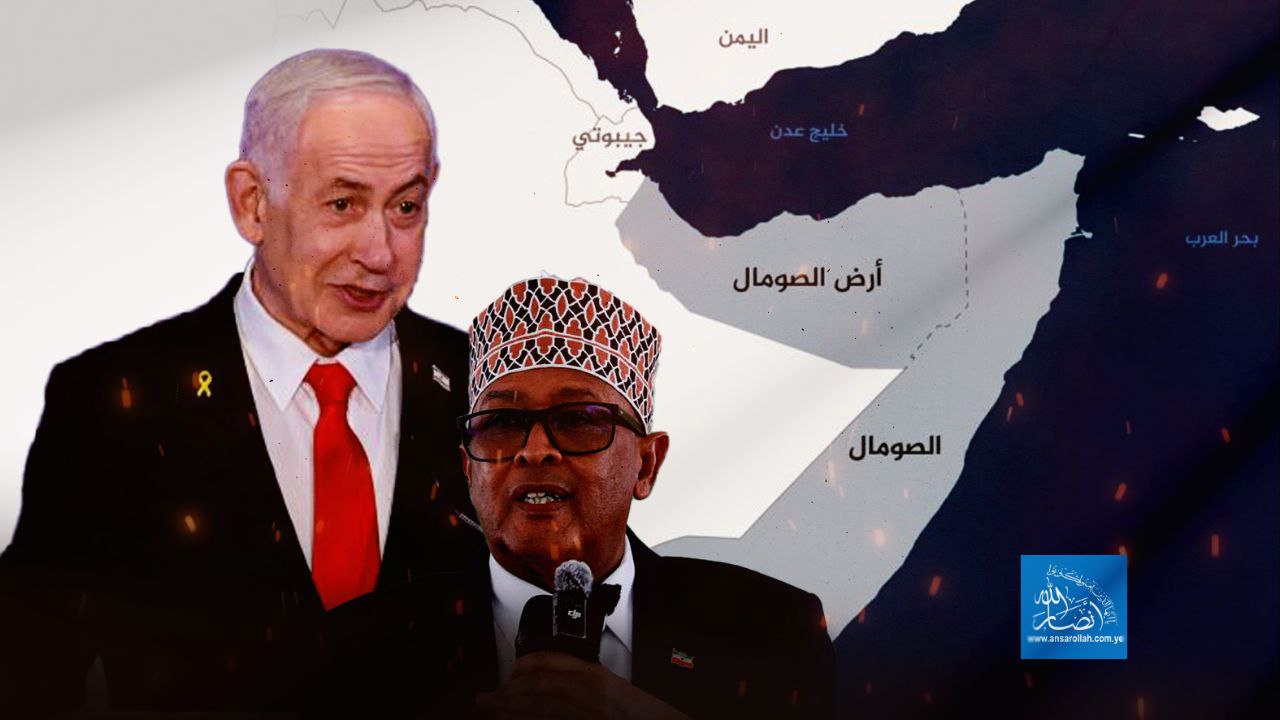
On 26 December 2025, the Zionist Netanyahu government announced its official recognition of the so‑called “Somaliland” region as an “independent sovereign state,” alongside the initiation of full diplomatic relations within the framework of the normalization project (the Abraham Accords). This marks an unprecedented step by the Zionist entity toward a separatist entity that has not received any international recognition since it declared secession from the Somali state in 1991.
This decision represents a clear challenge to the international consensus supporting Somalia’s unity. The recognition coincides with developments in eastern Yemen and the pursuit by the so‑called “Southern Transitional Council” of secession, a council that has welcomed normalization with the Zionist entity in exchange for recognition of the secession of southern Yemen.
This assessment is driven by a central question: Does the Israeli recognition constitute merely a symbolic political move of a propagandistic nature, or is it a foundational step in a process of strategic repositioning aimed at transforming the African coast opposite Yemen into a hostile security‑intelligence depth, within the context of intense and open competition in the Red Sea and Bab al‑Mandeb? This is examined within hostile maritime security strategies, including NATO’s new strategy issued this month (December 2025), British and U.S. efforts under the banner of so‑called maritime security (September 2025), and the policy of transferring “Israel” from the U.S. European Command area of operations to the U.S. Central Command area of operations (2021).
The Geopolitical and Regional Context of the Development
The Israeli recognition came at a regional moment marked by a qualitative shift in the nature of the conflict in the Red Sea and in balances of power. Confrontation has moved from a pattern of Western presence in the Horn of Africa and shows of force without engagement to a pattern of mutual deterrence imposed by Yemeni naval capabilities, which have resulted in the disruption of shipping linked to or supportive of the Israeli enemy. This transformation has weakened the ability of Western and Israeli forces to manage the conflict from within the maritime theater itself and has increased the cost of direct deployment there.
Within this context, a counter U.S.–Zionist–British trend has emerged, seeking to shift the center of gravity from the sea to the land opposite Yemen—namely, the African coast of the Gulf of Aden. This would allow for the rebuilding of monitoring, surveillance, and logistical support systems that are politically and militarily less costly, more gradual, and more discreet. The “Somaliland” region—by virtue of its geographic location directly overlooking Bab al‑Mandeb and its fragile legal status—appears to be an ideal candidate to play this role.
This trajectory intersects with intense competition in the Horn of Africa over ports and land corridors. Ethiopia, as a landlocked state, is seeking to break its geographic isolation through access to a maritime outlet, while the United Arab Emirates is working to complete a network of ports extending from the Gulf to the Red Sea, in line with a long‑term geo‑economic vision aimed at controlling supply chains. This coincides with internal tensions in Yemeni governorates under occupation (particularly Hadramout), reflecting fractures within the aggression camp itself, pushing some of its parties to seek alternative arenas to compensate for the erosion of their influence within Yemeni geography.
Regional and International Reactions and Their Significance
The Israeli recognition was met with explicit regional rejection led by Egypt, Somalia, Djibouti, Saudi Arabia, Palestine, the Arab League, the African Union, and the Organization of Islamic Cooperation. The step was described as a direct violation of Somalia’s sovereignty and territorial unity and a threat to stability in the Horn of Africa and the Red Sea. This rejection was not merely an adherence to a legal principle, but reflected a strategic awareness that opening the door to recognizing separatist entities threatens to dismantle the system of coastal states overlooking one of the world’s most important maritime corridors.
For Egypt, the rejection is linked to long‑term concerns regarding the potential expansion of Israeli–Ethiopian influence in the southern Red Sea, which could exert indirect pressure on the Suez Canal and Egyptian freedom of navigation in times of peace and war. From the perspective of military doctrine—despite the Camp David Accords—the Egyptian army still views the Zionist entity as the primary threat to Egyptian national security.
Turkey, for its part, views the step—through its rejection—as a breach of the balances in the Horn of Africa that Ankara has worked in recent years to consolidate by supporting the central Somali state. The Turkish position stems from competition with the Zionist entity over political expansion, unlike the Arab and African position, which views the step primarily as a threat.
Conversely, the “Somaliland” authorities welcomed the Israeli recognition and described it as a “historic moment,” attempting to leverage it politically to break isolation. Meanwhile, the Zionist Netanyahu government defended the decision as a “recognition of an existing reality,” in a discourse aimed at normalizing the idea of dealing with unrecognized entities whenever this serves Zionist security interests. It claimed that normalization would focus on exchanging expertise in technical and agricultural fields, without publicly declaring the hostile military and security trajectory.
The Functional Dimension of Israeli Recognition
From an analytical perspective, the danger of Israeli recognition does not lie in its legal value—which remains weak and internationally isolated—but rather in its potential political and security function under vague pretexts such as “protecting navigation” or “combating terrorism and piracy.”
This cover allows for the transformation of civilian infrastructure in “Somaliland”—particularly the port of Berbera—into dual‑use assets, including surveillance and radar systems, logistical support facilities, and platforms for operating drones, without the need to declare traditional military bases. In this sense, recognition constitutes a foundational step in re‑engineering the security environment surrounding Yemen from the outside in an aggressive manner, rather than confronting it directly at sea.
Strategic Implications for Yemen
For Yemen, this development represents an indirect but structural threat. It does not impose an immediate new military reality, but it lays the groundwork for a long‑term strategic encirclement aimed at reducing Yemen’s maritime depth, exposing its movements, and weakening the element of surprise that has been one of its sources of strength in the recent period.
The recognition also carries a geo‑economic dimension that is no less dangerous, as it opens the door to transforming Horn of Africa ports into Western‑backed alternatives to Yemeni ports, within a gradual economic isolation policy designed to strip Yemen’s geographic location of its strategic value. Added to this is the risk of exploiting the legal vacuum in “Somaliland” to expand smuggling networks toward Yemen, whether involving weapons, fuel, or people, thereby exacerbating internal security and economic challenges.
Development Trends and Likely Scenarios
In the short term, the recognition is likely to remain within a symbolic political framework, due to regional rejection and the absence of parallel international recognition. However, the medium term remains open to a scenario of gradual establishment of security relations through technical or maritime agreements used as a cover for building a permanent intelligence presence. The scenario of transformation into an explicit, publicly declared military base remains less likely in the foreseeable future, but it remains a deferred option linked to changes in deterrence balances in the Red Sea.
Overall Assessment
It can be assessed that the Zionist entity’s recognition of “Somaliland” does not constitute an immediate strategic shift in the balance of power, but rather represents a foundational step in a broader trajectory aimed at reshaping the security environment in the Gulf of Aden and Bab al‑Mandeb at Yemen’s expense. The danger of the step lies not in the event itself, but in its cumulative trajectory and in its attempt to shift the conflict from costly maritime confrontation with Yemen to long‑term geographic and intelligence encirclement via the African coast.
At the same time, the expansion of regional rejection and the conflicting interests among the parties pursuing this trajectory make the project containable and disruptable. This, however, remains conditional on Sana’a’s early awareness of the nature of the threat and its treatment as a strategic indicator of adversaries’ repositioning, rather than as an isolated or transient diplomatic step.
Conclusion
In conclusion, a composite approach emerges before Sana’a that combines calm political investment, calibrated deterrence tools, and enhanced anticipatory analysis. The explicit regional rejection of Israel’s recognition of “Somaliland”—particularly by Egypt, Somalia, Djibouti, and Turkey—represents an objective political opportunity that can be built upon without sliding into alliance politics, through rational discourse that reinforces the notion that the Yemeni position falls within the protection of Red Sea stability and the unity of coastal states, thereby limiting attempts to portray Sana’a as a source of threat.
At the same time, this path requires preserving Yemeni maritime deterrence as a high‑cost strategic tool for adversaries and avoiding its exhaustion in open confrontations, as this power reaches its peak effectiveness when managed as a balance lever rather than as a tool of attrition. This complements the necessity of building an early‑warning system focused on the Horn of Africa, based on systematic monitoring of indicators of Zionist security construction—ranging from undeclared military movements and opaque technical contracts to the expansion of dual‑use infrastructure and visits by security delegations. Recognition provides an initial cover for developing broad institutional relations that appear economic and technical in form—areas of importance to the entity—while concealing, in an undeclared track, security and intelligence cooperation under security‑related titles. This would enable Sana’a to practice anticipatory analysis and prevent the ongoing cumulative trajectory from crystallizing into a complete security reality that would be difficult to contain at a later stage.