Published: Rajab 10, 1447 AH
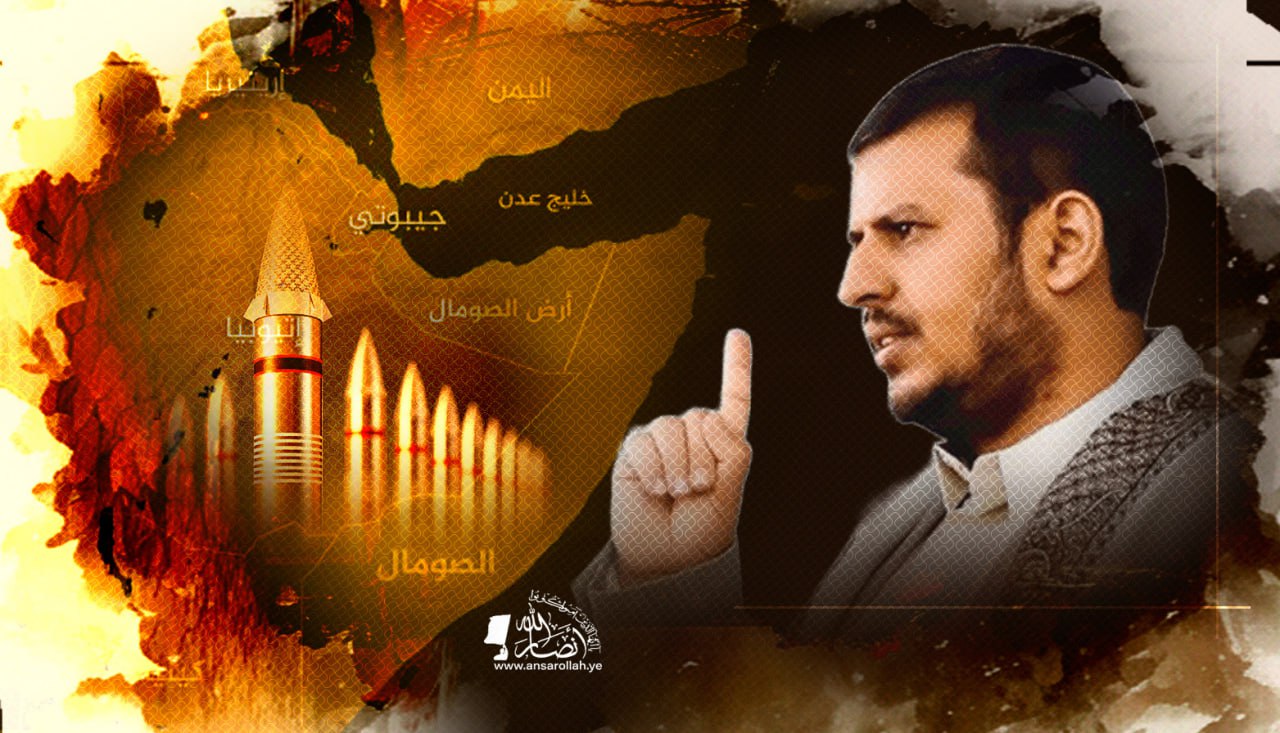
Before midnight the other night, a significant statement by Sayyed Abdulmalik Al-Houthi regarding “Somaliland” was closely followed. The statement was not merely an expression of emotional solidarity; rather, like many of the Leader’s positions—may Allah protect him—on Islamic and Arab causes, it represented a fundamental shift in the way political conflicts are addressed. His responses are not confined to conventional diplomatic frameworks but go beyond them to the formulation of field-based equations that impose a new reality on the map of conflict. In the Somali context, the statement was not a protocol-level condemnation of Israel’s recognition of the “Somaliland” region as a sovereign state and its separation from the Federal Republic of Somalia. Instead, it constituted a firm strategic document redefining the balance of power in the Red Sea and Gulf of Aden region.
The Foundations of Sayyed Abdulmalik Al-Houthi’s Position
As outlined in the statement, this position stems from a vision that considers Arab and Islamic geography as a single, indivisible entity. Al-Sayyid Al-Houthi—may Allah protect him—views any Zionist penetration into the African coast opposite Yemen as a direct and advanced threat to Arab national security in general, and Yemeni national security in particular. From this perspective, the statement derives its importance as an “announcement of a security and military ban” on the movements of the enemy entity in the region. It shifts the conflict from the realm of legal debate over state sovereignty into the arena of direct confrontation, aimed at preventing the consolidation of any Zionist presence that could threaten regional stability.
Between the Leader’s Statement and the Arab States’ Statement
Arab states had previously issued a statement condemning the Israeli recognition. However, that statement stood as a model of what can be described as “incomplete diplomacy,” which historical experience has proven ineffective against the Zionist entity. Regardless of the strength of its rhetorical language or legal expressions, such diplomacy remains confined to paper and international forums. This entity, accustomed to disregarding international resolutions, has never been deterred by Arab condemnation statements, no matter how forceful. Unfortunately, that official position is not far removed from similar stances that limit themselves to describing a “legal violation” without possessing real pressure tools capable of breaking Zionist will. As such, it remains a formal position lacking tangible impact against an entity that understands and respects nothing but material force and facts on the ground.
From Foundations to Response
The fundamental difference lies in the nature of the proposed response. The joint Arab statement amounted to something akin to a legal pleading before a judge without authority—a plea suspended in the air. Although it sought to politically isolate the Israeli step and prevent its international legitimization through the lens of the UN Charter and “rules of sovereignty,” it remained detached from effective enforcement. In contrast, Al-Sayyid Al-Houthi’s statement proceeded from the premise that the usurping entity of “Israel” lacks legitimacy for itself, let alone the authority to grant it to others. From this standpoint, he moved directly toward preemptive deterrence, transforming threat into concrete, anticipatory action. By explicitly declaring that any Israeli presence in “Somaliland” would be treated as a legitimate military target, he imposed a new security equation that makes the cost of alliance with the entity high and fraught with military risks.
The National and Geopolitical Dimension
At the national and geopolitical level, the Arab statement focused on the stability of the Red Sea region from a political and administrative perspective. The Yemeni statement, however, bound the two shores of the Red Sea with a bond of shared destiny. Al-Sayyid Al-Houthi—may Allah protect him—viewed Israeli infiltration as an attempt to encircle Yemen and fragment the African depth, considering the defense of Somalia’s sovereignty an integral defense of Yemen’s national security. This linkage transformed the issue from a regional border dispute into a strategic confrontation front aimed at thwarting the “Middle East reshaping” project through which Israel seeks to create small entities revolving within its orbit.
The most prominent feature of the Yemeni position was its tangible solidarity with the Somali people. The statement did not limit itself to military threats against complicit authorities, but also extended a discourse of inclusion toward the people of Somaliland, affirming support for the brotherly Somali people and their protection from Zionist exploitation. Through this, the position seeks to create a popular environment hostile to Israeli presence, supported by a military protection umbrella designed to bury the project at its inception before it materializes along the African coast.
Advanced Positions That Restore the Nation’s Dignity
The statement did not directly aim to expose official Arab positions. However, any citizen in the Arab and Islamic world knows that Arab condemnation statements have not liberated an inch of Palestine, nor protected Sudan or Somalia. As such, the Leader’s statement will be seen as a model of action preceding words, raising popular expectations and placing official regimes in an embarrassing position before their peoples, who demand practical steps rather than rhetorical statements that neither nourish nor satisfy hunger.