Published: Rajab 11, 1447 AH
The failure of the United States and the Israeli entity in confronting Yemen has become a solid reality acknowledged by their own research centers, media outlets, and military leaders. After more than two years of open confrontation in the Red Sea, sustained airstrikes, and unprecedented naval deployments, Washington and “Tel Aviv” now face a non-traditional adversary that has imposed new equations and exposed the fragility of Western power when it collides with firm will and an asymmetric fighting doctrine.
For decades, Yemen was viewed in American and Zionist calculations as a distant geographic margin—something that could be contained through air raids, subdued by blockade, or exhausted through complex wars. This was the assumption inside planning rooms in Washington and “Tel Aviv,” and on it were built strategies of “deterrence by bombardment” and “shows of force.” What followed, however, proved to be a tactical failure and a conceptual rupture. Yemen, besieged for a full decade, emerged as a central actor that redefined the meaning of power and imposed itself as a difficult and influential factor in regional and international security equations.
A Sky No Longer Open
Air superiority has long been the cornerstone of U.S. military doctrine. From Vietnam to Iraq, and from Afghanistan to Libya, the skies were under American control, breaking an adversary’s will before ground engagement even began. Yemen overturned this rule entirely. When retired American Colonel Mark Gunzinger, a former B-52 test pilot, acknowledged on the Task & Purpose website that operations in Yemen revealed an air defense system more advanced than expected, it amounted to an admission that all entire assumptions had collapsed.
American pilots began maneuvering where they once did not, avoiding areas they once attacked, and calculating risks where they once imposed them. Non-stealth aircraft were no longer instruments of dominance but potential targets, forcing Washington to deploy B-2 stealth bombers—an explicit acknowledgment that Yemeni airspace was no longer permissive or exposed.
The Burden of the Red Sea
In the Red Sea, where Washington sought to display its naval might, realities on the ground showed that a massive force, when drawn into an asymmetric arena, can become a heavy burden. Admissions reported by the Zionist newspaper Globes, quoting a U.S. admiral who acknowledged the failure of the American coalition to deal with Yemeni naval operations, were part of a broader narrative of confessed incapacity.
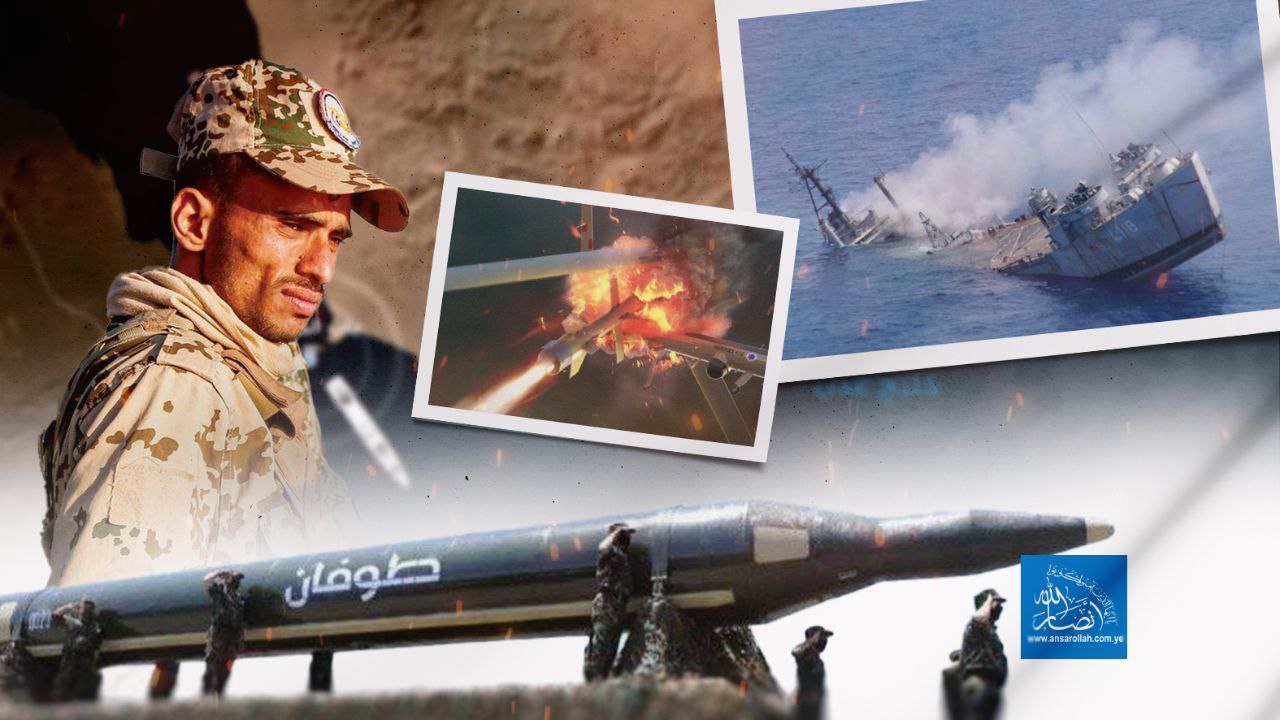
American acknowledgments confirmed that Yemenis carried out complex maritime operations using simple, low-cost means, forcing advanced fleets into a constant defensive posture. Aircraft carriers—the symbol of U.S. dominance—ceased to be offensive spearheads and instead became besieged platforms, spending billions of dollars to intercept drones costing only thousands.
The cost was not merely financial but psychological and operational. Crews were exhausted, command rooms disoriented, and the confusion was compounded by fatal “friendly fire” incidents and a growing loss of confidence in existing systems. The Red Sea ceased to resemble a routine maritime corridor and instead became a theater of prolonged attrition that exposed the fragility of American deterrence.
At Bab al-Mandab, Yemen required neither aircraft carriers nor overseas bases. An acknowledgment by Trade Winds that “the Yemenis are the undisputed masters of the Bab al-Mandab Strait” was sufficient. Control here was not only military but also economic, psychological, and strategic, prompting global shipping companies to reroute, recalculate, and await de-escalation signals from Sana’a. Thus, the strait was transformed into a global pressure card in the hands of a party once classified as merely “besieged.”
The Unexpected Yemeni School
Despite initial American denial of the setbacks suffered in the Red Sea, reality ultimately surfaced—especially after hostilities paused and battle losses became evident. This was reinforced by successive U.S. admissions of failure. The most serious and symbolically significant acknowledgment came from the U.S. Marine Corps itself, where officers wrote that Yemenis had become “the most dangerous combat school in modern naval warfare.” This meant that the Yemeni model had surpassed being merely a peer to the Marines and had evolved into a military school in its own right.
Overall, American admissions conceded that Yemen is “an army without a conventional air force,” lacking a formal navy or massive military bases. Yet it succeeded in drawing the United States into a secondary theater that drained its defensive arsenal, imposed a “joint weapons” dilemma, and restricted the freedom of movement of the largest naval fleet in history. This revealed a fundamental truth: the Yemeni experience proved that power is not measured by the size of platforms but by the intelligence with which they are employed.
Air Defenses That Do Not Defend Themselves
The Israeli entity has long presented itself as possessing “impenetrable air defenses,” but Yemeni drones shattered this claim in practice. Yemen carried out dozens of military operations deep inside the Zionist entity, and Zionist sources themselves documented the accurate arrival of Yemeni weapons at their targets.
In recent days, Grand Pinnacle Tribune confirmed the penetration of Israeli air defenses and direct hits in Umm ar-Rashrash, collapsing the illusion of an “airtight shield.” The Yemeni attack constituted a strategic blow that demonstrated the Israeli depth was no longer secure and that its advanced systems were not immune to intelligent, low-cost tools.
In the same context, research centers such as RANE Worldview and Modern Policy spoke of “concern” and the failure of the Western security model. They noted that deterrence by bombardment neither stopped Yemeni operations nor imposed dominance nor resolved the conflict. On the contrary, it forced Washington to reshape its military presence, scale back ambitions, and search for political exits. Yemen, they concluded, did not defeat America with a single blow but undermined it over time through prolonged attrition that rendered conventional superiority meaningless.
Yemen and the Post-Hegemony Equation
What Yemen imposed was both a military victory and a transformation in the rules of the game. It proved that attrition defeats superiority, intelligence defeats cost, and will defeats technology. American and Zionist admissions are not merely documentation of defeat but an indirect declaration of the end of an era of absolute dominance. Yemen—once intended to be broken—emerged from the confrontation as a military school, a strategic dilemma, and a symbol of people’s ability to impose their own equations. In an age when myths are collapsing, Yemen has written a new chapter of history.
In summary, Washington failed to secure Zionist navigation, failed to break Yemeni will, and failed to protect its naval prestige. The “Prosperity Guardian” alliance effectively collapsed, and aircraft carriers were transformed from offensive tools into exhausted defensive platforms.
More than one billion dollars were spent intercepting drones that cost only thousands. This was compounded by the downing of MQ-9 drones and Super Hornet aircraft, incidents of friendly fire, and confusion within command rooms—clear indicators of comprehensive failure.
Yemenis mastered asymmetric warfare, distributed firepower, operational deception, emissions management, communications, and strikes from mobile, untraceable platforms. These elements practically nullified American technological superiority and proved that Yemen is the undisputed master of Bab al-Mandab. Major shipping companies do not return except under Sana’a’s conditions, and any escalation in Gaza immediately restores the maritime blockade.
What occurred was no stroke of luck. Adversaries did everything in their power to contain Yemen, yet deterrence by bombardment failed, and conventional superiority proved no longer decisive. What unfolded in the Red Sea, in Yemeni airspace, and along the shores of Bab al-Mandab demonstrates that one who acts from a foundation of faith and in accordance with divine guidance cannot be defeated by any power in this world.