Published: Shaʻban 3, 1447 AH
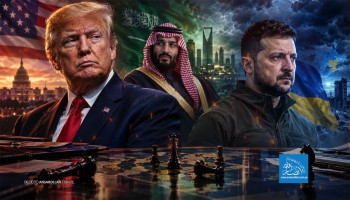
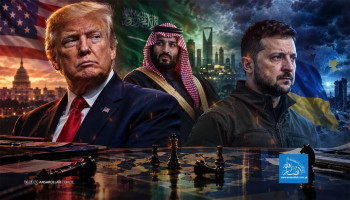
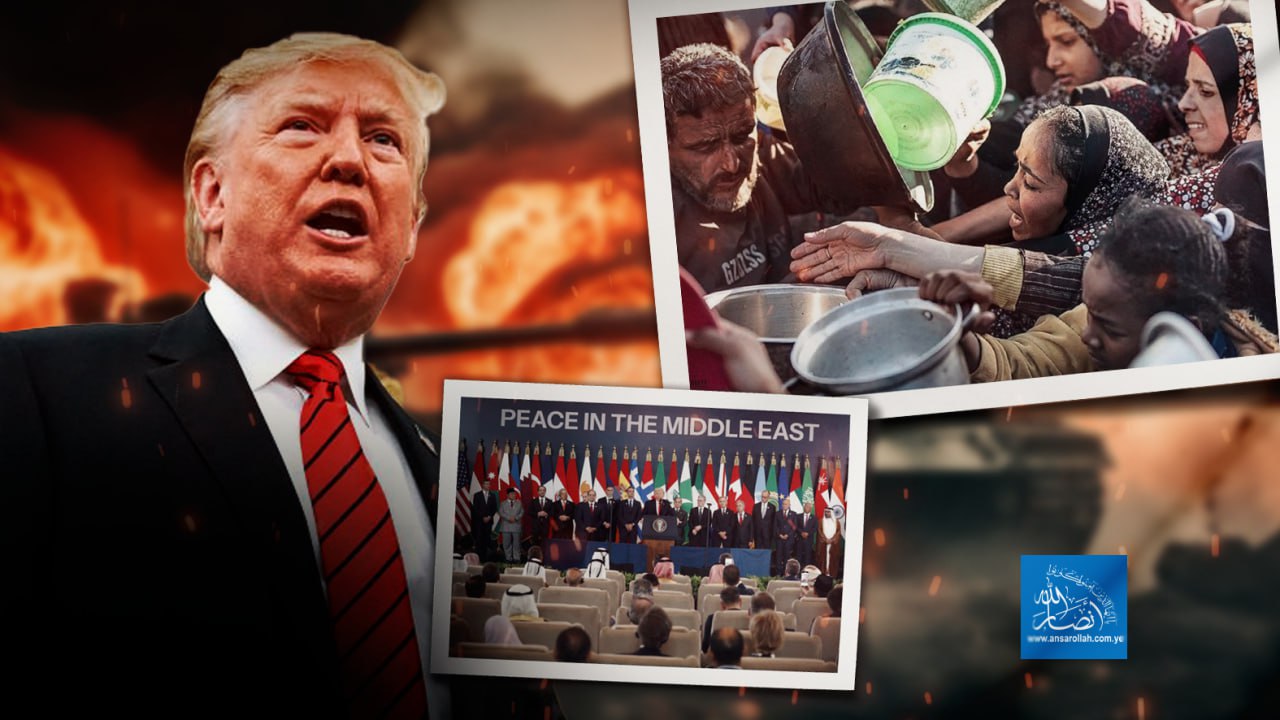
In a dangerous development that reflects the nature of the American-Israeli approach to the conflict, the Criminal U.S. President Donald Trump resorted to imposing what he calls “peace in Gaza” through military force, via an integrated project based on disarming the resistance and reshaping the Gaza Strip as a non-sovereign entity, in exchange for promises of reconstruction and humanitarian assistance.
Trump announced that the disarmament of the resistance would be carried out by force, within a vision adopted by Washington and fully aligned with Israeli objectives. As part of this approach, a so-called “Peace Council” has been formed to serve as a political umbrella for managing Gaza, not as an occupied land engaged in resistance, but as a humanitarian crisis zone to be administered according to a relief logic rather than one based on rights.
According to the proposed vision, the Palestinian people are being treated as a “food and services problem,” in an attempt to replace national rights—among them the Palestinian state, the right of return, and self-determination. When food baskets and reconstruction projects are conditioned on disarmament, it represents a dangerous political trade-off that empties the Palestinian cause of its liberation content.
From Washington, and under international and UN cover, a new form of guardianship over Gaza is being reproduced through the establishment of an imposed administration wearing a national façade, limited to service-related aspects only. This step aims to separate the Strip from its resistance dimension and confine it to a narrow administrative framework. In this context, the role of Dr. Ali Shaath, head of the National Committee for the Administration of Gaza, emerges within a track seeking to market an imposed administration under the title of “civil governance.”
In addition, Nikolay Mladenov, a member of the executive council, has appeared as a “special representative” for Gaza, tasked with serving as a field liaison between the “Peace Council” and the National Committee for the Administration of Gaza. He is to support the council’s oversight of all aspects of governance, reconstruction, and development in Gaza, while ensuring coordination between civil and security tracks.
The most dangerous file in the project lies in the security dimension, where leadership of the so-called “International Stability Force” has been assigned to Major General Jasper Jeffers, an officer in the American special forces. This effectively means that security in Gaza will be managed with an American mindset, with the declared goal of disarmament and the imposition of “stability” according to the Israeli concept.
Under this vision, Gaza is not managed from within, but from a political room led by American figures known for their bias toward the Israeli entity, foremost among them Donald Trump as head of the executive council, alongside the U.S. Secretary of State, a special envoy for reconstruction, and Jared Kushner, responsible for the economic strategy. This scene confirms that the Strip is being managed with a deal-making mentality rather than a rights-based approach.
In the reconstruction file, the World Bank and major investment companies are offering billions of dollars for rebuilding, but these funds are tied to conditions related to governance, oversight, and disarmament, turning money into a tool of political blackmail rather than purely humanitarian support.
Regionally, roles are distributed among Arab parties within a single coordination framework that includes security, financial, and development aspects, all aimed at controlling Gaza and preventing any movement outside the pre-drawn U.S.-Israeli parameters.
Available indicators confirm that what is being prepared for Gaza is an administration without sovereignty, security led by the United States, and reconstruction conditioned on stripping the resistance of its weapons, in an attempt to reproduce occupation in a softer form after its military failure.
Description of the Gaza Administration Council
There are attempts—though not new—that are now being entrenched to replace the natural right of the Palestinian people to their homeland and sovereignty over their land with a council that provides some humanitarian services. In other words, transforming the cause from one of existence as a natural right of the Palestinian people into merely a right to life. This constitutes a plot aimed at liquidating the Palestinian cause and turning it into a purely humanitarian right to survive in any form.
Regardless of the names proposed and the extent of their bias toward the Israeli enemy, what matters are the roles associated with the three formed committees (the Technocrats Committee, the Peace Council headed by Trump, and the Executive Council). What the Zionist entity and the United States want from these committees is to implement Zionist agendas. The Executive Committee and the Peace Council function as a mandate council, placing Gaza under guardianship in what is intended to be a permanent form. The danger in the Technocrats Committee lies in its intended role as a substitute for the legitimate Palestinian representative, meaning replacing Hamas, other Palestinian factions, and even the Palestine Liberation Organization. Despite the facilities offered by the Abbas Authority, it remains outside the council, indicating that the enemy is moving to pull the rug out from under Palestinian factions in Gaza, starting with creating this framework as a representative of Palestinians and shifting from treating Palestinians as rights holders to treating them as residents in need of relief and housing. Herein lies the danger.
In addition, efforts are underway to strip the technocratic government of all points of strength. On the security side, there is a committee called the “International Stability Force.” On the financial and reconstruction side, as well as funding, there are specialized committees. This means that decisive matters are now beyond the control of Palestinian decision-making.
Looking at the reality of the Palestinian people, the goal has become clear: to push Palestinians toward the American and Israeli option by force of circumstances. Palestinians are now presented with a choice between accepting foreign security militias along with a Peace Council with full powers, or being deprived of their basic rights to life—meaning no food, no medicine, and no shelter—especially in light of the lack of alternatives, Arab and Islamic submission, and the abdication of international organizations from their roles.
It is not only the Palestinian resistance that is facing a real threat; the Palestinian cause as a whole is under threat. It is clear that the American-Israeli enemy seeks to bring about a radical change in the Palestinian landscape.
Disarmament as an Entry Point to Imposing Peace
In Trump’s announcement of the “Peace Council” in Gaza and the statements it included, the goals of the council are revealed. Trump pledged to disarm the Islamic resistance movement Hamas “willingly or unwillingly,” stating: “With the support of Egypt, Turkey, and Qatar, we will ensure a comprehensive agreement to disarm Hamas and destroy the tunnels. As I said before, Hamas can do it the easy way or the hard way.”
What is being proposed for Gaza today cannot be described as a peace project, but rather as a project to manage occupation. The ongoing discourse is nothing more than a new attempt to entrench Israeli dominance, this time with American will and international sponsorship, in an effort to beautify the face of the Israeli enemy and reproduce it through soft political and administrative tools. At the same time, a careful reading of the U.S. and Israeli positions reveals that the focus on what is called “the day after” does not stem from a serious search for a just political solution, but from an attempt to escape forward after the failure of the aggression to achieve its military objectives, and to turn the humanitarian catastrophe in Gaza into an entry point for imposing arrangements that primarily serve Israeli enemy's security.
Based on the tasks assigned to the “Peace Council,” it carries no sovereign or national content for Palestinians. It is intended to be a functional framework for managing the population under the Israeli parameters, without ending the siege or recognizing the legitimate political rights of the Palestinian people, foremost among them the right to self-determination and the establishment of an independent state. The enemy seeks to re-engineer the Palestinian scene in a way that ensures continued control and domination, by weakening the collective national structure, marginalizing Palestinian factions, and emptying the Palestinian Authority of its political content, while keeping Gaza as an open arena for security and humanitarian experiments.
Reactions
Hamas opposed the idea, describing it as an attempt to change the political face of Gaza and impose a foreign agenda. The Islamic Jihad Movement rejected the initiative, considering it a step toward dividing Palestinian decision-making. The Gaza Strip witnessed popular protests rejecting the idea, viewing it as an attempt to impose a new form of guardianship. Egypt called for Palestinian consensus as a condition for any new arrangements, emphasizing Palestinian unity. Qatar stressed that any arrangements must be carried out through internal Palestinian consensus and not by external imposition.
The United Nations cautiously welcomed the idea, emphasizing the need for inclusive representation and practical guarantees. The European Union affirmed that the council should be part of a political process leading to a “two-state solution.” The Arab League called for ensuring Palestinian representation and rejecting any imposed solutions without their consent. The Palestinian Authority rejected the idea, considering it an attempt to create an alternative to the Palestine Liberation Organization.
European positions vary between cautious support and conditional opposition, with consensus on rejecting any solutions separate from the comprehensive political context of the Palestinian cause. The French Foreign Minister stated that the Peace Council in Gaza is “very far from the UN Charter.” The Finnish President said that the United Nations is the best organization for mediating peace.
Conclusion
A comprehensive reading of the American track in promoting what is called the “Peace Council for Gaza” indicates that it does not represent a political initiative to end the aggression or address the root causes of the conflict. Rather, it reflects an attempt to reimpose external guardianship over the Strip and entrench a new political and security reality that bypasses the United Nations and international law, and empties the Palestinian cause of its national and sovereign content. The proposed project is based on creating alternative frameworks to so-called “international legitimacy,” managed according to American will, excluding any party that does not comply with its conditions, and transforming Gaza into a model that can be generalized in managing conflicts through externally imposed political, economic, and security tools.
The nature of this proposal shows that reconstruction is not a humanitarian goal as much as it is a tool of pressure and blackmail, tied to political and security conditions led by disarmament, restricting national identity, and separating Gaza from its Palestinian depth, in exchange for financial and administrative promises without guarantees. The project also reveals an effort to impose a hollow administration stripped of real powers, confined to service provision, while sovereign decisions are confiscated and transferred to political rooms outside of Palestine.
It is also clear that what is being marketed under the titles of “peace” and “stability” practically opens the door to a long-term guardianship not bound by a time parameter, entrenching a form of indirect colonialism and reproducing occupation in a soft form after the military aggression failed to break the will of the Palestinian people. This is accompanied by attempts to redraw Palestinian geography, reduce Palestinian areas, and legitimize new facts on the ground that strike at the core of historical rights, foremost among them self-determination, return, and sovereignty.
In light of these data, it is evident that the danger is not limited to Gaza alone, but extends to the future of the Palestinian cause as a whole and to the international system itself, which is being pushed toward a phase in which crises are managed through the logic of force and blackmail rather than law and justice. According to intersecting analyses, this project represents a new episode in the path of liquidating the Palestinian cause, not a step toward a just peace or real stability in the region.