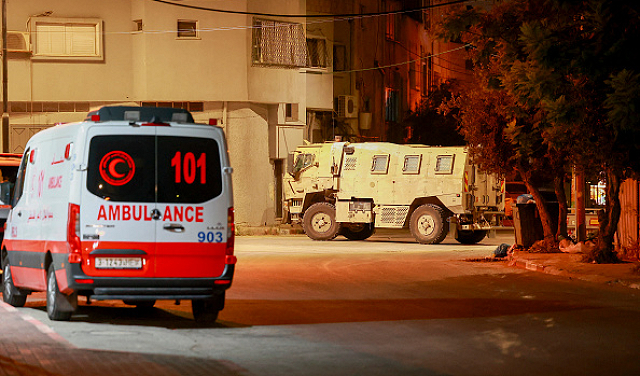
Zionist enemy forces carried out a wide campaign of incursions and raids on Palestinian homes across various areas of the West Bank and occupied al-Quds at dawn and on Thursday morning, resulting in the arrest of a number of Palestinians and the subjecting of dozens to field interrogations that lasted for hours.
In Nablus, groups of settlers, under heavy protection from Zionist enemy forces, carried out a large-scale incursion into the site of Yossef’s Tomb, as the forces imposed a military cordon on the eastern neighborhoods of the city for several hours.
Zionist enemy forces evacuated nearby homes and residential buildings and converted them into military barracks, taking over rooftops and deploying snipers on them. The forces also prevented journalists and medical crews from being present in the area.
The Captives’ Club reported the arrest of the two young men Huthaifa Al-Saeed and Qais Al-Basha, from the town of Qabatiya south of Jenin, while the young man Ahmed Saeb Issa was arrested after his home was raided in the town of Kafr Thulth east of Qalqilya.
A Palestinian young man was also injured after being run over by a military vehicle in Balata refugee camp, east of Nablus.
The incursions extended to several cities and towns, including Beit-lehem, Silwan in al-Quds, Beita south of Nablus, Attil and Deir al-Ghusun north of Tulkarm, al-Khalil, al-Jalazone north of Ramallah, Azzun and Kafr Thulth east of Qalqilya, Jenin, Tubas, and Dar Salah east of Beit-lehem. During these raids, forces stormed homes, detained young men, and fired stun grenades and illumination flares.
By morning hours, Zionist enemy forces withdrew from the eastern area of Nablus following the end of the settlers’ incursion into Yossef’s Tomb and pulled their vehicles back toward military checkpoints, particularly the Huwwara checkpoint.
In this context, Zionist media reported that the Zionist enemy allowed, for the first time in 25 years, the holding of a Jewish morning prayer at the Yossef’s Tomb site. The Zionist “security” establishment said this step came after a “security assessment,” noting that no exceptional incidents were recorded.