
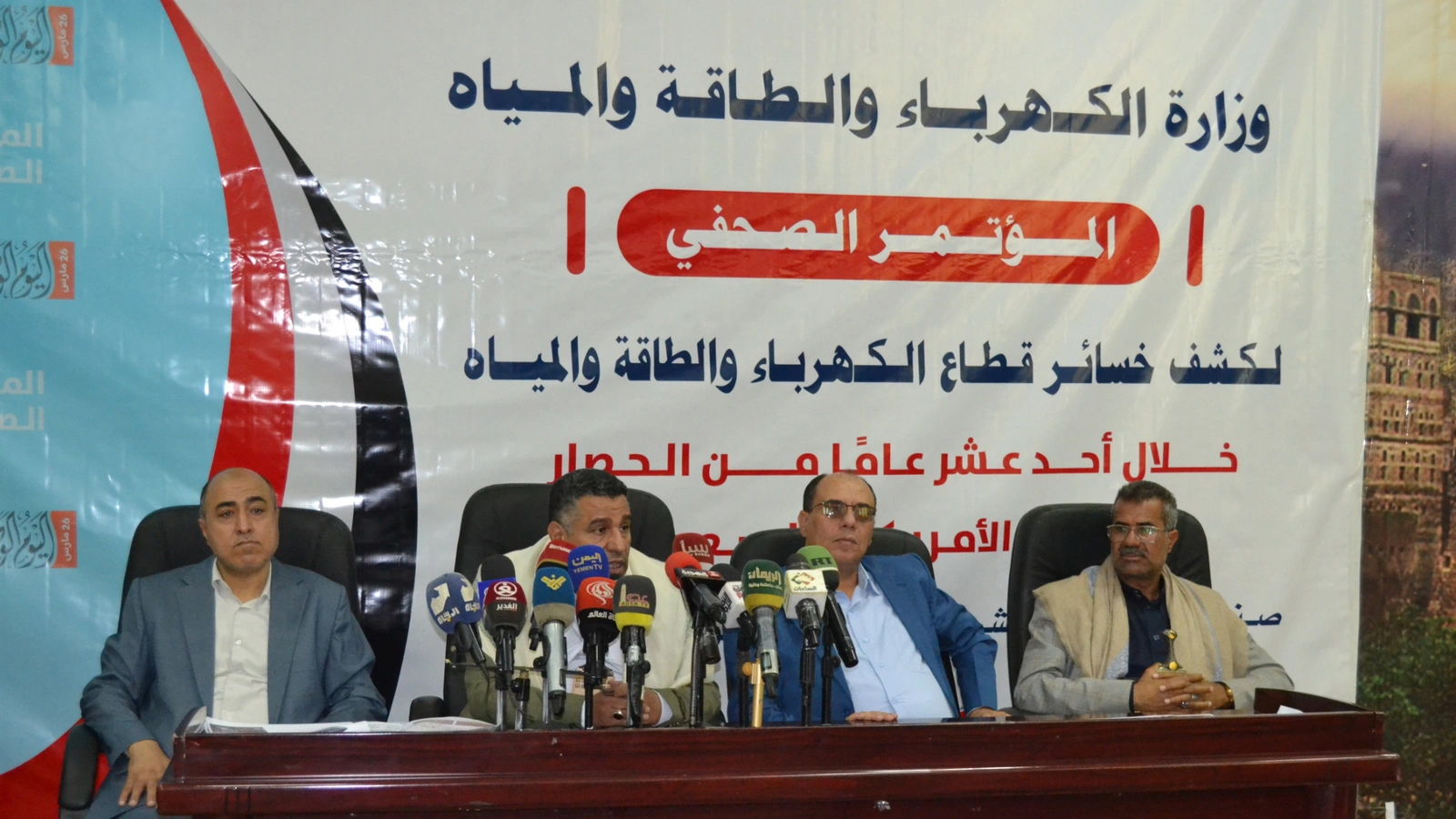
The Ministry of Electricity, Energy and Water in Sana’a held a press conference on Sunday to mark the National Day of Resilience, highlighting the scale of losses and damage inflicted on the electricity and water sectors as a result of the U.S., Israeli, Saudi and Emirati aggression from 2015 to 2026.
During the briefing, Deputy Minister of Electricity, Energy and Water, Adel Bader, revealed that total losses sustained by the two sectors over 11 years had reached 15.094 trillion Yemeni rials—approximately $28 billion.
He stated that the electricity and energy sector alone incurred losses of 14.620 trillion rials due to the destruction or damage of 5,600 facilities and electrical assets. Meanwhile, the water and sanitation sector suffered losses amounting to 428.5 billion rials following the destruction or impairment of 12,400 water-related facilities and installations.
Bader praised the steadfastness of the Yemeni people throughout more than a decade of war and blockade, saying they had thwarted attempts by the aggressor states and their proxies to turn Yemen into a subordinate state under U.S. and Israeli influence. He added that this resilience had transformed external threats into opportunities for success and victory.
He further noted that, over the course of the aggression, Yemen—“by the grace of Allah,” alongside what he described as the wisdom of its revolutionary and political leadership and the resilience of its people—had developed its military capabilities, including drone and missile technologies that have reached deep into the Israeli entity in occupied Palestinian territories.
The deputy minister asserted that Yemen, through the “legendary resilience” in the face of one of the fiercest U.S.-, Saudi- and Emirati-led offensives—followed by U.S. and Israeli escalation and Yemen’s support for Gaza and the Palestinian resistance—has emerged as a significant regional and international actor.
He also drew parallels between Yemen’s experience and what he said is ongoing U.S.-Israeli aggression against the Islamic Republic of Iran, targeting infrastructure. He noted that Yemen had faced similar attacks over 11 years, during which, he said, all aspects of life were targeted, including infrastructure, civilian assets, industrial facilities and the broader economy.
For his part, Deputy Minister of Information Dr. Omar Al-Bukhaiti highlighted the prominent role played by media institutions in exposing the scale of the war and blockade on Yemen over the past 11 years.
He commended the leadership and staff of the Ministry of Electricity, Energy and Water for maintaining and improving services despite the circumstances, citing their accumulated expertise as a key factor in sustaining electricity and water provision.
Al-Bukhaiti stressed that the importance of the conference lies in its timing, coinciding with the National Day of Resilience and the ongoing confrontation—both military and civilian—with the U.S.-Saudi-Emirati coalition, which, he said, had sought to cripple the electricity and water sectors.
“The enemy continues to bet on destabilizing the internal front and obstructing essential public services, including electricity and water, which are vital to sustaining development and serving society,” he said.
He added that the 11th anniversary of the National Day of Resilience comes amid significant developments, emphasizing that Yemen—under the wise leadership and the steadfastness of its people—has become a force that cannot be ignored.
Al-Bukhaiti further stated that Yemen had faced the most powerful military alliance led by the United States, Israel, Saudi Arabia and the UAE, along with “agents and mercenaries,” pointing to what he described as major achievements in building strategic deterrence capabilities. He cited, among recent developments, the arrest of a cell allegedly affiliated with Israel’s Mossad.
He emphasized that the integration of military, security, political, civilian, social and cultural fronts had thwarted adversaries’ plans, adding that the Ministry of Electricity had proven capable of restoring power despite the shutdown of generation plants due to what he described as direct Israeli attacks.
Following this, Eng. Ahmed Al-Mutawakel, Undersecretary for the Electricity Sector at the Ministry, presented a comprehensive statistical report—prepared by the Ministry’s Director General of Systems and Information, Zaki Al-Maamari—detailing the damage inflicted on the electricity, energy, water and sanitation sectors over the past 11 years.
According to the report, total losses reached 15.049 trillion rials (approximately $28 billion).
Al-Mutawakel stated that losses in the electricity and energy sector amounted to 14.620 trillion rials (around $27.328 billion), resulting from damage to 5,600 facilities and electrical assets.
He noted that direct losses in the sector totaled 4.801 trillion rials, while indirect losses reached 9.818 trillion rials.
Regarding the water and sanitation sector, he said losses amounted to 428.513 billion rials (approximately $800 million), due to damage to 12,400 facilities and water-related infrastructure.
Direct losses in this sector were estimated at 100.539 billion rials, while indirect losses totaled 327.974 billion rials.
Al-Mutawakel also reported human losses, stating that 134 personnel were killed as a result of the conflict—86 in the electricity sector and 48 in water and sanitation.
He added that since 2015, around 489 direct airstrikes have targeted electricity and water facilities. The presentation included visual documentation of damaged infrastructure, including power plants, desalination facilities, sewage networks and water pumping stations.
The press conference was attended by officials including the head of the General Corporation for Electrical Industries, Abdulghani Al-Madani; Assistant Undersecretary for the Water Sector Eng.
Abdul Salam Al-Hakimi; representatives of rural water projects and water resources authorities; the Executive Director of the Rural Electrification Authority; the Director of the Local Water and Sanitation Corporation in the capital; as well as a number of journalists and correspondents from local, regional and international media outlets.


