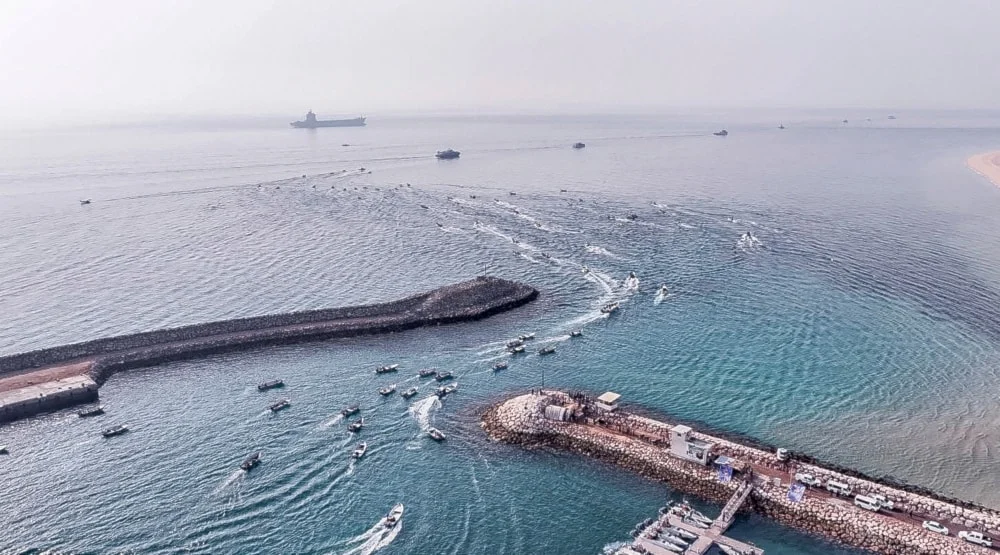
Security in the Gulf and the Sea of Oman will be enforced on a reciprocal basis, following the United States’ announcement of a naval blockade targeting Iran, the spokesperson for the Khatam al-Anbiya Central Headquarters, Lieutenant Colonel Ebrahim Zolfaghari, stated.
Zolfaghari said Iran considers the defense of its territorial waters a “natural and lawful duty," stressing that the presence of foreign-aligned vessels in key maritime corridors will not be permitted.
“The Armed Forces of the Islamic Republic of Iran explicitly and decisively declare that the security of ports in the Persian Gulf and the Sea of Oman is either for everyone or for no one,” the spokesperson said, warning that any threat to Iranian maritime security would result in broader regional consequences.
Hormuz passage and maritime control
The statement reaffirmed Tehran’s position that it will continue to regulate passage through the Strait of Hormuz under a “permanent regime” implemented by its armed forces. It also stated that vessels affiliated with adversaries “do not have and will not have the right to pass” through the strategic waterway, while other ships would be allowed transit under Iranian regulations.
Iran emphasized that US restrictions on maritime navigation are “illegal” and an act of “maritime piracy”.
“If the security of the ports of the Islamic Republic of Iran in the waters of the Persian Gulf and the Sea of Oman is threatened, no port in the Persian Gulf and the Sea of Oman will be safe,” Zolfaghari emphasized.
The US move comes after US President Donald Trump announced measures to interdict vessels entering or leaving Iranian ports following 21 hours of inconclusive talks between US and Iranian officials in Pakistan.
Escalating US-Iran tensions
The blockade, set to take effect Monday, is expected to involve US naval forces intercepting and potentially seizing vessels linked to Iranian maritime activity or vessels transiting the Strait in accordance with Iranian regulations. According to US Central Command, the measure would be enforced against vessels of all nationalities, while maintaining freedom of navigation for ships transiting to non-Iranian ports through the Strait of Hormuz.
The announcement follows a breakdown in negotiations, despite Washington signalling that its proposal remained a “final and best offer," according to US Vice President JD Vance.
Trump expressed confidence that a deal could still be reached, while reiterating Washington’s core demand that Tehran abandon its nuclear program entirely. Trump has consistently framed Iran’s uranium enrichment activities, permitted under its obligations as a signatory to the Treaty on the Non-Proliferation of Nuclear Weapons (NPT), as indicative of a pursuit of nuclear weapons, despite Iran's repeated assurances otherwise, insisting on a zero-enrichment policy as a guarantee that Iran would not acquire such capabilities in the future.
Global energy and market impact
The escalation has already rattled global energy markets, with crude prices surging on fears of supply disruption through the Gulf. Asian equities also fell across major indices amid concerns that prolonged instability could affect energy imports and trade flows.
Analysts warn that any sustained disruption in the Strait of Hormuz, through which a significant share of global oil shipments pass, could deepen volatility in already strained energy markets, particularly for Asian economies heavily dependent on Gulf supplies.
Source:Websites


