The latest American–Israeli aggression against Iran is beginning to reveal its true contours—objectives that stretch well beyond immediate security pretexts to target the very core of the global economy and the sovereignty of regional states.
As Washington applies pressure behind closed negotiating doors—via its Pakistani intermediary—to impose crippling conditions that verge on the total dismantlement of Iran’s nuclear program, a complete halt to enrichment, and the stripping away of its medium-range missile capabilities, statements by U.S. President Trump lay bare the deeper logic driving these demands.
Trump’s incendiary remarks about the U.S. Navy’s ability to seal off the Strait of Hormuz and forcibly redirect global shipping toward purchasing American oil, rather than that of the region, reinforce—observers argue—that the quest for absolute dominance over the global energy market remains a central objective of Washington’s strategy, even if it comes at the direct expense of its Gulf allies, whose security appears increasingly exposed to the risks of this American gamble.
The Doctrine of Sanctions: From Weapons Denial to Strangling a Model
Washington’s relentless push to constrain Iran’s nuclear program cannot be understood in isolation from its broader drive to crush any attempt at building an independent development model in the region.
The nuclear file—despite the technical and military dimensions invoked by Washington and rejected by Tehran—has, at its core, served as little more than a pretext for imposing successive waves of suffocating economic sanctions, designed over decades to subdue political will before military capability.
At the heart of U.S. strategy lies a carefully crafted narrative: that prosperity and progress are privileges dispensed by America only to those who orbit within its sphere, and that stepping outside this orbit inevitably leads to collapse and deprivation.
Against this backdrop, Iran’s resilience—its endurance, growth, and advancement over four decades of siege—has evolved into a profound propaganda dilemma for Washington.
Iran’s strides in nanotechnology, space science, nuclear medicine, and sovereign military capability, achieved through domestic effort, dismantle the myth of dependency as a prerequisite for progress.
The Failure to Halt Development and the Collapse of Sanctions
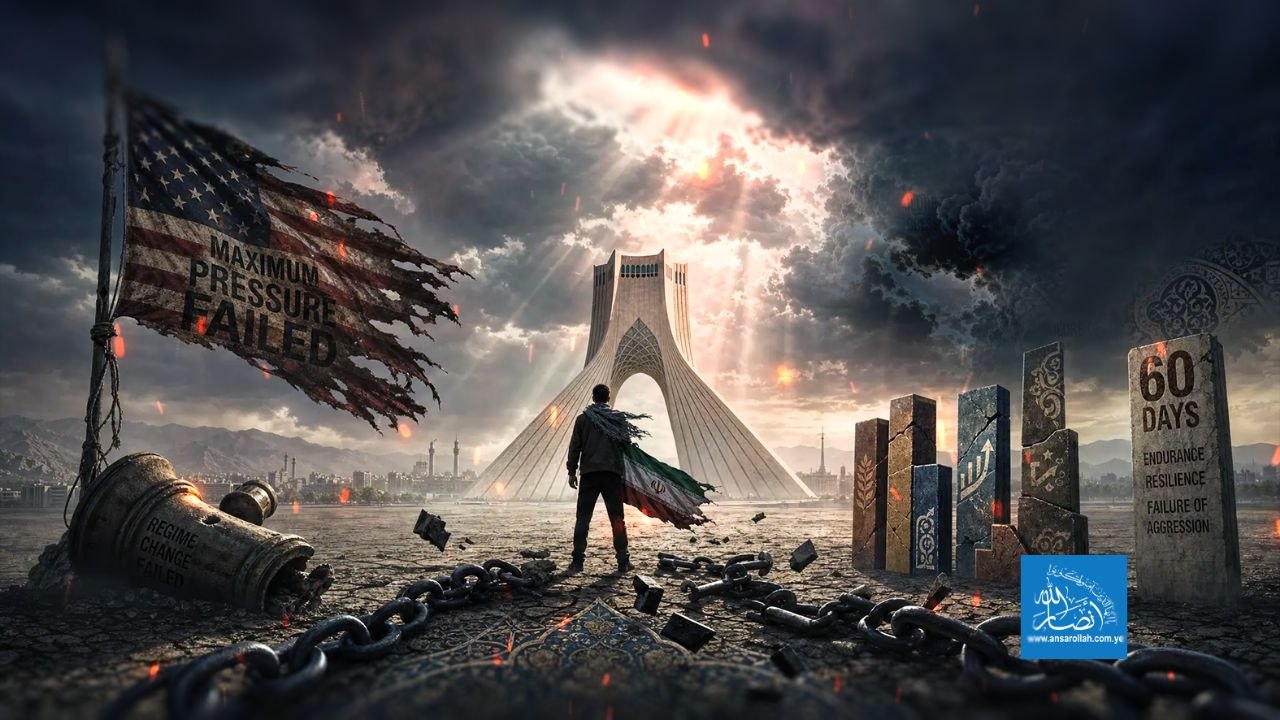
When Washington found itself incapable of stopping the momentum of Iran’s development despite maximum pressure, it became clear that the “threat of the model” had already materialized.
This model—shaped by independent, committed, and ideologically driven Iranian minds—has sent a stark message across the region: self-reliance and technological localization are achievable beyond the mantle of American tutelage.
Determined to prevent that message from taking root, Washington has escalated its efforts to dismantle this success through military aggression after sanctions failed to break it—fearing that such resilience could inspire broader geopolitical shifts that challenge the monopoly of a unipolar order over the levers of power and development in West Asia.
This is why American–Israeli strikes have focused less on fortified military capabilities buried deep underground and more on infrastructure, factories, research laboratories, and scientific libraries.
Based on economic indicators and documented reports from 2025 and 2026, Iran’s self-sufficiency strategy stands as a cornerstone of what it terms the “resistance economy,” with several sectors reaching notably advanced stages.
By the end of 2025, Iran had achieved an overall agricultural self-sufficiency rate of approximately 87 percent. It has reached sustainable self-sufficiency in bread wheat production, with recent harvests covering domestic demand, while limited imports are used to bolster strategic reserves or for pasta production.
At the same time, Iran ranks among the world’s top ten producers of more than 15 types of fruit—including pomegranates, pistachios, dates, and apples—achieving full self-sufficiency with a surplus for export.
Self-sufficiency in meat and poultry stands at around 90 percent, with government plans targeting full (100 percent) self-reliance within the next two years through the development of more productive livestock breeds and the localization of feed production.
In recent years, leveraging its abundant natural gas reserves, Iran has produced large quantities of urea and ammonia sufficient to meet domestic agricultural needs, while exporting the surplus.
In the pharmaceutical sector, Iran manufactures more than 97 percent of its domestic drug needs locally, including treatments for chronic and critical illnesses such as cancer, as well as antibiotics.
Production of raw materials used in pharmaceuticals and health products has surpassed 70 percent, significantly reducing reliance on foreign currency.
In construction and building materials, Iran holds advanced global rankings in steel and cement production, achieving full self-sufficiency to meet the demands of infrastructure projects and urban expansion.
Experts argue that this expansion in self-sufficiency is precisely what has rendered the “maximum pressure” policy ineffective in triggering the economic collapse Washington has long pursued.
Across successive Republican and Democratic administrations since the 1979 revolution, Iran’s economy has gradually shifted from a rentier, import-dependent structure to a more diversified, production-oriented model.
The Nuclear Paradox: History Refutes Washington
In 1967, under the banner of “Atoms for Peace,” the United States acted as the legal midwife of Iran’s nuclear program, supplying the Tehran Research Reactor with highly enriched uranium fuel reaching levels of 93 percent.
At the time, high-level enrichment posed no threat to global security in Washington’s calculus—because the Iranian “Shahanshahi” regime functioned as the West’s loyal “policeman of the Gulf” and a steadfast ally of Israel.
Today, the equation has been entirely reversed. Washington now mobilizes its full diplomatic and economic weight to impose an absolute ban on any indigenous enrichment activities in Iran, offering instead to supply low-enriched fuel for medical and research purposes from external sources.
This shift reflects less a genuine commitment to nuclear non-proliferation than a calculated effort to strip a defiant state of the instruments of power—one that has refused to orbit within the American and Zionist sphere.
Gulf Security as an American Gambling Chip
The contradictions do not stop at the nuclear file; they extend into the very engineering of the regional missile balance. U.S. policy is attempting to impose restrictions that would confine Iran’s missile arsenal strictly to short-range capabilities.
Here, the harsh truth for Gulf states becomes impossible to ignore: these limitations are designed to protect the Israeli strategic depth, while deliberately leaving the Gulf within the operational reach of those same missiles.
It must be reiterated that Iran has consistently declared its missile program to be purely defensive in nature and not directed against any of its neighboring countries.
This American strategy can only be described as an outright and reckless gamble with the security of the Gulf states. Washington is not pursuing stability; it is engineering a controlled state of tension in which threats are kept alive just enough to sustain massive arms deals and preserve dependence on the American security umbrella—while ensuring, at all costs, that no element of this equation touches the security of its primary strategic ally, the Israeli entity.
The Energy War and the Struggle for Global Influence
In another dimension no less significant, Washington is working to undermine the independence of the Gulf’s energy sector through attempts to assert dominance over the global energy market.
The United States seeks to kill two birds with one stone: tightening its grip on international rivals by controlling energy supplies—thereby strangling the Russian and Chinese economies, and even extending economic pressure onto Europe itself, which has increasingly come under American economic discipline.
Analysts argue that Washington may even resort to manipulating energy prices as a tool of pressure and political punishment against the European continent, in response to what it perceives as Europe’s “obstinacy” over the Greenland strategic file, as well as what it views as insufficient European participation in supporting the aggression against Iran.
This project, at its core, cannot succeed without weakening the Gulf states’ ability to export oil. This explains the American drive to push the region toward the edge of escalation, where any disruption—particularly the closure of the Strait of Hormuz and its militarized control—would effectively sever the Gulf’s export lifeline and reduce regional oil flows by more than half.
This deliberate paralysis of regional supply chains is designed, fundamentally—especially in the wake of tightening control over Venezuela’s energy points—to transform energy into an exclusive American weapon, used to sustain unipolar dominance and subject both adversaries and allies alike to Washington’s coercive will by forcing global dependence on alternative sources firmly under its control.
Conclusion
In sum, what the region is witnessing today goes far beyond a dispute over uranium enrichment or missile ranges. It has escalated into a struggle of wills between two competing projects: one seeking to entrench a permanent unipolar order under Washington’s dominance and to turn the region into an exclusive sphere of Zionist influence; the other resisting this corrosive project by proving that sovereignty is not granted but taken, and that genuine development is not bestowed by America, but emerges from within and is fortified by self-sufficiency.
With sanctions failing to break the Iranian model, and Washington shifting toward direct military aggression against scientific and civilian infrastructure, it becomes increasingly evident that the greatest threat to American interests is not a nuclear weapon Iran does not even seek to possess, but an independent will and an enlightened mind capable of shattering the myth of dependency.