
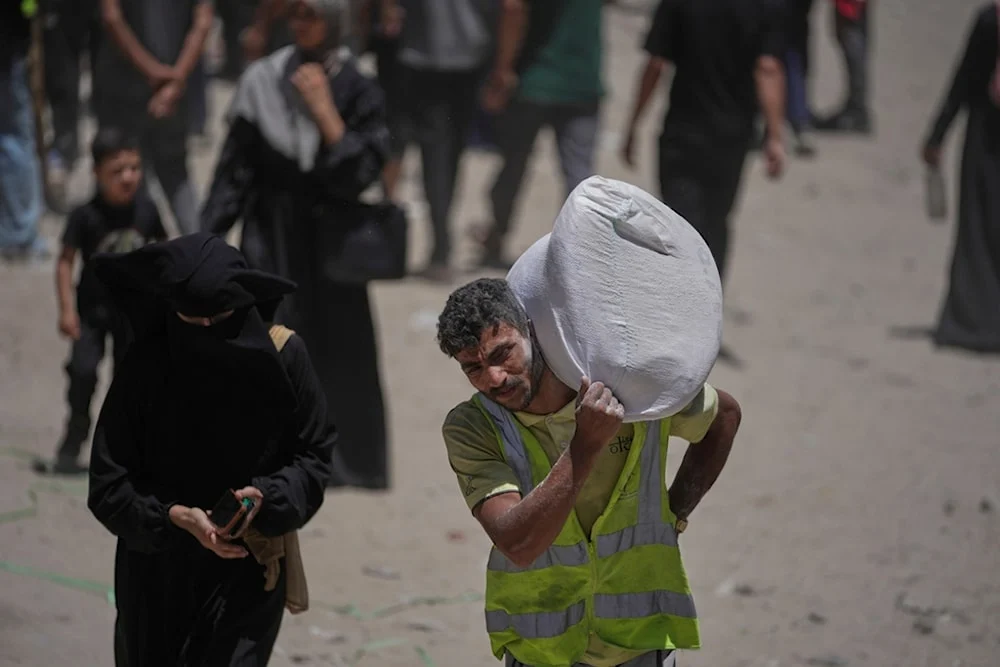
The World Food Programme (WFP) has warned that the ongoing US war on Iran is intensifying food insecurity across some of the world's most vulnerable regions, as rising fuel prices, disrupted supply chains, and shrinking humanitarian funding place millions at greater risk of hunger.
Speaking to CNN, WFP Acting Executive Director Carl Skau said the conflict's consequences are already being felt far beyond West Asia, with communities in Africa and Asia facing mounting pressure from escalating food and transportation costs.
According to Skau, the closure of the Strait of Hormuz has sharply increased fuel prices, significantly raising the cost of humanitarian operations while simultaneously driving up global food prices. The disruption has also affected fertilizer shipments from Gulf countries, threatening agricultural production in countries already struggling with food shortages.
"In many places, we're already taking from the hungry to give to the starving," Skau said, describing the increasingly difficult decisions facing aid agencies.
The Strait of Hormuz was initially closed by Iran following unprecedented US-Israeli attacks in late February as a means of economic retaliation by Iran against the aggression and the regional countries supporting it. Following the announcement of a ceasefire in April, Washington imposed its own blockade, further increasing the crisis.
Rising costs threaten food access across multiple regions
The WFP warned earlier this year that tens of millions of additional people could face acute hunger if oil prices remain elevated. Those concerns are now beginning to materialize, according to the organization.
Skau pointed CNN to countries including Somalia, Afghanistan, and Sri Lanka, where higher transportation and commodity costs are placing additional strain on populations already facing economic hardship.
In poorer countries, food inflation often translates directly into reduced consumption, he explained.
"When the price of food goes up 20-30%, well, they eat 20-30% less," Skau told CNN.
The agency estimates that 45 million more people could face acute food insecurity if energy prices remain at current levels, underscoring the global reach of the conflict's economic consequences.
Even if shipping through the Strait of Hormuz resumes immediately, Skau warned that recovery would take time as supply chains and markets gradually stabilize.
Funding cuts compound humanitarian challenges
The worsening food crisis is unfolding as the WFP confronts one of the most severe funding shortfalls in its recent history.
The organization, which depends primarily on voluntary government contributions, reported a sharp decline in donor support. Contributions from the United States, traditionally the agency's largest donor, have fallen significantly compared to previous years.
Skau told CNN that overall funding declined by approximately 40% last year, limiting the organization's ability to respond to growing humanitarian needs.
Unlike previous global emergencies, including the COVID-19 pandemic and the Ukraine war, the current crisis has not generated a corresponding increase in international aid contributions.
As a result, aid workers are increasingly forced to prioritize assistance for only the most severe cases.
Humanitarian needs continue to grow
The funding squeeze comes as humanitarian crises deepen across multiple regions.
In Sudan, millions face severe food insecurity amid ongoing conflict and displacement. In Afghanistan, aid agencies are struggling to determine which vulnerable families can continue receiving support as resources shrink.
Skau described to CNN the difficult discussions among field teams attempting to decide which households qualify for assistance when funding is insufficient to reach everyone in need.
He cited examples of aid workers weighing whether support should be limited only to women-led households with larger numbers of children, despite knowing that families excluded from assistance remain highly vulnerable.
Meanwhile, operations in places such as South Sudan have become increasingly expensive as humanitarian agencies rely on air transport to reach famine-threatened communities cut off by conflict and poor infrastructure.
Those costs have risen sharply alongside fuel prices, forcing agencies to balance emergency interventions in one area against growing needs elsewhere.
Source:Websites