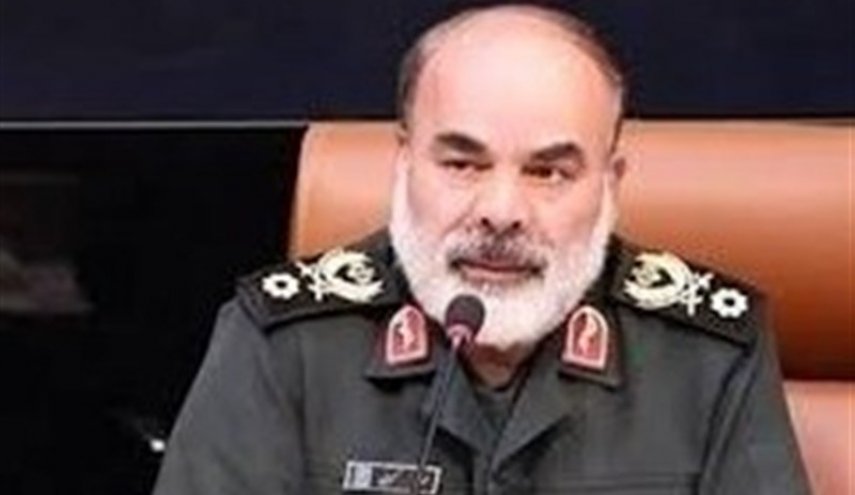
The Commander of the Islamic Revolutionary Guard Corps (IRGC) Ground Forces, Brigadier General Mohammad Karami, has confirmed that the Iranian Armed Forces have redesigned their defensive plans following recent confrontations. He emphasized the continuous enhancement of military and security capabilities to counter American and Israeli threats.
In an interview with state television, Karami stated that the martyred Leader of the Revolution had always emphasized the necessity of moving toward building a strong Iran. He explained that the defense and security sectors were among the primary areas receiving special attention, particularly regarding modern technologies and future warfare.
The IRGC Ground Forces commander added that the Iranian Armed Forces—including the Army, the IRGC, and the police forces—have operated under a strategic vision centered on developing scientific and technological capabilities and maintaining readiness for an immediate response to any threat. He noted that "the results of these preparations became evident during the recent war."
Karami pointed out that restructuring military plans after the 12-day war has enhanced the Armed Forces' ability to handle developments on the ground. He added that the Iranian response came just hours after the targeting of military leaders, which he described as a direct outcome of advance planning and operational readiness.
General Karami praised the leadership capabilities of the martyred Lieutenant General Mohammad Pakpour, stating that he possessed "exceptional capabilities in operational design and battlefield vision." He noted that Pakpour worked around the clock to develop military plans and training, including conducting maneuvers, war simulations, and advancing missile and drone capabilities.
Furthermore, Karami highlighted that Pakpour played a pivotal role in establishing "sustainable security" in northwestern and southeastern Iran, noting that the efforts exerted in those regions significantly contributed to security stability.
Addressing border threats, Karami stated that the United States has provided support and equipment to armed opposition groups with the objective of executing operations in border areas. However, he emphasized that the Iranian Armed Forces, the IRGC, and the Basij mobilization forces successfully thwarted these plots through preemptive measures.
"The enemy's designs were based on executing operations synchronized with the American operations," Karami said, confirming that Iranian forces took action before those entities could carry out their plans.
The IRGC commander also touched upon the role of local populations during the confrontations, stating that citizens in the affected areas provided extensive support to the Armed Forces and placed their homes and resources at the disposal of the military, which he considered "a major factor in boosting morale."
He added that "the unity and harmony among the people, the government, and the Armed Forces" was a key reason for the failure of adversaries' plans. He called for maintaining this cohesion in the face of the hybrid war targeting Iran across economic, cultural, and social domains.
Karami affirmed that the IRGC continues to raise its level of readiness in light of the ongoing "American hostility that has persisted for 47 years," stressing the importance of combining monotheistic faith with technical capabilities and military innovation.
"Today, the enemy is attempting to achieve through the tools of hybrid warfare what it failed to accomplish militarily," Karami said, accusing the adversary of seeking to incite internal divisions and create economic, social, and cultural problems.
The IRGC Ground Forces commander concluded by reaffirming his country's commitment to developing its defensive capabilities, declaring that Iranian forces "will continue to stand until the end and will not fear any threat," adding that "reliance on Allah provides the strength to confront adversaries."