Iran's Khatam al-Anbiya Central Headquarters asserted on Monday that Iran will never permit the United States to interfere in the management of the Strait of Hormuz, emphasizing that American adventurous attempts to intervene in its administration have seriously endangered regional security, international trade, and the transit of oil tankers.
In an official statement, the Khatam al-Anbiya Headquarters explained that cooperation by some countries in the region has also increased the risk of the conflict spreading across the entire region. It stressed that the responsibility for the manifestations of instability and the expansion of the war lies with the United States and the countries cooperating with the military of that criminal nation.
The headquarters issued a direct warning to the leaders of regional countries, stating:
"We warn the leaders of regional countries that any cooperation with America and support for 'Israel' is considered a war against Iran's sovereignty and its national security."
This statement followed claims made on Monday by U.S. President Donald Trump, who alleged that there had been an agreement between his country and Iran which Tehran "breached." Trump stated that the United States "will guard and control the Strait of Hormuz," adding in his remarks that the U.S. would take over guarding the Strait of Hormuz and impose financial fees in exchange for securing the waterway.
On the same day, the spokesperson for the Iranian Ministry of Foreign Affairs and member of the negotiating delegation, Esmaeil Baghaei, confirmed during his weekly press conference that the United States had breached the memorandum of understanding with Iran. Baghaei stressed that within a short period, the United States had violated various parts of the 14 clauses of the memorandum of understanding.
Baghaei maintained that the United States did not stop at breaching the memorandum of understanding, but also endangered maritime security and caused an escalation of tensions in the region.
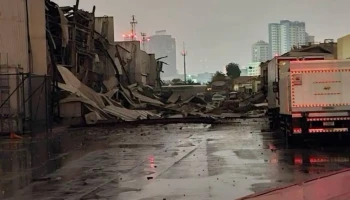
Over the past two days, American strikes have targeted sites in Bandar Abbas, Bushehr, Sirik, Qeshm, Jask, Konarak, and Chabahar. The attacks targeted air defense and coastal surveillance systems, missile and drone sites, naval and port facilities, as well as civilian infrastructure, fishing harbors, and areas close to the Bushehr nuclear power plant, though without hitting the plant itself.
In turn, the Iranian side is responding to the continuous American strikes by targeting U.S. bases in the Gulf states, from which the attacks on Iran are launched.