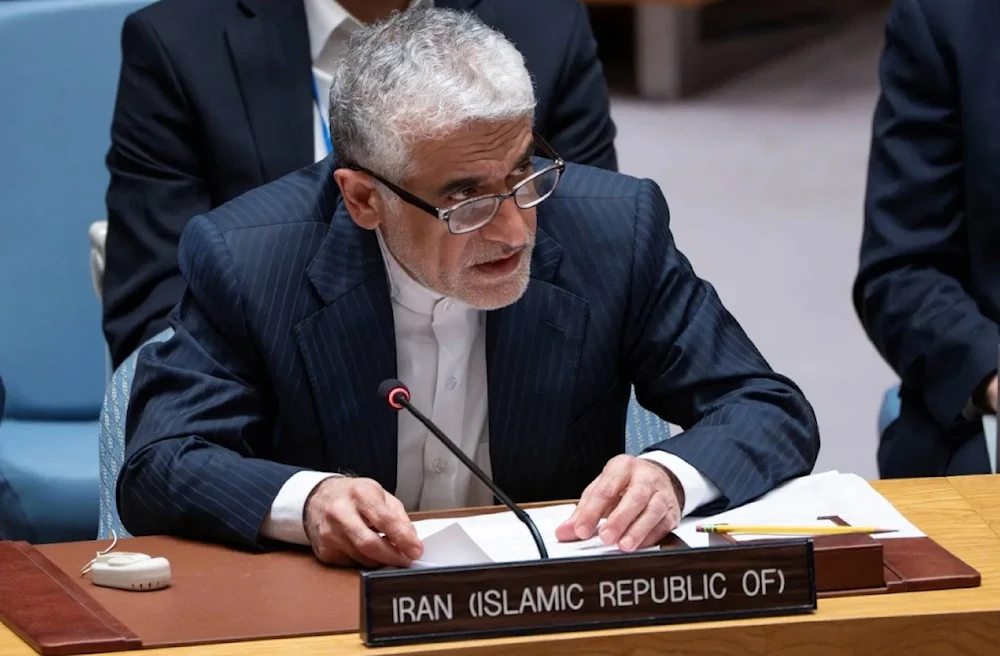
Iran’s Ambassador and Permanent Representative to the United Nations, Amir Saeid Iravani, addressed a letter to the UN Security Council and the Secretary-General following the American aggression on Iran, which targeted civilian infrastructure and resulted in the martyrdom of citizens.
Iravani pointed out Washington's continuation of its crimes against the Iranian people due to the Security Council's inaction, which constitutes a flagrant violation of the UN Charter and international humanitarian law.
Iravani cited statistics from the Iranian Ministry of Health, stating that from the beginning of July until the morning of the 17th of the same month, 43 Iranian citizens were martyred and 400 others were injured. Among the martyrs are 3 women and a child, in addition to injuries sustained by 22 women and 9 children, with 47 of the wounded remaining in hospitals in critical condition.
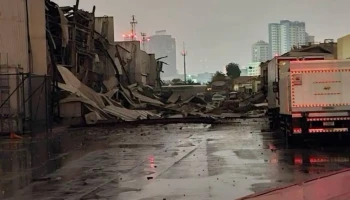
Iravani stated that the American aggression carried out between the night of July 16 and the dawn of July 17 targeted sites in Hormozgan Province, resulting in a number of civilian casualties as well as the systematic destruction of civilian infrastructure through the demolition of major bridges.
He drew attention to another crime committed by the United States: following the destruction of one of the bridges, a civilian vehicle plunged from the damaged structure, resulting in the martyrdom of 7 civilians and the injury of 9 others. Furthermore, an assault on a neighborhood in Bandar Abbas resulted in the martyrdom of one civilian and the injury of 8 others, parallel to explosions occurring in the vicinity of Masan village on Qeshm Island, alongside shells falling on areas in Bandar Lengeh and Sirik.
Continuing its assaults, American forces directly targeted civilian railway infrastructure, according to Iravani, attacking the Bandar Abbas railway station. This station serves as a major terminal in southern Iran connecting it to the Shahid Rajaee port, and constitutes a vital hub on the International North-South Transport Corridor.
According to local authorities, the attacks resulted in the destruction of civilian facilities, including the Gheriveh bridge, a bridge past Latidan village, two bridges on the Kahurestan–Lar road, a bridge under construction on the Bandar Khamir–Kashar–Bandar Abbas road, as well as a bridge in Maru village in Bandar Khamir.
Consequently, Iravani reiterated that attacking vital infrastructure is a blatant violation of international humanitarian law, as it has disrupted commercial activities, civilian livelihoods, and relief operations.
Accordingly, Iravani conveyed the Islamic Republic's condemnation of the ongoing and escalating American aggression against Iran and its deliberate targeting of civilian infrastructure. He emphasized that this is a flagrant violation of Paragraph 4 of Article 2 of the UN Charter, the fundamental principles of sovereignty and territorial integrity, and the prohibition of the threat or use of force.
Iravani stressed that the repeated targeting of civilian property and sites, particularly vital transportation and railway networks, constitutes a war crime. He affirmed that the United States of America bears full international responsibility for the loss of lives, injuries, infrastructure destruction, environmental damage, and all consequences arising from its internationally unlawful acts.
Therefore, Iravani stated that the government of the Islamic Republic affirms that the continuation of the attacks poses a serious and direct threat to international peace and security, freedom of navigation, regional stability, and the security of the Gulf and the Strait of Hormuz.
In light of the above, Iravani highlighted Iran's call for the Security Council to fulfill its primary responsibility to maintain international peace and security in accordance with the Charter, and to take immediate and effective measures to halt the American aggression and ensure that the United States is held accountable for all the gross violations it commits.
He concluded by emphasizing that the continued absence of any effective action by the United Nations and the Security Council legitimizes the Islamic Republic retaining its inherent right under international law to take all necessary measures to protect its sovereignty, territorial integrity, people, and vital national interests.