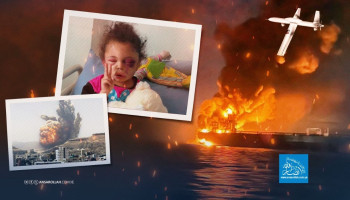

Yemen's Ministry of Health and Environment has condemned the Saudi aggression's targeting of civilian infrastructure, including Hodeidah port and Kamaran Island, which resulted in the injury of a telecommunications worker in Hodeidah and a woman on Kamaran Island.
In an official statement issued Saturday, the ministry considered this crime "an extension of the systematic aggression of the Saudi enemy against vital and service infrastructure that directly affects the basic rights of citizens," adding that it constitutes "a flagrant violation of all international and humanitarian norms, and a clear violation of international humanitarian law."
'Blatant Disregard for Human Life'
The statement noted that "the continuation of these brutal attacks on civilians and infrastructure—foremost among them service facilities—affirms the aggression forces' persistence in their criminal approach, and their complete disregard for the sanctity of lives and souls guaranteed by all divine laws and international charters."
The ministry highlighted that "this crime represents a dangerous escalation that puts civilians' lives at imminent risk," holding "the Saudi enemy fully responsible for its humanitarian and health consequences."
Call for International Action
The statement called upon the international community, the United Nations, and international health and human rights organizations "to fulfill their moral and legal duty, condemn this crime, and immediately pressure to halt the repeated attacks, and to open a neutral investigation into the grave violations against the Yemeni people."
It also called on all medical and ambulance personnel to "redouble their efforts to save the injured and provide necessary care."
The Saudi strikes on Hodeidah port and Kamaran Island represent a significant escalation in the Saudi aggression and siege against Yemen.
Hodeidah port handles approximately 70% of Yemen's commercial imports and humanitarian aid, making it essential for the population's survival.
The targeting of telecommunications infrastructure, which provides essential connectivity and information services for civilians, constitutes a violation of international humanitarian law, which prohibits attacks on civilian infrastructure.