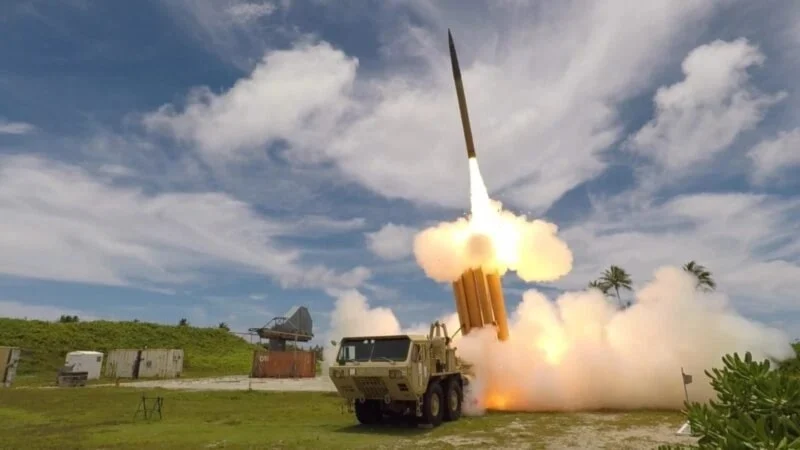
The US Department of War has signed a framework agreement with Lockheed Martin and Northrop Grumman to expand production of components for the Patriot PAC-3 and THAAD interceptor systems, the department said on Monday.
Under the deal, Patriot production is set to triple and THAAD output to quadruple. The department did not disclose a dollar figure, but said the agreement establishes a second manufacturing source for PAC-3 solid rocket motors and increases output of ignition safety devices.
Pentagon officials have been pushing contractors to move faster on production commitments made earlier this year, as the US war on Iran and the war in Ukraine continue to draw down US weapons stocks.
Ukraine, in particular, has faced persistent Patriot shortages; the system remains the only weapon in its arsenal capable of shooting down ballistic missiles.
Part of a broader production push
Monday's agreement is the latest in a series of deals aimed at rebuilding depleted interceptor stocks.
On July 27, the Pentagon signed its first framework agreements with Lockheed Martin targeting a tripling of Patriot PAC-3 propulsion output and a quadrupling of THAAD component production, with Lockheed aiming to raise THAAD output from 96 to 400 units a year. Days later, L3Harris signed a similar agreement covering solid rocket motors and maneuver systems for both platforms.
Northrop Grumman's entry into the program, announced the same day as Monday's deal, is worth a combined $3 billion over seven years, where $2 billion will go to accelerate PAC-3 solid rocket motor production, positioning Northrop as a second supplier alongside L3Harris, and $1 billion to expand THAAD component output.
Stockpiles under strain
The push to expand production follows steep interceptor losses since the US war on Iran began in February.
A Center for Strategic and International Studies assessment published on 27 July estimated that US Patriot stocks, numbering around 2,200 before the war, had fallen by roughly 65 percent, while THAAD inventories, previously around 452, had dropped by about 38 percent.
The report's authors, Mark Cancian and Chris Park, warned that depleted stockpiles could force the US and its partners to accept greater risk in air defense operations, noting there are no adequate substitutes for Patriot and THAAD against ballistic missile threats.
They estimated that rebuilding inventories to prewar levels would take three years or more under current production timelines, raising concerns about US readiness in other potential conflicts.
Monday's framework agreement follows a contract awarded last week by the US Army to Lockheed Martin, worth up to $58.6 billion, to produce Patriot interceptor missiles.
Whether the new agreements meaningfully close the gap between consumption and output remains an open question. Framework agreements of this kind are demand signals meant to encourage contractors to invest in expanded capacity; they are not binding production orders, and deliveries under them will take years to materialize.
Source:Websites