Military and strategic affairs expert Brigadier General Mujeeb Shamsan said the Yemeni Armed Forces have established a clear equation under which every violation of Yemeni airspace by Saudi reconnaissance aircraft will be met with a response that imposes a heavy cost on the Saudi strategic depth. He said the Saudi regime will be forced to reassess its calculations as the price of its intelligence and reconnaissance operations rises.
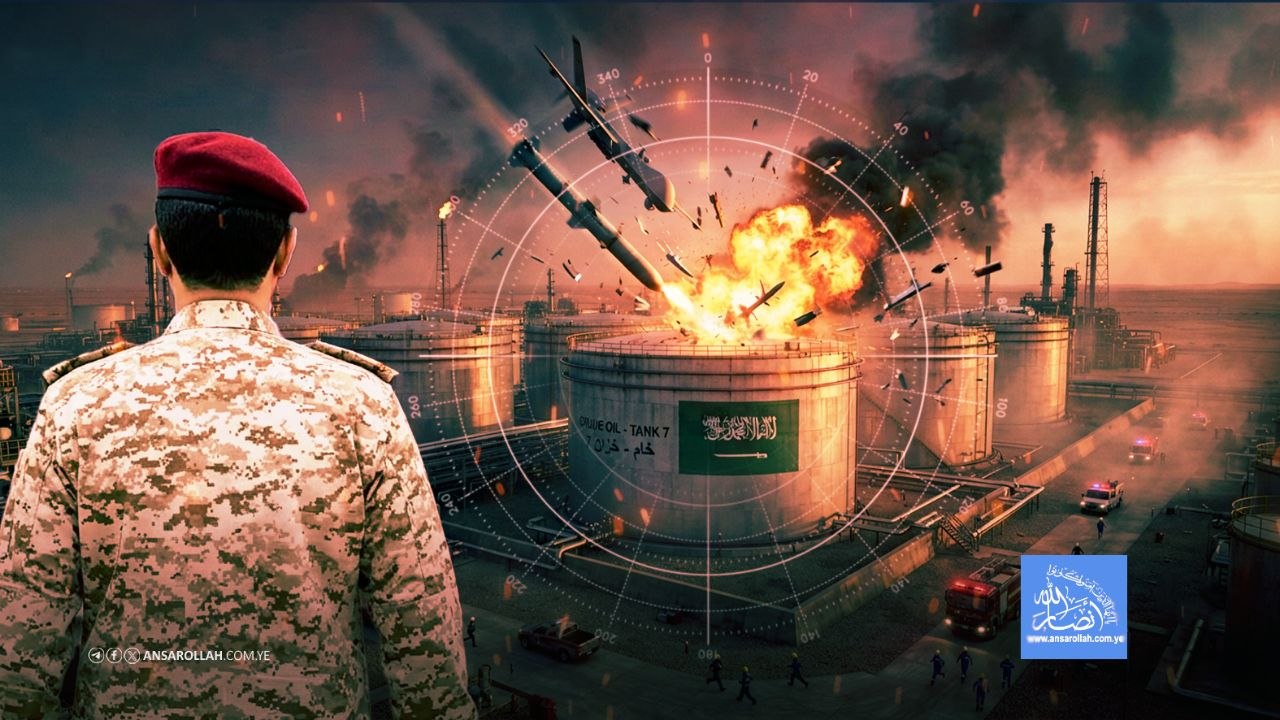
Speaking on Al Masirah TV on Tuesday evening, Shamsan said the targeting of Najran Airport came in response to a Saudi reconnaissance aircraft violating Yemeni airspace, alongside espionage activities over Sa'adah and Hajjah governorates. He recalled that the Yemeni Armed Forces had shot down a Turkish aircraft days earlier while it was carrying out reconnaissance missions on behalf of the Saudi regime, as well as a Wing Loong drone over Al-Baidha Governorate at an earlier stage, an incident followed by the targeting of the East-West oil pipeline.
He added that the downing of a Karayel aircraft over Al-Jawf Governorate, together with the downing of the Wing Loong and the subsequent responses, demonstrates that the cost is no longer limited to destroying reconnaissance platforms but has expanded to include strategic facilities inside Saudi Arabia. This, he said, multiplies the Saudi regime’s losses and confirms that every violation will trigger a greater response.
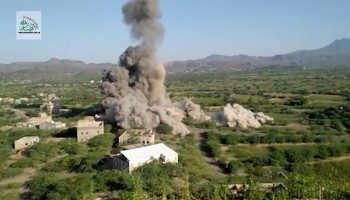
Shamsan said the Saudi enemy is seeking to collect intelligence in preparation for further hostile military operations. The Yemeni response therefore targeted Najran Airport as a major intelligence base housing Wing Loong aircraft and various intelligence platforms, in addition to American and British personnel who participated in managing hostile operations during the years of war and the current round of confrontation. He said the airport had become an advanced intelligence platform because of its geographical proximity to Yemeni territory.
He said Yemeni Air Defenses have demonstrated a high level of effectiveness in preventing aerial incursions, either by shooting down aircraft or preventing them from carrying out their missions. He explained that the response targeting Najran Airport and the East-West pipeline was intended to establish an equation whereby any airspace violation or intelligence operation would incur a far greater cost than in the past.
Shamsan stressed that this equation cannot be separated from other equations established by the Yemeni Armed Forces, foremost among them “blockade-for-blockade” and “escalation-for-escalation,” describing them as a direct response to the continued aggression and blockade imposed on Yemen for nearly 12 years.
He noted that airports and military bases in southern Saudi Arabia have for years been used as forward bases for reconnaissance and hostile operations against Yemen. Wing Loong and Karayel aircraft, among others, have operated from these bases to gather intelligence and conduct reconnaissance missions. During the past two years, he said, they were also used as platforms for managing military operations against Yemen under US and British supervision.
Shamsan described the Saudi regime’s current role as an extension of the US, British, and Israeli enemy’s mission in the aggression against Yemen. He therefore said these military bases have become legitimate targets when used for intelligence and hostile activities, adding that targeting them sends clear messages that Sana'a possesses accurate intelligence and has achieved a high level of operational intelligence that enables it to reach sensitive targets.
He stressed that Yemen’s success in imposing a maritime blockade has undermined the image the Saudi regime sought to cultivate for itself. Riyadh, he said, has been confronted with a new reality imposed by the Yemeni Armed Forces, with vessels linked to Saudi Arabia forced to stay away from its ports or reroute before reaching the Red Sea, while vessels that ignored Yemeni warnings and insisted on proceeding have been targeted.
According to Shamsan, the consequences of the maritime blockade equation extend far beyond what has been reported in the media. They first reflect the scale of capabilities now possessed by the Yemeni Armed Forces, while simultaneously diminishing the image of the Saudi regime, which had presented itself as the region’s foremost power while serving as an instrument of the US, British, and Israeli enemy’s project in the aggression against Yemen.
He said these developments did not emerge in a vacuum. Sana'a did not start from scratch but built its capabilities through two years of operations in support of Palestine, during which it targeted around 228 vessels and engaged directly with Western naval forces. This experience, he said, has rendered any Saudi attempt to form alliances or secure condemnatory statements ineffective against a battlefield reality that Sana'a has imposed through deterrence and accumulated operational experience.
Shamsan said the success of the “blockade-for-blockade” equation reflects the level of development reached by the Yemeni Armed Forces and further diminishes the image the Saudi regime sought to project as the region’s dominant power. He reiterated that Riyadh represented the US, British, and Israeli enemy’s project in its aggression, while Sana'a’s ability to impose a maritime blockade demonstrates its capacity to respond and secure the rights of the Yemeni people.
He said the Saudi regime has been forced to confront a new reality, with vessels moving away from its ports or rerouting before reaching the Red Sea, while those that ignored Yemeni warnings came under attack. This equation, he stressed, was not built from scratch but drew on the Yemeni Armed Forces’ two-year experience supporting Gaza, during which they confronted Western fleets and imposed a blockade that led to the closure and bankruptcy of the port of Umm Al-Rashrash. Any Saudi efforts to solicit condemnations or form new alliances, he argued, have lost their effectiveness in the face of this reality.
The Yemeni Armed Forces, Shamsan continued, have made qualitative advances in their military and intelligence capabilities compared with previous stages, including in drones, missiles, and combat tactics. He stressed that accurate intelligence has become the foundation of successful operations, as demonstrated by the precise targeting of sensitive sites.
He said missile accuracy has reached less than 10 meters, while drones have demonstrated even greater precision. He cited operations targeting the East-West pipeline and Ramon Airport in occupied Palestine despite the long distances involved, layers of air defenses, and jamming attempts.
Shamsan argued that these capabilities enable Sana'a to inflict significant damage on the Saudi regime and steadily increase the cost of confrontation whenever it persists with its intransigence and refuses to meet Yemen’s demands. He described attempts to seek alternatives or break the blockade as a failed option, saying any airspace violation or intelligence activity would be met with stronger responses, as occurred when the East-West pipeline was targeted following the downing of a Wing Loong aircraft.
He asserted that Yemen’s current measures remain part of a graduated escalation process, noting that Sana'a has not yet moved to impose a comprehensive air blockade. He said the strike that disrupted southern Saudi airports for more than 20 days carried a clear message about what could happen if operations were expanded to include airports in Jeddah, Riyadh, or the Eastern Province.
Shamsan recalled that the decision to impose the maritime blockade proved effective from the moment it was announced, with numerous vessels immediately responding to the warnings because they understood that Sana'a does not issue media threats but carries out what it announces. He said this deterrence framework was consolidated through two years of confrontation with the Zionist entity and US and British forces.
He added that the Saudi regime does not enjoy the same level of protection afforded to the Israeli enemy, arguing that the United States has demonstrated during recent events that it is more prepared to deploy its capabilities to protect the Zionist enemy than to defend other allies.
The recent confrontations, he said, also exposed the declining effectiveness of what had previously been regarded as the strengths of the United States and its allies. Aircraft carriers and fixed military bases, he argued, have lost much of their value in the face of increasingly advanced missiles and drones capable of greater precision and of overcoming conventional defense systems, turning such bases into vulnerabilities rather than assets.
Shamsan stressed that recent Iranian strikes demonstrated that US bases built to withstand attacks were unable to do so. This, he said, makes Saudi bases and facilities even more vulnerable because they lack the same level of protection, meaning any new escalation would make the cost of confrontation for the Saudi regime significantly higher.
In conclusion, Shamsan said the indicators point to the Saudi regime moving toward comprehensive escalation, citing the Leader’s speech in which he warned that any Saudi escalation would be met with comprehensive escalation by the Yemeni Armed Forces. Under these equations, he stressed, the Saudi regime has no option but to submit to Yemen’s demands, as continued aggression and intransigence will lead to further escalation and multiply its military and economic costs. Sana'a, he said, is continuing along a path aimed at securing the rights of the Yemeni people.