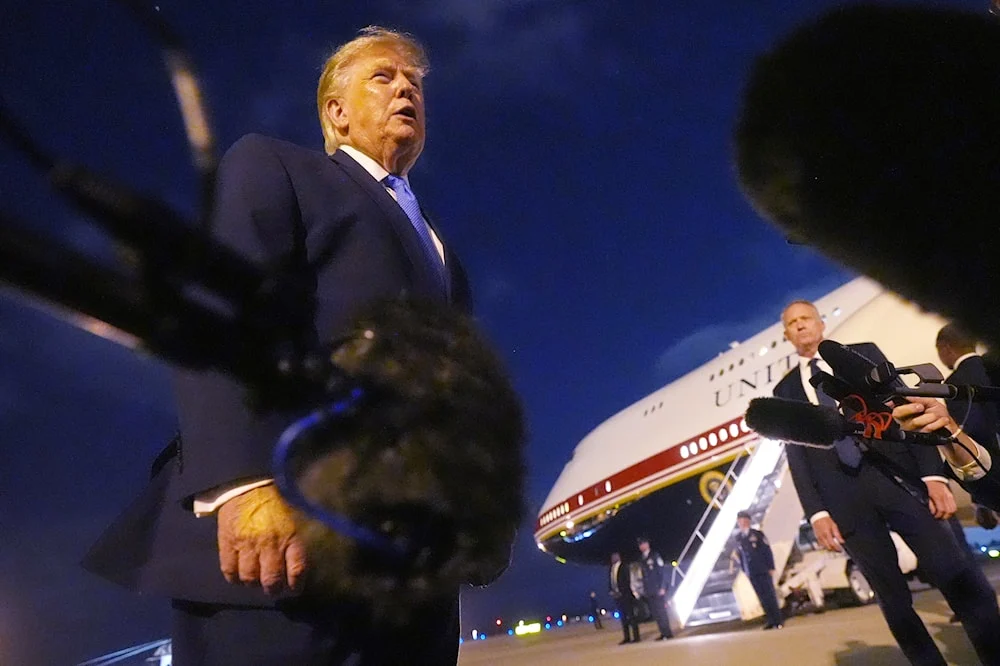
US President Donald Trump has turned his criticism toward major oil producers after soaring energy prices linked to the US-led war on Iran generated billions of dollars in additional profits for global petroleum companies, CNN reported.
“They’re making too much money,” Trump said in the Oval Office on Monday, as his administration faces mounting pressure over rising fuel costs ahead of November’s midterm elections.
“I don’t like it. And I should be the last one to say because I’m a big free enterprise guy,” he told reporters.
The remarks highlight the political consequences of Washington’s military campaign against Iran, which has disrupted regional energy shipments, driven international crude prices higher, and sharply increased costs for US households.
The average price of gasoline in the United States has risen by 37% since the war began, worsening an affordability crisis that threatens to undermine Republican support three months before the congressional vote.
“Too much money… I’ll say it loud and clear. I’m not happy about it,” Trump said.
Energy companies reap billions from price surge
Major oil producers have reported exceptional second-quarter earnings as restrictions on shipping through the Strait of Hormuz reduced supplies available to international markets.
Saudi Aramco announced on Tuesday that its quarterly profit had climbed by 33% to $33.4 billion, compared with $25.2 billion during the corresponding period in 2025.
US oil giant ExxonMobil reported $14.5 billion in profit, more than twice its earnings during the same quarter last year. Chevron recorded $12.1 billion, more than four times its year-earlier result.
British energy company Shell also reported close to $10 billion in quarterly profit, marking the second-highest three-month earnings figure in its history.
The figures demonstrate how energy companies benefit when wars, shipping disruptions, and fears of shortages push crude prices upward.
Brent crude had traded below $70 per barrel before the US-Israeli war on Iran began. It later rose above $100 before retreating amid changing expectations surrounding negotiations and maritime arrangements.
On Tuesday morning, the international benchmark was trading near $80 per barrel, approximately 14% above its pre-war level.
Trump faces consequences of his own Iran policy
Trump’s criticism of oil-company earnings comes as his administration struggles with the economic fallout from his decision to launch a war on Iran, which has disrupted tanker traffic through one of the world’s most vital energy corridors.
Polling cited by CNN indicated that Democrats could make substantial gains in Congress, increasing pressure on Trump to demonstrate progress on living costs before the elections.
The president has called on companies to “cut the retail price,” despite the continued financial incentives created by elevated global crude prices.
The situation resembles the political backlash that followed the escalation of the conflict in Ukraine in 2022, when then-President Joe Biden denounced what he described as “war profiteering” and raised the possibility of imposing a windfall tax on energy companies.
Saudi export alternatives face mounting risks
Saudi Arabia has attempted to reduce its dependence on the Strait of Hormuz by transporting oil westward and loading tankers from facilities on the Red Sea.
However, that route has also faced disruption after Sanaa announced a blockade targeting Saudi vessels passing through the Bab al-Mandeb Strait.
Saudi crude shipments through the Red Sea have consequently fallen by at least half, according to Rahul Choudhary, vice president of upstream research at Rystad Energy.
Speaking to CNN, Choudhary said Aramco’s recent performance had also benefited from increased exports of higher-value refined products, including diesel.
Nevertheless, he warned that “high revenue cannot hold forever,” noting that part of the company’s earnings came from oil drawn from stockpiles that have since declined.
As long as military escalation and shipping restrictions keep crude prices elevated, the world’s largest petroleum companies are likely to continue generating enormous profits, regardless of Trump’s public calls for lower prices.
Source:Websites