The Iranian Ministry of Foreign Affairs reaffirmed on Monday its nation's stance rejecting foreign interference in the region, considering the mutual defense agreement between Turkey, Pakistan, and Saudi Arabia evidence of nations' aversion to relying on Washington to guarantee their security.
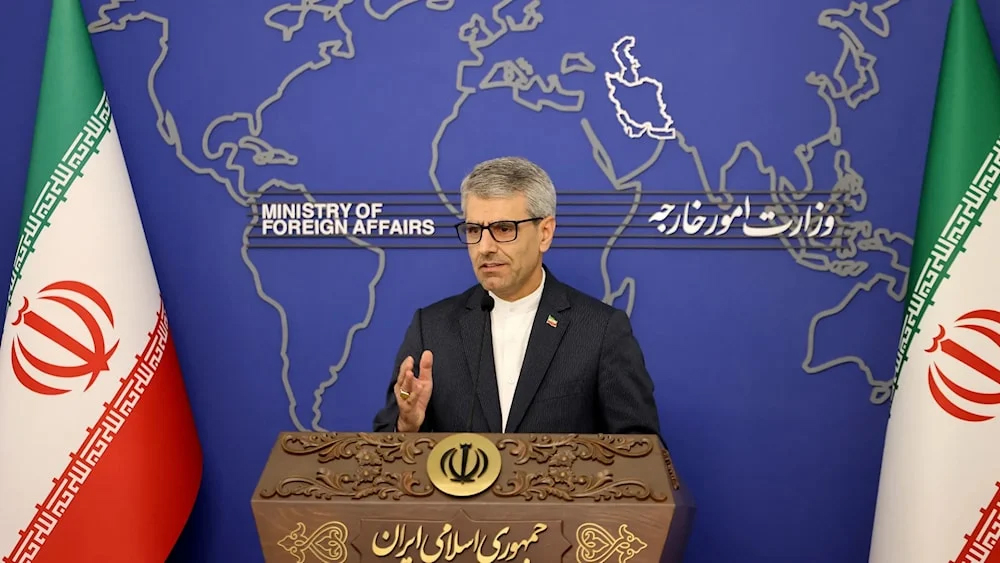
During a press conference, Foreign Ministry Spokesperson Esmaeil Baghaei stated that "the Zionist entity's expansionist policies have become clear, public, and exposed".
Baghaei opined that "the Mecca Agreement stems from the realization by regional countries that achieving security through the United States is no longer possible," calling on regional states to strengthen relations, trust, and security "without external actors".
On Friday, Saudi Arabia, Turkey, and Pakistan announced in a joint statement the signing of the "Mecca Joint Defense Agreement," expressing a shared commitment to continue strengthening collective security, while noting that "the agreement is not directed against any specific party and is open to other regional countries," as a Turkish official stated to Reuters.
Regarding concerns over whether the "Mecca Agreement" is directed against Tehran, Baghaei said: "There is no justification to consider the agreement between Turkey, Saudi Arabia, and Pakistan as directed against Iran".
The Iranian diplomat also reiterated his country's rejection of neighboring territories being used as a launching pad for aggression against Iran, adding: "Iran rejects foreign interference in the region".
He stressed: "We have proven to the world that our participation in international treaties depends on our national interests".
Regarding the Strait of Hormuz, the Iranian Foreign Ministry spokesperson explained that closing the strait is "natural" to prevent it from being exploited in attacks against Iran, noting that "the reopening of the Strait of Hormuz is linked to the circumstances and Iran's conditions, and as long as the war continues, we will not allow passage through the strait".
Concerning ongoing consultations with the Sultanate of Oman in this regard, Baghaei stated that these discussions did not touch upon the issue of fees, but added: "It is natural to collect fees in exchange for services."
While noting that negotiations with Oman are discussing determining navigation routes in the Strait of Hormuz, he emphasized that "the southern route of the Strait of Hormuz is not safe." He continued: "The goal of the talks with Oman is to reach a temporary route in the Strait of Hormuz".
Furthermore, Baghaei reaffirmed that Tehran is currently focusing on the Strait of Hormuz rather than resuming the negotiation track with the United States.
For about two months, Iran and Oman have been conducting talks regarding joint management of navigation in the Strait of Hormuz as the two littoral states bordering the strait, at a time when Tehran refuses to involve any third party or open a corridor without coordination with it.
The talks encompass issues of coastal state sovereignty, guaranteeing their security, future arrangements for managing the strait, establishing a joint coordination center between Iran and the Sultanate of Oman to manage maritime traffic, and obtaining necessary information from vessels passing through the Strait of Hormuz between the Sea of Oman and the Gulf, and vice versa.
On the Iranian domestic front, the Foreign Ministry spokesperson confirmed that "decision-making in Iran passes through a set of institutions," stressing that institutions in Iran are in full coordination.