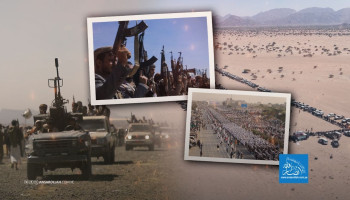
For many years, Saudi Arabia built a significant part of its international image on its vast oil reserves, massive production, advanced infrastructure, an extensive network of pipelines, ports, and facilities, and its ability to redirect exports through more than one maritime route. This system gave the Kingdom an exceptional position within the global energy market and granted it considerable room for maneuver in dealing with regional crises and market fluctuations.
But the rapid developments following the Yemeni blockade of Saudi maritime traffic are putting this image through a severe test. The situation goes beyond the targeting of a single oil facility and is moving toward pressure on an interconnected chain that begins with storage and refining facilities, extends to crude oil transportation pipelines, and reaches export ports and global markets. Here lies the significance of this development: the strength of an oil system is not measured solely by the size of its wells and its production, but by its ability to deliver the barrel to the buyer at the right time and at the appropriate cost.
This particular point places the East-West Oil Pipeline at the heart of the scene. The pipeline, extending for roughly 1,200 kilometers, transports oil from the Eastern Province to the port of Yanbu on the Red Sea, giving Saudi Arabia an outlet through which it can bypass the Strait of Hormuz when exporting part of its crude. Reuters reported warnings from buyers and traders that export-dedicated inventories could run out within days if the pipeline shutdown continues, with estimates that inventories in Yanbu are sufficient for only five to seven days of maintaining exports at the required levels.
These figures, if the disruption continues, raise a question larger than the issue of repairing a pipeline: To what extent can Saudi Arabia preserve the flexibility of its export system when several of its links come under pressure at the same time?
The Oil Artery Under Pressure
The sensitivity of the East-West pipeline stems from its position within Saudi Arabia’s strategic calculations. Over decades, the Kingdom developed massive infrastructure to reduce its dependence on exports passing through the Gulf and the Strait of Hormuz. The route extending from the eastern oil fields to the Red Sea therefore represents one of the most important elements of maneuverability within the Saudi energy system.
When this very pipeline becomes threatened or is forced to stop, the alternative that was originally designed to confront the risks of maritime routes finds itself under pressure as well. Here, the nature of the problem changes. Saudi Arabia is facing a system that requires more than simply producing oil; it needs functioning transportation pipelines, storage tanks capable of accommodating crude, refineries operating efficiently, ports capable of receiving tankers, secure maritime routes, and customers able to receive shipments on schedule. Yet all of these routes have now come under the Yemeni threat.
Reuters confirms that a shutdown of the East-West pipeline could threaten the loss of as much as 4% of global oil supplies, while sources indicated that repairing the damage could take five to six weeks. The issue therefore goes beyond a temporary market impact toward the possibility of a time gap emerging between the scale of the damage and the speed at which operational capacity can be restored. Here, the importance of inventories becomes apparent. Oil stocks give producing countries the ability to absorb shocks for a limited period, but they cannot compensate for a prolonged disruption to the transportation network. The longer the disruption lasts, the more inventories shift from being a protective tool into a countdown clock determining how much room remains for decision-makers.
This is precisely what is reflected in the warnings conveyed by traders and buyers regarding inventories in Yanbu. Five or seven days may appear to be a short period under normal circumstances, but it becomes extremely sensitive when the global market itself is experiencing disruption in supplies and transportation routes.
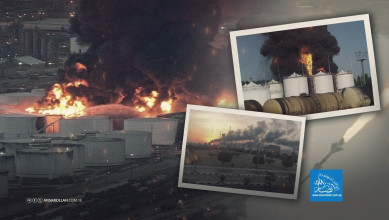
More importantly, the pressure is not appearing at a single point. Another indicator points to damage affecting Aramco facilities in Abha and Jizan, as well as damage to storage tanks and the Jizan refinery, coinciding with the disruption of the East-West pipeline. Satellite imagery shows the destruction of at least six tanks at the fuel storage facility in Abha, with damage to eight additional tanks, while other imagery indicated damage to tanks in Jizan.
Thus, a picture is emerging that differs from the traditional strike that targets a facility and whose effects end once the attack is over. Here, the damage can accumulate over time: a storage facility taken out of service, a refinery operating at reduced capacity or shutting down, a pipeline out of service, ports facing restrictions on crude flows, and tankers forced to recalculate their risks and costs. This chain is what makes the economic impact greater than the physical size of the targeted facility itself.
Aramco Confronts a New Equation
Aramco occupies a central position in the Saudi economy, and therefore any disruption affecting its facilities cannot be measured solely by direct losses to equipment. The issue is connected to confidence, production stability, the company’s ability to fulfill export programs, inventory management, and the preservation of revenue flows. In this regard, Reuters recorded a decline in Saudi equities, with the Saudi index falling 1.3%, its largest daily decline since early April, while Aramco shares fell 1.6%, Luberef dropped 10%, Ma’aden declined 3.2%, and Al Rajhi Bank fell 1.2%.
The stock market here functions as a rapid mirror of investor anxiety. Markets do not always wait for final loss figures to emerge before they begin pricing them in. It is enough to see a growing possibility of disruption to cash flows, production, or exports for them to begin reassessing companies linked to the energy sector and the domestic economy.
From another perspective, a strike targeting oil facilities carries a psychological and sovereign impact as well. For decades, Saudi Arabia has presented itself as one of the countries most capable of protecting its oil infrastructure and securing global energy flows. Therefore, repeated damage at multiple locations raises a question concerning the limits of this capability, particularly when strategic facilities can be reached from a long distance.
Here, satellite imagery becomes exceptionally valuable. It provides observers, investors, and specialized entities with a relatively independent means of assessing the scale of the damage, particularly under circumstances in which detailed official data are limited.
In this context, the importance of open-source information becomes apparent. Smoke, thermal signatures, facility activity, changes in storage tanks, and other indicators can all be transformed into evidence that allows a more accurate picture of the situation on the ground to be drawn.
When the Impact of the Strike Reaches the Global Market
The equation does not stop at Saudi Arabia. Oil is a global commodity, and any tangible decline in the exports of one of the world’s major producers quickly affects prices, shipping companies, refiners, and consumers.
The International Energy Agency lowered its forecasts for Saudi supplies, noting that supplies in August reached around 6 million barrels per day, the lowest level in more than three decades. It also pointed to a decline in Saudi crude shipments to around 3.5 million barrels per day, alongside a decline in inventories.
The figures here reveal the core of the crisis: when production or supply declines at the same time as transportation is disrupted, the market faces a double shock—less oil reaches the market while, at the same time, the cost and risks of transporting it increase.
This is why higher crude prices were among the direct consequences, with prices surpassing elevated levels during the period in question, alongside estimates from financial institutions that continued shipping disruptions could push prices even higher.
But the more dangerous economic consequence is the widening circle of impact. Higher oil prices do not hit importers alone; they raise the costs of transportation, manufacturing, electricity, and petrochemicals, and increase inflationary pressures in economies that depend on energy stability. If the crisis persists, it can transform from a disruption in the oil market into a source of pressure on the global economy as a whole.
From Protecting the Facility to Protecting the System
The most significant development in the current scene is that the concept of protecting oil facilities has changed. Defending a storage tank, refinery, or pumping station is not sufficient on its own if the entire system becomes vulnerable to simultaneous pressure.
A facility may remain intact while the route transporting crude to it is disrupted. A refinery may be technically ready while its ability to obtain supplies or export its products declines. Vast quantities of oil may exist underground, but the inability to transport them to ports transforms reserves from an immediate economic strength into a resource that cannot be monetized at the required moment.
This is the paradox exposed by the Yemeni military operations against the Saudi Kingdom: possessing oil is one thing, while possessing the ability to turn it into stable financial flows is another.
From this perspective, pressure on the East-West pipeline takes on particular significance. The pipeline was originally designed to serve as an instrument of Saudi flexibility in confronting maritime risks. Its disruption therefore represents pressure on one of the most important maneuvering tools the Kingdom has built over decades.
The issue becomes even more complicated with the disruption of maritime traffic in the region. Saudi Arabia is facing pressure on both its Gulf and Red Sea export routes as a result of Iran’s closure of the Strait of Hormuz and the targeting of Saudi oil vessels by the Yemeni armed forces.
Thus, the safe space between production and export is shrinking. Whenever land-based risks coincide with maritime risks, the oil economy becomes more vulnerable to what could be called a supply-chain choke point: the disruption of a single sensitive link can disable broad sections of the system.
A Battle Over the Barrel and the Ability to Endure
In the strategic calculation, the effectiveness of a strike is not measured only by the number of facilities hit, but by its ability to generate a cumulative impact. A facility that stops operating for a few hours may quickly resume operations. But a chain of facilities subjected to repeated pressure requires greater time and resources for maintenance, assessment, and restart, while the market continues to monitor every new delay. This is what makes the time factor critically important.
If repairs take weeks while export inventories cover only a limited number of days, then the time gap itself becomes an element of pressure. And if shipping companies and buyers enter a phase of reassessing risks, the impact of the crisis may increase even before exports actually stop on a wide scale.
In this situation, the cost of insurance, transportation, and geopolitical risk becomes part of the price of the barrel. Buyers may pay higher prices to obtain supplies from regions less exposed to risk, while importing countries search for alternatives and refineries rearrange their purchases.
On the other side, Saudi Arabia faces an extremely difficult equation: it must maintain the flow of its exports, protect its facilities, repair the damage, secure transportation pipelines, reassure markets, and manage inventories, all while confronting a turbulent regional environment.
Here, the strategic value of strikes targeting oil infrastructure becomes clear: their impact does not end at the moment of the explosion or fire. Rather, it can continue through markets, inventories, insurance, shipping, investment, and confidence.
Saudi Oil Faces a Test of Endurance
The developments reveal a scene that extends beyond the boundaries of direct military confrontation. The equation has begun reaching into the economic depth, where the pipeline, refinery, storage tank, port, vessel, and oil contract become links in a single battlefield.
The most important question facing Riyadh is not merely whether it can repair a damaged facility, but whether it can preserve the continuity of the system when multiple links come under pressure simultaneously.
Saudi Arabia possesses enormous oil capabilities, long experience in managing production and exports, and massive infrastructure. Yet the scale of strength under normal circumstances does not eliminate the vulnerability of choke points. Every system of this magnitude possesses specific points where pressure can generate an impact far greater than their physical size.
This is precisely where the significance of the East-West pipeline takes shape: a single pipeline roughly 1,200 kilometers long can become a major factor in calculations within the global oil market because its function is tied to reshaping the route through which Saudi crude is exported away from the Strait of Hormuz.
With damage to storage and refining facilities in the south, disruption to shipping routes, declining supplies, rising prices, and growing concerns among buyers, the effects are converging in a single direction: narrowing the room for maneuver available to the Saudi economy and forcing its oil system to operate under sustained pressure.
For this reason, the current battle is not about one facility here or one refinery there. It is about the deeper question: Can an oil system upon which the Kingdom and the world depend maintain its normal flow when the routes of production, transportation, storage, and export have all become part of the battlefield?
Does the Saudi Kingdom realize that it has placed itself in a major dilemma by choosing escalation in Yemen instead of responding to its legitimate and just demands? The developments and Yemeni military operations have demonstrated that the Saudi Kingdom has no military solutions against Yemen. At the same time, however, it is unwilling to rectify what it has inflicted on Yemen over the past 12 years. Consequently, it is the party that bears full responsibility for, and the consequences arising from, the current round of escalation.