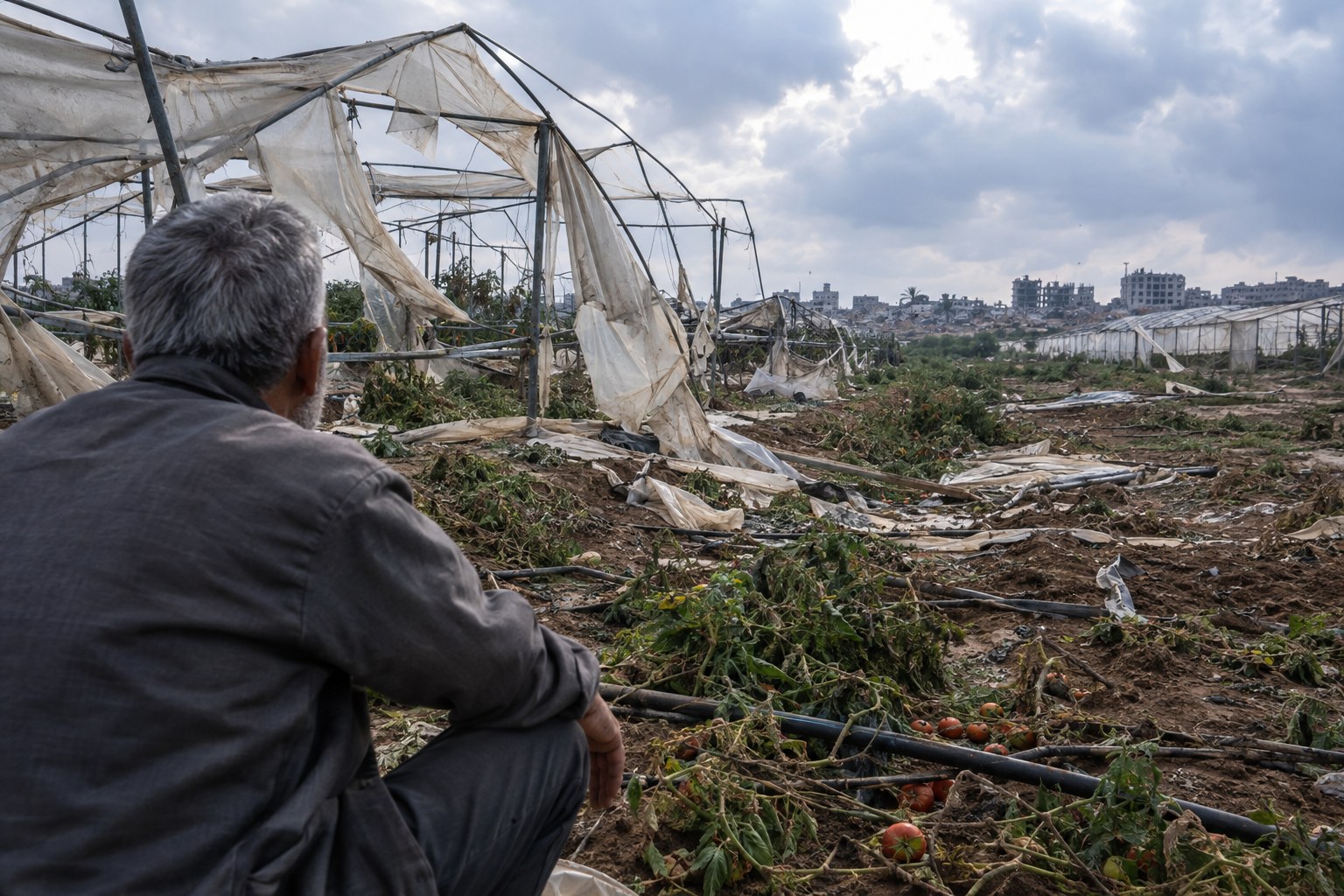
Israel’s war on the Gaza Strip has not spared the agricultural sector from destruction, with damage affecting land, crops, water sources and irrigation networks. Areas that can be accessed and cultivated have shrunk to a marginal share, threatening to keep the territory dependent on imports and food aid.
Bahaa al-Agha, director of policies and planning at Gaza’s Ministry of Agriculture, said around 87.6% of the territory’s agricultural land has been completely damaged, alongside widespread damage to soil, water wells, irrigation networks and transmission lines.
Al-Agha said various agricultural production sectors, including livestock and fish production, have sustained damage ranging between 85% and 90%, amid the continued repercussions of the war and the difficulty of accessing large areas of farmland.
According to recent data cited by the UN Food and Agriculture Organization, only about 3% of open agricultural land can be safely accessed, covering around 4,480 dunums of undamaged land that can be reached safely.
Around 2,240 dunums of greenhouses, equivalent to nearly 16% of their total area, can also be safely accessed. When open farmland and accessible greenhouses are calculated together, the area actually available for safe access and cultivation does not exceed around 4% of Gaza’s total agricultural land.
The situation is further complicated by the fact that more than 70% of agricultural land lies within areas controlled by Israel in what is known as the “Yellow Line,” limiting farmers’ ability to reach their land and resume work.
The restrictions are not limited to land access. According to al-Agha, Israel imposes strict curbs on the entry of agricultural production inputs, including fertilizers, seeds, seedlings and pesticides, obstructing efforts to restart the agricultural sector even in areas that remain cultivable.
The shortage of production inputs has driven up agricultural prices and increased dependence on imported products and materials, placing many agricultural goods beyond the reach of broad segments of Gaza’s population as living and humanitarian conditions continue to deteriorate.
Source:Websites