
Ansar Allah website - Report -2 Rabi' al-Thani 1448 AH
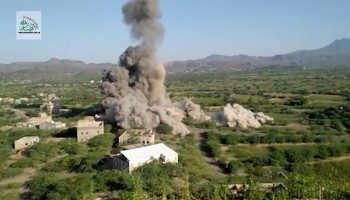
In a qualitative development reflecting a strategic shift in the course of the confrontation, the Yemeni Armed Forces announced the downing of a Saudi F-15 fighter aircraft with a locally manufactured surface-to-air missile over Marib Governorate, in an operation that came in response to the continued aggression and blockade. The media broadcast footage of the targeting operation, showing the missile striking the aircraft directly despite its launching numerous thermal flares (Flares) and carrying out intensive aerial maneuvers, underscoring a notable development in the capabilities of the Yemeni air defenses. This event came after a series of successive achievements that have established a new equation in the battle to confront the Saudi enemy.
Details of the Operation: Direct Hit Despite Aerial Maneuvers
According to a statement issued by the official spokesman for the Yemeni Armed Forces, Brigadier General Yahya Saree, the air defenses succeeded in shooting down the Saudi aircraft while it was carrying out hostile activities in support of its military mobilization in Marib Governorate, using a locally manufactured surface-to-air missile.
What is particularly striking about this operation is that the aircraft—despite employing advanced protective measures such as thermal flares and evasive aerial maneuvers—was unable to evade the missile, which struck it directly. This indicates that the defensive system used had surpassed traditional jamming and protection capabilities.
The statement also indicated that the Armed Forces subsequently confronted two Saudi combat formations consisting of F-15 and Typhoon aircraft that were searching for the wreckage of the downed aircraft. They were forced to retreat after being targeted with locally manufactured missiles.
0:03
/ 3:48
Accumulated Achievements
This achievement crowns a series of successful operations carried out by the Yemeni air defenses. Just two days earlier, the Armed Forces had announced that they confronted two Saudi combat formations in Saada Governorate consisting of Typhoon and F-15 aircraft, which had taken off from the Khamis Mushait and Taif air bases, and forced them to retreat with locally manufactured air-defense missiles.
As for drones, the Yemeni air defenses have achieved exceptional successes, managing to shoot down no fewer than 24 American MQ-9 Reaper aircraft during the “Promised Conquest and Holy Jihad” battle in support of the Palestinian people. This figure reflects a high capacity to engage some of the most advanced drones in the world. The number of MQ-9 aircraft shot down in Yemeni airspace has reached 25, including 21 since the beginning of the battle in support of Gaza and four during the period of the American-Saudi aggression.
The air defenses have also shot down dozens of Wing Loong aircraft, Turkish-made Bayraktar drones, and Chinese-made CH-4 aircraft belonging to the Saudi Air Force. The rate of shoot-downs reached four aircraft within just 24 hours, indicating a systematic development in detection and targeting systems. The achievements were not limited to drones; they also included the downing of an American-made ScanEagle aircraft with a locally manufactured surface-to-air missile.
The Technical Dimension: How Did the Air Defenses Achieve This Shift?
The significance of these achievements lies in the fact that they involve confronting advanced aircraft equipped with sophisticated technological capabilities. The F-15 is considered one of the most advanced fighter aircraft in the world, distinguished by its maneuverability, electronic warfare capabilities, and early-warning systems. Meanwhile, the MQ-9 is considered one of the most advanced and costly drones, at approximately $30 million per aircraft.
Specialized military analyses have revealed a qualitative development in Yemeni tactics. The American magazine Air & Space Forces indicated that the Yemeni air defenses had carried out a complex missile ambush involving six surface-to-air missiles targeting two American F-16 aircraft, with only 15 seconds separating the pilots from death.
The magazine explained that subsequent analyses revealed an advanced Yemeni tactic involving the integration of radar-guided missiles with visual surveillance, along with the use of electro-optical and infrared sensors. These were technologies that American sensors were unable to detect, confirming a qualitative development in Yemeni defensive capabilities.

Strategic Significance: Why Is This Event a Turning Point?
The significance of this event is reflected in several strategic dimensions:
First: Breaking the Air Superiority Barrier:
The Saudi and American air forces have long been regarded as possessing absolute air superiority over Yemeni airspace. However, the successive series of shoot-downs, culminating in the downing of an F-15 in Marib, demonstrated that this superiority is no longer guaranteed. The ability to shoot down an advanced fighter such as the F-15 using locally manufactured means represents a strategic embarrassment for forces that possess technological and technical superiority.
Second: The Effectiveness of Local Technology:
The use of locally manufactured surface-to-air missiles in these operations demonstrates that Yemen has managed to develop indigenous defensive capabilities despite the blockade, making these capabilities sustainable and capable of further development away from external pressure. The enemy described these systems as advanced and high-quality, capable of engaging sophisticated targets.
Third: Changing the Deterrence Equations:
Following these achievements, Yemeni airspace is no longer an open arena for hostile military aircraft. Rather, it has become an area fraught with risks, forcing hostile forces to reconsider their calculations when planning any aerial operation. Military observers have described this shift as a “new deterrence equation” imposed by Yemeni defensive capabilities.
Consequences: From Defense to Imposing the “Blockade for Blockade” Equation
These defensive achievements acquire a broader strategic dimension when placed within the context of the “blockade for blockade” equation announced by the Armed Forces. The Yemeni Armed Forces have moved from a position of defense and strategic patience to a phase of attack and the imposition of new rules of engagement, manifested in the stopping and detention of Saudi commercial ships and tankers in the Red Sea, and the closure of maritime routes to the Saudi economy, in response to the continued blockade and the closure of Yemeni ports and airports.
Moreover, possessing this advanced defensive technology gives Yemen the ability to protect its vital installations and leadership from hostile airstrikes, and reduces the effectiveness of the air campaigns launched by Saudi Arabia, which exceeded 450 raids in a single week, targeting the governorates of Taiz, Lahj, Al-Jawf, Hajjah, Marib, Saada, and Al-Bayda.
A Strategic Shift in the Balance of Power
The notable development in the capabilities of the Yemeni air defenses, culminating in the downing of an F-15 in Marib, the downing of 25 American MQ-9 aircraft, and dozens of other drones, represents a strategic shift in the regional balance of power. Yemen has demonstrated its ability to develop indigenous defensive systems capable of confronting the most formidable military technologies and transforming its airspace from an open arena for hostile aircraft into a prohibited zone.
Under the “blockade for blockade” equation, these defensive capabilities have become a central pillar of Yemen’s deterrence strategy and a guarantee for the continuation of offensive operations deep inside Saudi territory.
The question is no longer, “Can advanced fighter aircraft be shot down?” Rather, it has become: “How many aircraft will Yemen shoot down before the hostile powers realize that the rules of the game have changed?”