Ansarollah Website | Report by Wadee Al-Absi
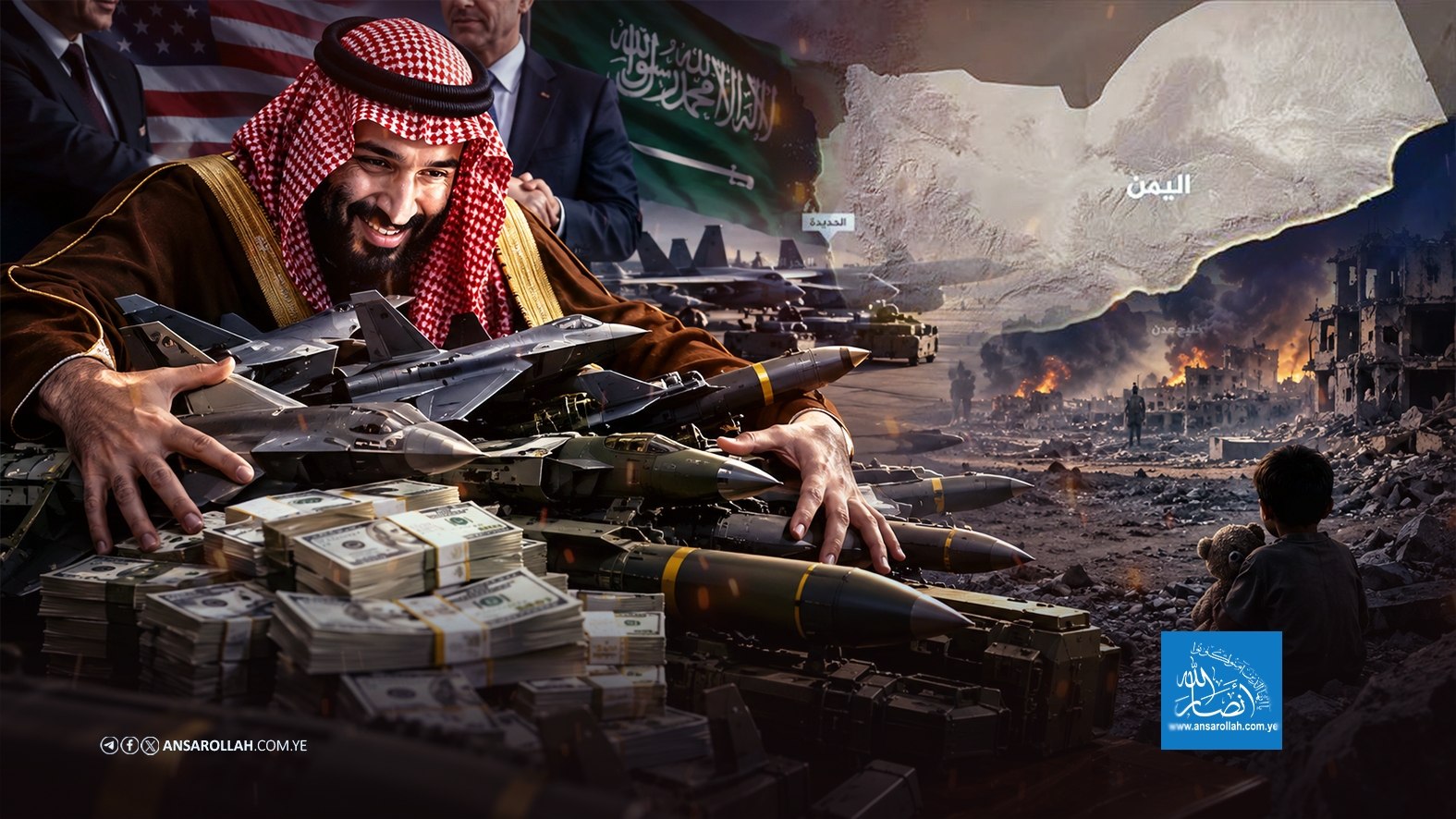
From the earliest days of the aggression against Yemen, the Saudi military apparatus relied on an extensive network of arms procurement deals concluded with major Western manufacturing powers. Chief among these was the United States, which served as the largest and most prominent supplier of military hardware, logistical support, and intelligence to Riyadh. Britain also participated heavily by delivering fighter aircraft, munitions, and engineering and maintenance support programs, alongside other European nations such as France, Spain, and Italy.
These massive transactions encompassed a broad spectrum of advanced military technology, heavily concentrated in the military aviation and helicopter sectors—such as F-15s, Tornadoes, Eurofighter Typhoons, unmanned aerial vehicles, aviation gear, and spare parts. This was in addition to vast arsenals of munitions, precision-guided bombs, air-to-surface missiles, artillery shells, jamming equipment, electronic countermeasures, and comprehensive umbrellas of advanced air defense systems designed to protect airspace and critical installations. The deals further covered land and naval vehicles and hardware, not to mention annual contracts for maintenance, field training, and aerial refueling support.
Widespread Destruction Touching Every Aspect of Life
These agreements were neither fleeting nor isolated events; rather, they spanned all the years of the aggression. The continuous annual inflow of weapons into Saudi Arabia underscored the immense rate of consumption. The acquisition of these systems was never a mere display of military muscle or a routine stockpiling of hardware in military warehouses. Instead, it served as definitive and practical evidence of the direct, ongoing deployment of this weaponry against the Yemeni population and their national infrastructure, as Yemeni territory was transformed into an open theater and a living laboratory for discharging the loads of these mega-deals.
This systematic consumption and material destruction extended to every facet of life in Yemen—servicing, economic, and social. Airstrikes, artillery shelling, and missile strikes hit agricultural farms, public markets, water and electricity stations, bridges, public roads, schools, hospitals, and manufacturing plants that sustained millions of residents and underpinned essential production capacity. Even displacement camps, funeral halls, and wedding gatherings were targeted in a comprehensive violation that poured billions of dollars in Western military contracts into destroying the basic means of survival for the poorest population in the region.
Simultaneously, annual maintenance agreements and the supply of precision-guided and smart munitions were renewed periodically to ensure that this destructive apparatus operated without interruption. It was as though this massive war machine had been built solely to exhaust its costly stockpile of destruction over unarmed civilians and across a geography where both land and people were relentlessly targeted.
International Organizations Bear Witness to the Scale of Aggression
The massive and conspicuous flow of weaponry, combined with its excessive use against the Yemeni people, sparked widespread condemnation and outrage from human rights and international circles at critical junctures of the catastrophe. Reports issued by prominent international human rights organizations—such as Amnesty and Human Rights Watch—repeatedly noted that the ongoing influx of Western arms shipments, alongside perpetual maintenance and munition contracts for Saudi Arabia, constituted "direct complicity in grave violations of international humanitarian law." These organizations expressed profound shock and dismay that commercial interests and billion-dollar deals were given absolute priority over the lives of Yemeni civilians.
Furthermore, reports published by the Control Arms Coalition cited researchers and observers who voiced deep condemnation regarding "the flooding of the region with advanced weaponry that is systematically used to devastate the infrastructure of a blockaded nation." The reports emphasized that the uninterrupted delivery of fighter jets and guided bombs reflected a complete detachment from basic humanitarian considerations.
In the same vein, independent think tanks—such as the Center for International Policy (CIP)—criticized the continued provision of logistical support, intelligence sharing, and spare parts supply, confirming that these recurring deals had turned into an open cover for draining civilian lives and deepening one of the worst contemporary humanitarian crises.
Ranking First Globally in Arms Imports
Throughout the years of aggression and the high intensity of military operations against Yemen, coupled with the regular and continuous flow of weapons, Saudi Arabia climbed to the top of the global arms procurement hierarchy. Reports from international research centers and Stockholm International Peace Research Institute (SIPRI) classified it as one of the largest arms importers in the world. During this period, Saudi Arabia alone accounted for eight to eleven percent of total global arms transfers, making it the undisputed primary destination for American and Western arms exports in the Middle East, while strategically positioning itself as a state with a colossal defense budget relying almost entirely on Western technology.
This series of multi-billion-dollar deals and procurement contracts continued to unfold year after year, shielded by a diplomatic and political umbrella provided by decision-making capitals in Washington, London, and Paris. These transfers were accompanied by open export licenses that remained uninterrupted even at the peak of international human rights criticism. This staggering volume of armaments allowed Saudi Arabia to possess an arsenal featuring the most advanced systems produced by global arms manufacturers, backed by highly sophisticated command, control, intelligence, surveillance, and reconnaissance (C4ISR) networks. The underlying military doctrine aimed to resolve the conflict swiftly and establish absolute dominance across air, land, and sea domains, securing vital maritime passages and global energy flows according to a comprehensive strategic vision involving modern warships, destroyers, and advanced radar systems.
A Path Born Out of Necessity
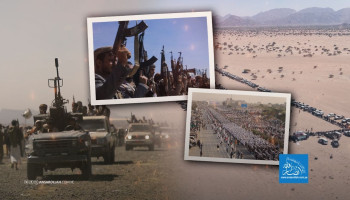
In stark contrast to this picture saturated with hardware and billions targeting everything in Yemen, the impoverished, targeted, and blockaded nation was suffering from a complete absence of foreign procurement deals and an inability to purchase even a single bullet. However, this besieged environment did not surrender to the logic of material disparity. Instead, it engineered an extraordinary path to compensate for the shortcomings of a conventional arsenal through local innovation and self-reliant manufacturing, overcoming the constraints of a comprehensive blockade and widespread destruction.
Yemen produced an integrated local arsenal consisting of long-range reconnaissance, strike, and loitering unmanned aerial vehicles, as well as ballistic and cruise missiles capable of bypassing the most advanced Western air defense systems. This was complemented by fast attack craft and naval weaponry that asserted their presence in writing new rules of engagement within the sensitive maritime choke points of the Bab al-Mandab Strait and the Red Sea.
This resilient path emerged from urgent necessity and self-reliance. Local personnel—by the grace of Allah Almighty—succeeded in repurposing basic available materials, converting them into effective deterrent weapons capable of reaching deep into the vital economic infrastructure of Saudi Arabia and the "Israeli" entity. This operational and strategic shift, forged over long years of confrontation, represented a radical overturn of traditional military concepts, wherein absolute considerations of numerical and financial superiority collapsed before the resolve for self-sufficiency and local manufacturing. Saudi Arabia, which expended tens and hundreds of billions of dollars on the latest outputs of defense factories in Washington, London, and Paris, ultimately found itself in direct confrontation with locally produced systems developed under conditions of extreme complexity, poverty, and siege.
Observers affirm that these locally manufactured capabilities humbled the military posture of Saudi Arabia in full view of the world—just as occurred with the United States, Britain, Germany, France, and the "Israeli" entity. Furthermore, it proved that the continuity of massive annual deals and multi-billion-dollar defense contracts does not necessarily guarantee decisive strategic dominance in the theater of operations. These powers collided with a solid wall of unconventional military innovation that redrew the region's red lines and forced those powers to completely recalculate their security and military postures.
The Field Where Traditional Theories of Superiority Collapsed
Thus, the continuous flow of weapons exposed the extent of the criminality committed against the Yemeni people. Transactions covering every category of weaponry, valued at hundreds of billions of dollars, were consumed in aggressive operations against Yemenis, explaining the scale of a destruction that spared nothing. Despite this, the intervention failed to achieve any of its goals; instead, it accelerated the emergence of a deterrent force that has become an unignorable factor in the regional equation.
The years of aggression against Yemen were transformed into an active field where traditional theories of superiority based on financial abundance collapsed. In their place emerged a new equation founded on adaptability, self-reliant innovation, and the capacity to repurpose available resources to establish deterrence against the world's most formidable and advanced arsenals.
A simple comparison between the hundreds of billions of dollars burned in annual Saudi arms contracts—allocated to target Yemenis—and the modest cost of developing local Yemeni capabilities clearly reveals the deep gulf between the logic of dependent military consumption and that of self-sustaining production. Experience has demonstrated that armies are not measured by the volume of arms deals they sign, nor by the sophistication of hardware imported from Western outlets to devastate homelands. Rather, they are measured by the human capacity to overcome adversity and extract innovative solutions from the midst of rubble and siege. It is this principle that has enabled the Yemeni side—despite its poverty and blockade—to assert itself as a formidable force and an indispensable regional factor in any future arrangements concerning the security and stability of the region.