
Parliament Speaker Mohammad Baqer Qalibaf has warned of reciprocal consequences for the countries seeking to disrupt Iran’s oil sales and undermine its security.
“Let both the Americans and other countries know: just as we have said before, in any region where we do not sell oil, no one will sell oil, and if our security is not guaranteed, no infrastructure will be safe,” the top legislator told Parliament's open session on Tuesday.
“The delusional American president has recently made remarks about the Strait of Hormuz and the passage of ships through the strait. These are repetitions of previous claims, and the baseless nature of these positions is known to everyone,” he added, referring to Donald Trump’s repeated claims of American “control” over the waterway and similar unfounded rhetoric.
Iran closed the chokepoint following the launch of the latest round of unprovoked American-Israeli aggression. The Islamic Republic and the United States agreed on a 60-day reopening period as part of a Pakistan-mediated memorandum of understanding in June, but American violations forced the country to reestablish the closure.
Tehran has conditioned reopening of the waterway on the realization of seven prerequisites.
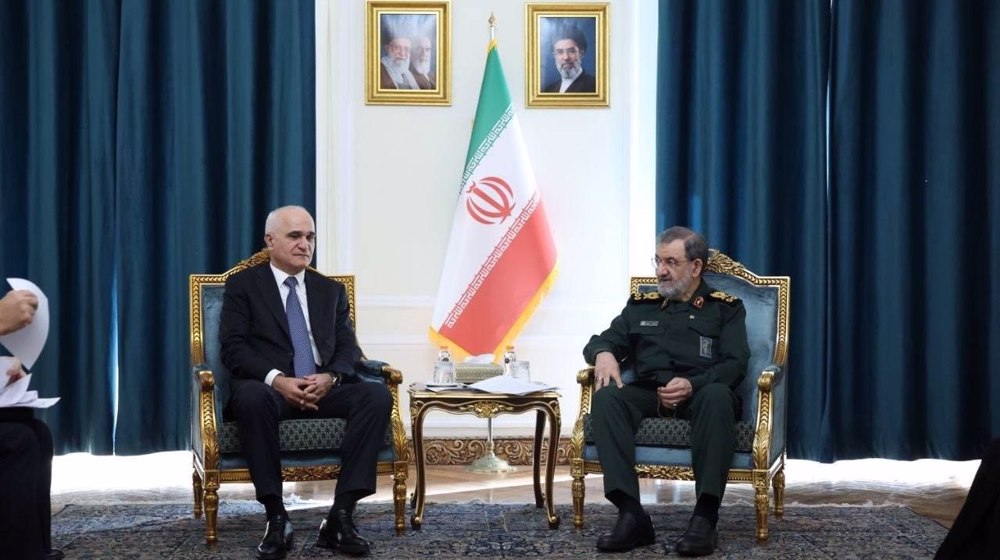
Recently, Secretary of Iran’s Supreme National Security Council Mohsen Rezaei said the country had declared its conditions for renewed talks with the United States, saying that Washington should agree to Tehran’s terms if it wanted to escape the quagmire of its war of aggression against the Islamic Republic.
He did not disclose the nature of the conditions, but previously, the security chief had described some of Iran’s conditions as cessation of warfare on all fronts, release of Iran’s frozen assets, and realization of an end to the illegal US naval blockade of Iranian vessels and ports.
Qalibaf said Iran would respond to any US attempt to enforce a naval blockade, close Iranian air corridors, or exert pressure on its commercial lifelines, drawing a parallel with the breaking of the siege of the southwestern Iranian city of Abadan during the war imposed on the Islamic Republic by Iraq’s former dictator Saddam Hussein in the 1980s.
“America’s current efforts will likewise be defeated through serious economic planning and management and military responses,” he said.
“A nation with such a proud and deeply-rooted history should never be intimidated by siege or threats. If the American enemy’s decision-making apparatus fails to understand this fundamental reality, it will remain trapped in a cycle of receiving heavy blows from the Iranian people.”
The official also referenced Trump’s recent address to the UN General Assembly’s 81st annual meeting, where the US president claimed he was poised to make a “big decision” on whether to make a deal or “quickly annihilate” Iran, besides repeating his allegations against the Islamic Republic of pursuing “a nuclear weapon.”
“The reckless remarks and his (Trump’s) affront to the great and civilization-building Iranian nation showed that they have still not changed their behavior. In response to such provocations, our answer remains the same clear message we have expressed before: Bring it on,” Qalibaf said.
“The Islamic Republic’s response to any act of aggression or adventurism will be tough, painful, precise, and swift.”
Qalibaf said Iran did not seek war, but would defend its security, dignity, and rights, asserting that no threat would force the Iranian nation to retreat, and that “war criminals and those who promote the language of genocide will face no fate other than destruction and eternal disgrace.”
He also praised President Masoud Pezeshkian’s recent remarks at the UN General Assembly, describing them as truly representing Iran’s position in the face of external pressure.
Qalibaf concluded by calling for “courageous decision-making, timely action at critical moments, and greater national solidarity and cohesion” as Iran faces a historic juncture.
Source:Websites