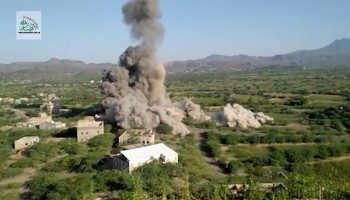
Military expert Colonel Rashad Al-Watiri has affirmed that the Yemeni Armed Forces "have foiled all schemes and burned all the cards in the Saudi enemy's hands, beginning with striking its mobilizations on the ground inside Yemen," adding that "preemptive military operations have struck all its mobilizations."
In an exclusive statement to Almasirah on Thursday, Colonel Al-Watiri said the Yemeni Armed Forces "continue these qualitative operations, clearing very large mountain ranges, reaching Al-Hajariyah, Al-Turbah, and Lahj."
He added that the Yemeni Armed Forces are "disciplining the collapsed, defeated, criminal Saudi enemy that continues its aggression and siege against the Yemeni people for twelve years," explaining that this came after they were granted an "absolute mandate by the Yemeni people and the Leader of the Revolution."
Colonel Al-Watiri noted that the Saudi aggression on Yemen is taking place "amid American-Israeli intelligence and logistical support, and Arab and Western silence toward the massacres it commits against the Yemeni people in all cities and places."
He pointed out that what the Yemeni Armed Forces are doing comes "within the framework of legitimate defense of Yemeni sovereignty and territory," within their "continuous, steadfast, principled, and sacred position in this battle." He noted that the battle today is a "pivotal battle."
Precise and Powerful Strikes
He explained that "defensive operations and preemptive strikes are focused, precise, and powerful against this enemy and its mobilizations." The Yemeni Armed Forces "possess powerful means, such as deterrence capability, military strategy, and elements of confrontation, and factors that helped them today possess exceptional and great expertise and capability in directing strikes."
Colonel Al-Watiri noted "setbacks, flight, and scattering of the Saudi enemy's mercenaries and tools from the militias that were killing Yemenis, cutting roads, and spreading corruption on earth." He affirmed that what is happening represents "qualitative developments and deterrent strikes, from defense to offense."
He explained that "when the Saudi enemy began its aggression on the Yemeni people, it started with aggression on airports, and wanted to portray the battle as a purely Yemeni-Yemeni war," before "showing its face and its aggressive, criminal aircraft for systematic targeting of civilian objects such as telecommunications towers, water tanks, wells, roads, and bridges."
He affirmed that the Yemeni people "did not surrender to those criminal acts," and therefore "the Yemeni Armed Forces' response by striking the Saudi depth became a natural response." He affirmed that "Saudi geography has become within the reach of the Yemeni Armed Forces," and that "all targets being bombed and targeted are military and economic targets belonging to the Al Saud regime."
Colonel Al-Watiri continued: The Saudi enemy "turned to international mobilization and wanted alliances to perhaps stop this response and also stop the naval blockade imposed by the Yemeni Armed Forces on Saudi ports, but it failed again," so it turned to begging for international positions with its "defiled, dirty money, which is the money of the oppressed people in the occupied land of the Two Holy Mosques."
He explained that "the world cares about international navigation being safe and stable, and its ships passing safely," which was affirmed by "the Yemeni Armed Forces, the Yemeni Foreign Ministry, the Yemeni people, and the Yemeni leadership."
The failure of the Saudi enemy "in finding other alliances drove it to lie and fabricate about targeting Mecca, and to takfiri mobilization and misleading fatwas to declare the Yemeni people infidels," trying to "appeal to Muslims worldwide with the necessity of fighting the Rafidah, infidels, and Magians."
He added that "the Yemeni people offer the finest of their sons as a sacrifice to God Almighty for the sake of Islamic sanctities, whether in Palestine or in the land of the Two Holy Mosques." He affirmed that "the Yemeni people are paying the price today, and the price is costly—it is dignity—and that the unity of arenas remains cohesive."
Colonel Al-Watiri affirmed that "the Saudi enemy today failed militarily, strategically, and intelligence-wise when all its cards were burned on the ground and internally," which drove it to target civilian objects and kill all Yemenis.
Colonel Al-Watiri issued a call to the people of Taiz, saying that "when the Yemeni Armed Forces entered Al-Mokha city, they imposed security and safety, restored stolen and plundered dignity, and opened roads."
He called on the people of Taiz to "rally around the Yemeni Armed Forces and the revolutionary leadership," affirming that "this enemy's battle today is with the Yemeni people, not with the Yemeni government in Sana'a or the Yemeni Armed Forces."
He described the Yemeni people as "the people of sacrifices, the people of faith and wisdom whom the Prophet (peace be upon him and his family) foretold."
He said that "the achievement of victories came as a result of the Yemeni people's rallying around their leadership and Armed Forces." He added that "the Saudi enemy today has no choice but to resort to targeting civilians and civilian objects, which is among the acts similar to what the Israeli enemy does in targeting civilian objects and killing the Palestinian people, children and women."
He noted that "these criminal acts are of an enemy that has lost all morals and values in the face of forces on the ground," amid "incapacity, inability, and lack of capability to stop the strikes of the Yemeni Armed Forces."
A Force That Cannot Be Defeated
He explained that "the world today sees in the Yemeni Armed Forces and the Yemeni people an invincible force, and a state that has imposed itself and changed the rules of the game and the rules of engagement," affirming that it "manages military operations and is ready for any options that may be imposed on the ground."
He explained that "the American lack of involvement in this military operation comes from its knowledge of the seriousness of the Yemeni Armed Forces with their qualitative strikes," especially since they now possess important economic and military cards represented in Bab al-Mandab and the Red Sea.
He praised the missile force, saying: "There is strength in the missile forces, to whom we extend greetings and appreciation for their efforts and the victories they have written."
He concluded by saying that "a new equation has been drawn that changed the field reality and placed the Saudi enemy today in a state of hysteria that made it act insanely in search of a way out."