Ansarollah Website | Report: Ali Al-Darwani
For more than twelve years, Saudi Arabia has been launching its brutal aggression against Yemen in service of the US-Israeli project, presenting itself as a major power fighting the battles of others—at times under the pretext of restoring the alleged "legitimacy" to Yemen, at times in the name of protecting international navigation, and occasionally to safeguard its own national security. However, the paradox that warrants reflection lies in the fact that this regime—which possesses one of the most heavily armed militaries in the region and spends tens of billions on state-of-the-art aircraft, tanks, and defense systems—does not appear confident enough to fully rely on this army alone to execute those massive tasks it has taken upon its shoulders. Consequently, this criminal regime took the initiative to seek the assistance of Sudanese mercenaries, as well as mercenary individuals from Yemen and elsewhere. Recently, it has been seeking the protection of regular foreign armies.
Dimensions of Trust between Central Authority and Tribal Structure
In this context, the issue of mutual trust between the political authority of the Saudi throne and certain tribal and regional components within the army comes to the forefront. The regime harbors apprehensions regarding the loyalties of some components, while the tribal society, in turn, views the central authority through a historical legacy fraught with conflict and the pursuit of power distribution. This dynamic cannot be separated from the historical context of the establishment and expansion of the House of Saud’s kingdom, which underwent multiple stages of conflict with forces and tribes across the Peninsula during its founding until it forced them to integrate into its new state.
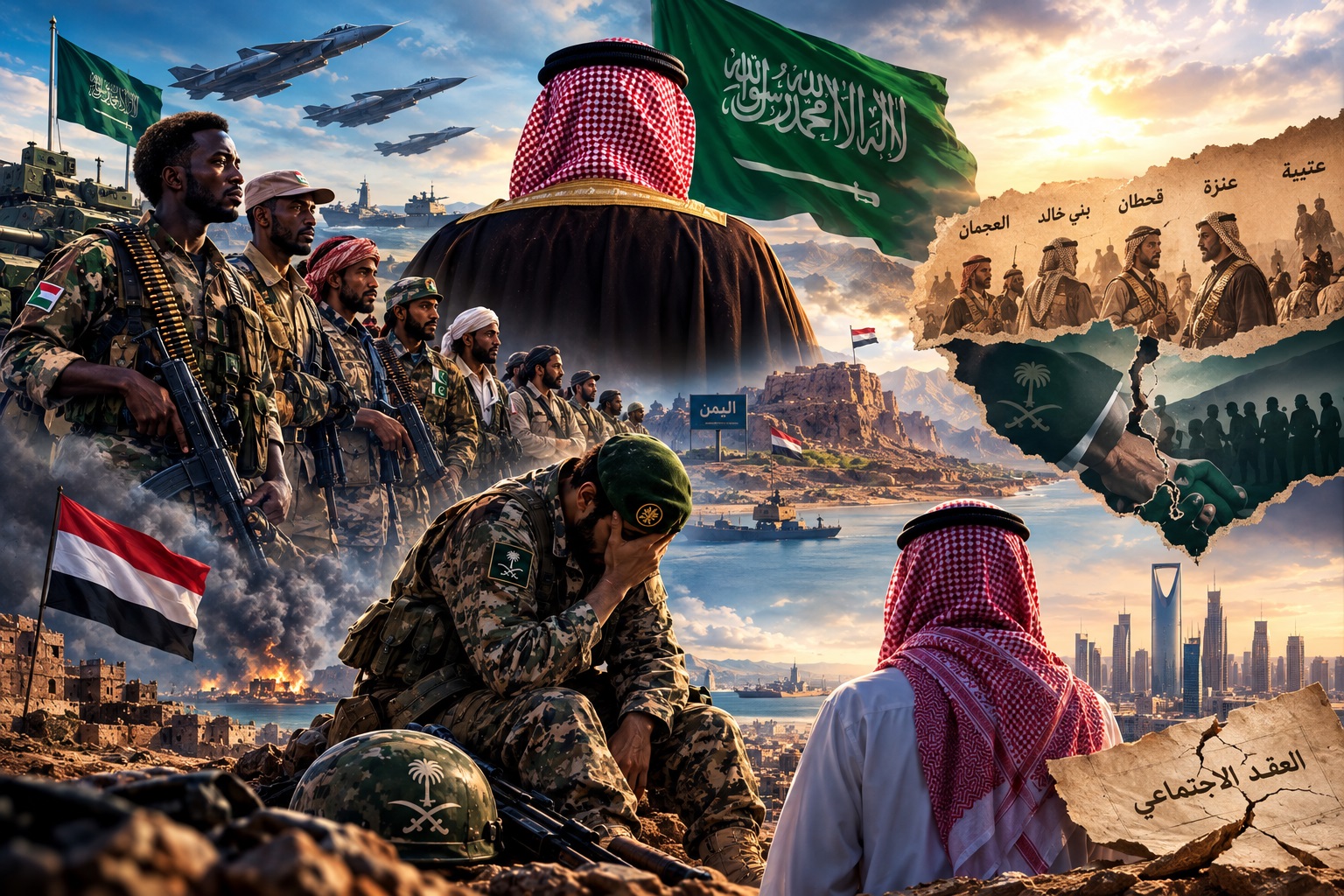
Based on the fact that historical and social memory does not fade with time, the House of Saud does not fully trust these tribes. It appears to recall this equation within the history of tribes such as Otaibah, Anizzah, Qahtan, Bani Khalid, and Al-Ajman, whose historical relations with the House of Saud witnessed varying forms of conflict and warfare. For a highly centralized, family-run authority, such a historical legacy of confrontation cannot be overlooked in evaluations of trust and loyalty, particularly during critical and hazardous junctures.
This issue becomes increasingly sensitive in the southern regions of original Yemeni heritage, where tribal and social structures overlap across geographic and cultural borders with Yemen. This perhaps explains why Saudi Arabia relies on foreign formations along the Saudi border, deploying—much to our regret—Sudanese and Pakistani battalions, as well as Yemeni mercenary units.
The Problematic Combat Doctrine: What Cause Is the Soldier Fighting For?
As previously noted, Riyadh frames this aggressive war within the context of what might be termed "others' wars." It fights on behalf of the world, as repeatedly claimed by Saudi media and officials. This in itself places a burden on the Saudi soldier—a responsibility he does not feel obligated to fulfill, and may even view as something he should not be undertaking. This is especially true as time wears on and Saudi Arabia has squandered billions of dollars to sustain a war from which it has achieved nothing except further failure and reputational damage, both for its military and its regime, not to mention its people who feel they had no need to enter this war in the first place. Making matters worse, the regime does not conceal its shared goals in this aggressive war with the Israeli and American enemy.
This offers a logical explanation for Saudi Arabia’s reliance on fabricated justifications to recruit foreigners, whether through international coalitions or by purchasing groups and individual mercenaries—chief among these excuses being the pretext of protecting the Kaaba or the Two Holy Mosques, which is a false claim and a dangerous slander that Yemenis reject.
Absence of the Political Contract between Citizen and Authority
In addition to the above, individuals who join the military establishment naturally belong to a society lacking an environment that represents their political, security, and social views. The House of Saud formulates its political decisions unilaterally through foreign policies and alliances with which the average Saudi citizen has no connection whatsoever. There are no elected parliamentary councils or legislative institutions to exercise oversight over decisions of war and peace—decisions monopolized by Al Saud family, which drags the entire country into them without the populace having any stake or say.
When citizens are stripped of the right to participate in formulating political decisions and are subsequently called upon as soldiers to carry out the consequences of those decisions, they find themselves in a relationship with the regime that does not extend beyond monthly salaries, allowances, and insurance. These are rights associated with the concept of employment and labor rather than citizenship and homeland. Thus, the soldier feels like an employee of a security company, feeling virtually no sense of national belonging.
Conclusion
Here, the distinction becomes clear between the state as an entity that represents the people and embraces the citizen, and the ruling regime as an authoritarian political structure. The homeland is an enduring concept, whereas political power is a choice that changes with circumstances. However, in arrogant regimes, power is reduced to foreign policy decisions, alliances, and the management of security institutions kept in the hands of a single dynastic family.
Ultimately, these policies place the Saudi regime and the citizen on an inevitable—albeit currently silent—collision course. On one hand, the citizen finds himself dragged into wars in which he has no stake, fought for the benefit of external parties and authoritarian desires, and is asked to pay the bill out of his security, stability, and national resources. On the other hand, the regime views this citizen as a source of constant apprehension and anxiety; it denies him political participation and does not trust him to guarantee the nation's security. Thus, it resorts to bringing in foreign armies, battalions, and mercenaries to hold the border strip instead. Consequently, soldiers and citizens alike clearly see that this authoritarian family does not trust its army or its people, preferring dependency on outsiders over building a genuine social contract with its own citizens.
This deepening chasm between authority and society reduces the Saudi military institution to a mere hollow shell, turning "others' wars" into an internal time bomb that the regime realizes could explode one day—when citizens and soldiers alike reconsider the futility of fighting a war that protects no land, represents no people, and serves only the survival of a regime shielded by foreigners.