Ansarollah Website | Report
An escalating fragmentation and structural collapse are witnessed by reality and imposed by facts on the ground, yet the Saudi enemy continues to read the landscape with arrogance and haughtiness, remaining incapable of forming a realistic picture of field data and Yemen's capability to reach targets and prove parity in dealing with its runaway aggressive tendencies.
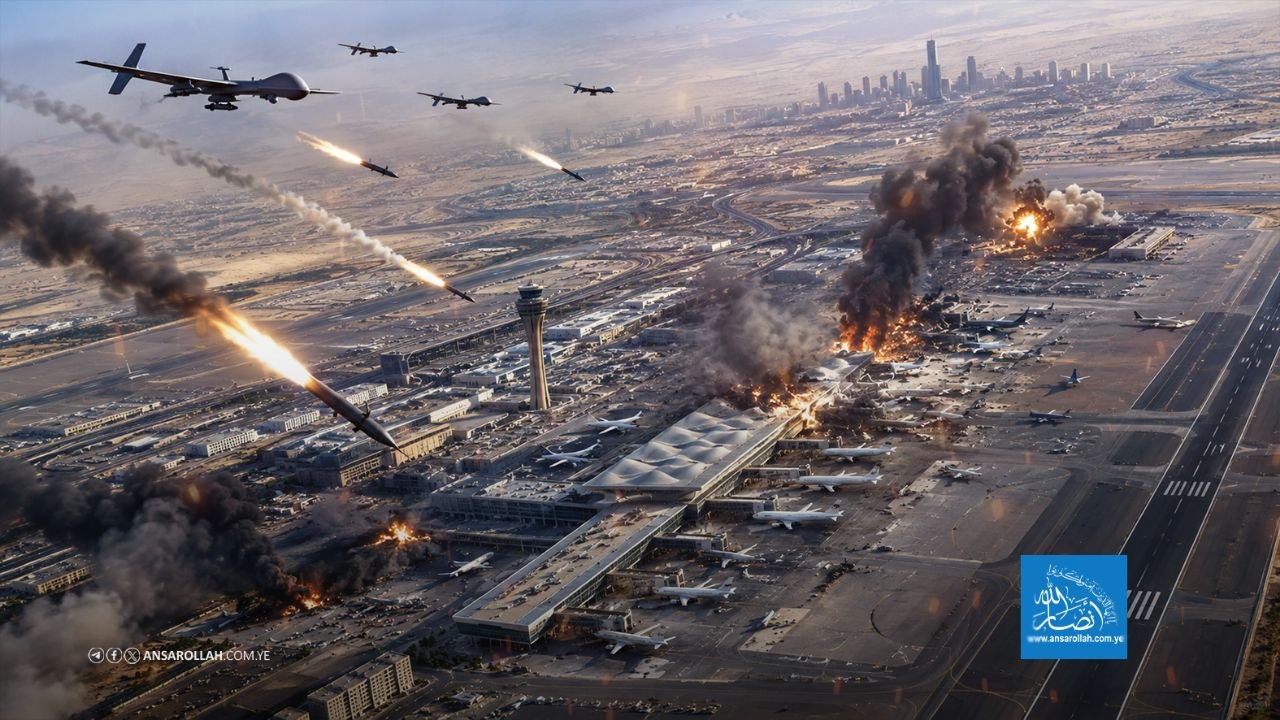
The recurrent closure of airports confirms the success of the Yemeni Armed Forces in establishing absolute field control over Saudi airspace and imposing an effective, comprehensive air blockade—with the exception of Makkah and Medina airports—alongside a continuous naval blockade on navigation. This growing operational paralysis and declining safety rates in air facilities and navigation routes do not merely reflect a shift in the balance of control; they have redefined the concepts of air and maritime sovereignty in a region that for years believed it was fortified behind the most formidable defensive armaments and cross-border protection shields.
Flightradar24 (specialized in tracking and analyzing international aviation) indicates that a sharp and continuous shift in flight paths over the region's airspace has been observed, alongside frequent suspensions of commercial flights and the rerouting of dozens of aircraft away from major airports as a direct result of threats and heightened operational risks.
Unprecedented Field Paralysis
This disruption has not been limited to civil and commercial aviation traffic; it has extended to shake deep confidence in Saudi defensive capabilities to protect its airspace and vital facilities. This was confirmed by the British newspaper The Times in its analysis of the field landscape, noting that the widening scope of Yemeni airstrikes and missile attacks targeting vital airports has created an unprecedented state of field paralysis, forcing airlines and partner entities to reassess security risks in the region.
Precise offensive operations carried out by Yemeni forces deep inside Saudi territory have escalated, prompting numerous tracking and monitoring centers to acknowledge that the continuation of this bleeding places the Saudi economic and security system before a harsh test. In its field coverage, Reuters stated that the succession of missile and drone attacks now threatens energy security and logistical activities, creating a state of permanent apprehension among companies and investors that has harmed the business environment.
No Retreat Except Through Peace Requirements
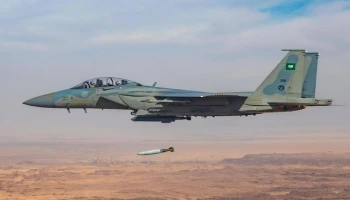
Faced with this, Saudi Arabia resorted to all available options. Suffering from the illusion of force, its actions remained limited to intensifying airstrikes, yet this direction was not at a level capable of settling the battle. Previous air campaign experiences by the axis of evil and American, British, and Israeli strikes have proven that air superiority does not translate to an ability to dismantle the military infrastructure of the Yemeni Armed Forces or inflict any impact on their field capabilities. This is precisely what has happened over twelve years during which numerous alliances were formed, and various types of bombs and missiles were used, causing massive destruction in Yemeni cities.
In tracking this interconnected military failure, the specialized military and intelligence affairs magazine Military Watch pointed out that heavy reliance on airstrikes and long-range targeting has proven the inability of traditional air superiority to paralyze the ballistic offensive capabilities of drones and precise missiles or curb their momentum. This explicit military characterization highlights how the technological and tactical development of the Armed Forces has turned Saudi air superiority into a mere indiscriminate destructive tool devoid of strategic and field utility.
Amid this military deadlock, Saudi Arabia roamed the world crying and wailing. At times, it attempts to turn the international community against Yemen under the pretext of navigation; at other times, it asks for direct assistance by launching attacks on Yemenis; at times, it resorts to forming new alliances; and at other times, it asks the Omani mediator to intervene to agree on a truce. While all desperate appeals ended in failure, Saudi intransigence continued to portray its ability to carry out a series of renewed crimes committed periodically followed by returns to truces. However, Yemen has firmly decided this time not to retreat except with the full requirements of peace, no matter the sacrifices—a matter agreed upon by all segments of society.
In an analytical journalistic report, the British newspaper Financial Times shed light on Saudi erratic maneuvers in facing Yemeni attacks and fleeing forward, pointing out that Riyadh's endeavors to mobilize international allies and impose foreign protection for corridors and facilities have faced rigid boundaries, pushing it to seek a negotiated exit via regional mediations amid mounting losses. These repeated pleas to regional mediations and international alliances have revealed to the entire world that the defensive cloak behind which Riyadh sheltered has been torn, and that no rounds of diplomacy will grant the enemy a lifeline unless it fully complies with the just humanitarian and political requirements of the Yemeni people.
Parity Was Not a Coincidence
This Saudi field collapse extended to connect with the reality of the sovereign equation and direct deterrence. Riyadh can no longer threaten and determine when and where to strike without receiving an immediate answer. Yemen's rise and declaration of the battle for liberation was neither a maneuver nor aimed at pressuring for narrow gains, but rather a strict orientation to end the state of subjugation, violation, and treatment of Yemen as a subordinate geographic area.
Hence, the Armed Forces announced their response to the call of the Yemeni people, who endured prolonged oppression and suffering to satisfy the appetite of a neighbor that violated the rights of neighborliness and the constants and teachings of religion. Consequently, its response matched the objective, preventing the enemy from remaining the sole decision-maker, exposing its reliance on the stick of others, and hurting it at the core of its assets, economy, and regional prestige.
In an extensive strategic reading of the new balance of power, the American magazine Foreign Policy affirmed that Sana'a has succeeded in imposing rules of engagement that stripped the other party of the ability to unilaterally decide escalation or determine its timing and location, forcing it to submit to a mutual and direct deterrence equation. This parity was neither a coincidence nor the result of momentary calculations, but the fruit of a solid popular willpower recognizing that breaking the backbone of aggression requires making the enemy pay the heaviest prices in the strongholds of its decision-making and economic joints.
When the enemy launched its threats and imagined they would serve as a deterrent, it received counter-threats. Its raids were always cowardly, targeting only civilians and their infrastructure, and it was met with painful strikes deep within its cities, allowing fires and smoke to continuously cover its skies.
Rapid Deterioration in Safety Levels
Within this fiery context of mutual escalation and harsh deterrence, economic facts confirm that the repercussions of these strikes touched vital centers and Saudi production joints. Bloomberg, in a specialized analysis regarding the economic repercussions of the security situation, stated that high security risks and direct military escalation place economic plans and foreign capital before complex challenges amid rising insurance costs and fears of targeting productive assets.
Along the same lines, the French security and intelligence platform Intelligence Online revealed suppressed anxiety within ruling circles in Riyadh, noting that security reports submitted to the leadership warn that the depletion of defensive capabilities and the failure of foreign armament umbrellas threaten structural stability and reduce available maneuvering options.
This state of economic terror and investment paralysis experienced by Saudi Arabia today is a natural and direct result of the continuous aggression and blockade on Yemen, and the persistence in ignoring firm Yemeni warnings. This erosion of presence and prestige affecting the core of its life (oil and investment), and this rapid deterioration in internal and public safety levels, undoubtedly reflect directly and catastrophically on all Saudi economic ambitions and major future projects built upon the premise of stability.
Analyses indicate that what is taking place on the ground is not mere skirmishes, but a collision with a solid strategic wall that revealed a deep deficiency in the Saudi defense and security system, specifically after the myth of absolute security and multi-billion-dollar defensive armament umbrellas collapsed before precise strikes that redraw the conflict map from its foundations and place Riyadh before a complete deadlock in field options.
Erosion of Political and Economic Capital
This precise military diagnosis, based on the repercussions of the field reality, is what also pushes many Western think tanks to acknowledge the continuous erosion of Riyadh's standing and resilience capacity. In an extensive reading of this strict dynamic, the Washington Institute for Near East Policy affirmed in an analytical study that the collapse of security prestige and the fall of prior deterrence equations compel regional parties to recognize the existing reality of parity, rather than betting on Saudi options of decisive force, which have proven ineffective on the ground. This confirms that the downfall of the absolute defense myth under the weight of focused strikes overturned the enemy's arrogant vessel and forced it to taste the bitterness of failure and strategic floundering.
The Economist magazine notes that the continuation of the confrontation and the expansion of the Yemeni target bank to encompass production centers, ports, and airports represent an economic nightmare for Riyadh, as continuous threats undermine long-term investment infrastructure and put economic transformation plans in jeopardy.
This troubled reality undoubtedly reflects the magnitude of the strategic quagmire Saudi Arabia placed itself in when it assumed the war on Yemen would be a short military stroll, only for it to turn into a continuous and open-ended exhaustion consuming the capital of its political and economic system, placing it before a naked truth that cannot be covered by media statements or exorbitant armament deals that have proven absolute field failure.
Gradual Sinking into Collapse
Based on this comprehensive field deadlock and the growth of strategic losses across economic and security levels, the leadership in Riyadh has no escape left except to submit forcibly to the realities of the field and move seriously toward a fair political settlement and realistic diplomatic dialogue as the sole exit to address the crisis from its roots, avoiding the drag into a long and costly war of exhaustion beyond the endurance capacity of institutional and economic structures and devoid of any prospects for a decisive outcome.
The reality of the situation confirms that the Saudi scene faces three main scenarios: either continuing military and economic bleeding and total operational paralysis under the blows of the expanding Yemeni target bank; or fleeing forward with foolish escalation met by harsher Yemeni responses targeting sovereign decision-making centers; or compulsory submission to field pressure and full compliance with just Yemeni conditions requiring the lifting of the comprehensive blockade, stopping the aggression, and paying reconstruction dues.
Consequently, these scenarios corner the system into a narrow angle with no room for evasion: either acknowledging the reality of failure and accepting the terms of a fair peace and full sovereignty imposed by Yemen with absolute parity, or gradually sinking into a comprehensive strategic collapse with no way out.
Submitting to the Voice of Rights or Continued Bleeding
Gauging from this, the American magazine National Interest affirmed in a strategic analysis of the conflict's future that any long-term exhaustion nightmare will necessarily mean continuous erosion in the components of the Saudi state, and that accepting the new field equations and responding to the other party's demands is the sole path to limiting catastrophic losses resulting from the continuation of the war.
This estimate intersects with ongoing data on the ground, as Yemen proves day after day that the peace equation cannot be attained through flawed mediations or anesthetic truces, but is rather imposed through the effectiveness of deterrence and high readiness to execute the harshest strategic strikes deep inside Saudi territory.
The truth shaping the awareness of experts is that political haughtiness has ended irreversibly before the steadfastness and capability of the Yemeni Armed Forces, and Riyadh can no longer bet on foreign protection to avoid the bills of aggression and blockade.
Before the successive paralysis of airports and vital facilities, the ball is now in the Saudi court: either respond to the voice of rights and fulfill the requirements of comprehensive peace by lifting the blockade and paying reconstruction compensation without procrastination, or persist in arrogance to face escalating strikes hitting the core of sovereign and economic decision-making centers, leaving Riyadh to face its inevitable fate under the weight of comprehensive bleeding and helplessness with no choice left but final submission to the will of Yemeni truth.