Ansar Allah website - Report -8 Jumada Al-Awwal 1448 AH
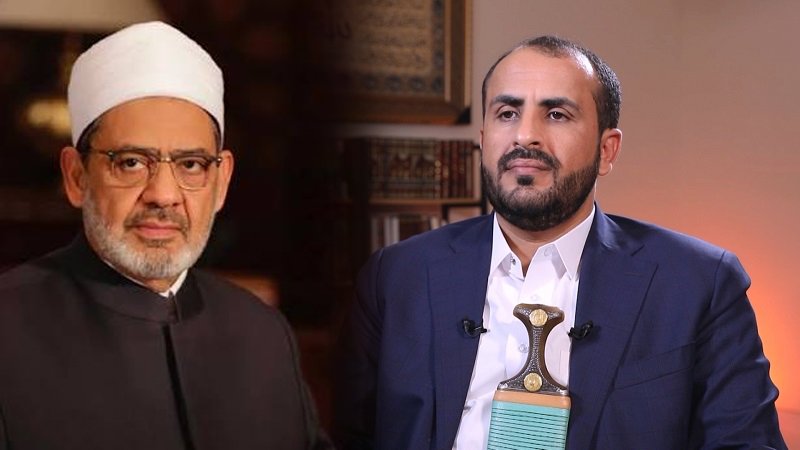
Mohammed Abdulsalam, the official spokesperson for Ansarullah and head of the National Negotiating Delegation, welcomed the call by Al-Azhar Grand Imam Dr. Ahmed Al-Tayeb to end wars in the region, affirming that Yemen had never threatened Saudi Arabia in any way nor initiated a war against it.
In a message addressed to the Grand Imam of Al-Azhar, Abdulsalam said: “As we welcome your responsible and wise call to end the wars in the region, we would first like to express our gratitude and appreciation for your kind initiative, praying to Almighty Allah to crown your efforts with success and guidance. We also hope that He grants you and the dear Egyptian people abundant goodness under the shade of Islamic dignity and Arab honor.”
He added: “You have graciously called for an end to conflicts in the region, and given that what is taking place between Yemen and Saudi Arabia is currently the most prominent, we wish to place before you indispensable facts concerning the Saudi aggression against the Yemeni people, which has continued from 2015 until today.”
Abdulsalam explained that the Yemeni people had never threatened the neighboring kingdom in any form, nor had they ever initiated a war against it. He noted that, before the outbreak of the 2015 war, Yemenis were experiencing political disagreements and military conflict, but regardless of the details of that period, the conflict remained internal.
He continued: “In an effort to prevent the conflict from escalating further, I was sent by al-Sayyid Abdulmalik Badruddin al-Houthi to the Kingdom at the beginning of 2015 to convey a message of reassurance and explain the nature of what was taking place inside our country, Yemen. The Kingdom was not to consider our Yemeni revolution a challenge to it, and we were prepared to resolve any political disagreement through dialogue and understanding.”
The head of the National Negotiating Delegation further stated: “This was the essence of the message that al-Sayyid Abdulmalik Badruddin al-Houthi entrusted me to deliver to the Kingdom during the reign of its late King Abdullah bin Abdulaziz. Following the king’s death, I was asked to return to my country, Yemen, in the hope that communication would resume later.”
He pointed out that what happened afterward was that the new leadership, under King Salman, ascended the Saudi throne carrying a plan for war rather than peace. “Thus, without any justification, events took a disastrous turn when the new Saudi regime, on March 26, 2015, took the Yemeni people and the region by surprise with airstrikes. The first targets that night, while people were asleep, were Sana’a International Airport and an adjacent residential neighborhood. The world awoke to what they called ‘Operation Decisive Storm.’ What is striking is that it was announced from Washington, in a treacherous and blatant act of aggression for which there was absolutely no justification.”
He continued: “Perhaps Saudi Arabia believed at the time that, with its American warplanes and open-ended American support, it could achieve a swift military victory. It failed to realize that it was only making matters worse and pouring more oil on the fire that is now burning on a wider scale as a result of that reckless and irresponsible adventure.”
Abdulsalam noted that, according to the principles of Islam, Arab solidarity, and good neighborliness, Yemen’s situation did not require foreign war. The Arab countries, particularly Saudi Arabia as the larger neighboring state, should instead have taken the initiative to resolve the disagreements among Yemenis peacefully, without siding with one party against another, and should have responded positively to the message of reassurance that he personally delivered on behalf of al-Sayyid Abdulmalik Badruddin al-Houthi.
He said: “It is no secret to you, Your Eminence, Grand Imam of Al-Azhar, as a man of knowledge and understanding who occupies a position of leadership and responsibility, that intervention to resolve a dispute between brothers must begin with dialogue, not war. If reconciliation is achieved, that is the desired outcome, and Allah will have spared the believers the evils of fighting. If reconciliation is not achieved, then it must be determined which of the two parties is transgressing, and that party must be restrained until it returns to the truth. Once it accepts the truth, the process of reconciliation must resume on the basis of justice, not dominance, so that no party feels aggrieved and the conflict does not reignite.”
He added that this is what the Holy Qur’an teaches, citing the verse: “And if two groups of believers fight, make peace between them. But if one of them transgresses against the other, then fight the one that transgresses until it returns to the command of Allah. If it returns, then make peace between them with justice and act equitably. Indeed, Allah loves those who act equitably.”
Abdulsalam continued: “What has been mentioned above is of great importance as an essential starting point for understanding the current situation, which is an extension of what came before. As we have explained, Saudi Arabia’s military intervention poured oil on the fire. It continued along the same path, committing massacres and documented crimes, in addition to imposing a suffocating blockade. All of this resulted in the shedding of the blood of tens of thousands of innocent citizens. Those who were not killed by airstrikes died because of the blockade, which itself claimed hundreds of thousands of lives.”
The head of the National Negotiating Delegation noted that, during its early years, the Saudi military intervention failed to achieve its objectives, which were illegitimate and has no basis in divine law. Nor, he added, did it spare the Kingdom the consequences of its aggression, which it continues to insist upon.
He recalled that this was followed by the 2022 truce, which the Yemeni people welcomed with hope that Saudi Arabia would seize the opportunity to extricate itself from its predicament and fulfill its obligations. However, the first year of the truce ended without any progress, even on urgent humanitarian issues.
Abdulsalam stated that, after the first year of the truce, a regional development took place with Operation Al-Aqsa Flood. The Yemeni people responded to the call of the people of Gaza by supporting them to the best of their ability. Unfortunately, he said, Saudi Arabia saw this as an opportunity to procrastinate and lie in wait for Yemen while it was occupied with supporting Gaza.
He continued that the truce consequently extended over four years, during which Saudi Arabia failed to rise to the level of responsibility and dealt irresponsibly with the consequences of its military aggression. Instead, he said, it intensified the blockade measures beyond their previous levels, with ships reaching the Port of Hudaydah only after months of obstruction and delay. This placed an additional burden on the Yemeni people, who faced rising commodity prices as the costs of goods increased due to these delays. He also accused Saudi Arabia of obstructing the payment of Yemeni public employees’ salaries, further worsening the humanitarian situation.
He continued: “It is necessary to clarify the facts. We have now reached the current stage, which does not differ from previous ones in that Saudi Arabia leans more toward war than peace, seeks domination rather than mutual respect, and behaves arrogantly, far removed from the teachings of Islam, which prohibits arrogance, particularly when a neighbor acts arrogantly toward another neighbor.”
Abdulsalam affirmed that the current phase began with Saudi airstrikes on Sana’a International Airport on July 13, without any justification. “We do not know how the return of Yemeni citizens from abroad to their homeland aboard an Iranian aircraft carrying an official delegation could constitute a violation of Yemen’s sovereignty, or how it could pose a threat to the security of the Kingdom,” he said.
He continued: “Once again, the Saudi regime acted arrogantly and launched airstrikes against Sana’a International Airport, which lies within the territory of the Republic of Yemen, not within Saudi borders. This was a blatant act of aggression and a major provocation to the Yemeni people. Those strikes were the straw that broke the back of the truce, from which nothing had been achieved. The Yemeni people had been anticipating peace, only to find themselves facing a new escalation.”
He added that what followed was a confrontation of escalation with escalation, in accordance with the words of Almighty Allah: “So whoever has assaulted you, then assault him in the same way that he has assaulted you,” and: “And whoever avenges himself after having been wronged—for those there is no cause for blame.”
Concluding his message, Abdulsalam said: “Your Eminence, respected Grand Imam of Al-Azhar, as we place before you the facts and events concerning what has happened and what continues to happen between the Republic of Yemen and the Kingdom, we renew our welcome for your gracious initiative. Sana’a would be honored to receive a visit by a committee of wise and respected figures of your choosing, whose members would embody the qualities Allah desires of those who seek reconciliation: piety and the courage to speak the truth, however difficult it may be.”
He cited the Qur’anic verses: “Those who convey the messages of Allah and fear Him and do not fear anyone except Allah,” and: “And do not let the hatred of a people prevent you from being just. Be just; that is nearer to righteousness.”
Abdulsalam stressed that the Yemeni people seek justice and fairness and ask for nothing beyond justice, while accepting nothing less than justice. He concluded: “And Allah is behind the intention, and He guides to the right path.”
Full Text of the Message
In the Name of Allah, the Most Compassionate, the Most Merciful.
Praise be to Allah, Lord of the Worlds. May Allah’s blessings and peace be upon our master Muhammad, the truthful and trustworthy, who delivered the trust, fulfilled the message, and strove for the cause of Allah as it deserved to be pursued until certainty came to him. May blessings and peace be upon him and his family, among the first and the last, and may Allah be pleased with his chosen and righteous companions.
To His Eminence, the respected Grand Imam of Al-Azhar, Professor Dr. Ahmed Al-Tayeb,
May the peace, mercy, and blessings of Allah be upon you.
As we welcome your responsible and wise call to end the wars in the region, we would first like to express our gratitude and appreciation for your kind initiative, praying to Almighty God to crown your efforts with success and guidance. We also hope that He grants you and the dear Egyptian people abundant goodness under the shade of Islamic dignity and Arab honor.
Your Eminence, respected Grand Imam of Al-Azhar,
You have graciously called for an end to conflicts in the region. Given that what is taking place between Yemen and Saudi Arabia is currently the most prominent, we wish to place before you indispensable facts concerning the Saudi aggression against the Yemeni people, which has continued from 2015 until today.
The Yemeni people have never threatened the neighboring Kingdom in any form, nor have they ever initiated a war against it.
Before the outbreak of the 2015 war, we Yemenis were experiencing political disagreements and military conflict. Regardless of the details of that period, the conflict was internal. In an effort to prevent it from escalating further, I was sent by al-Sayyid Abdulmalik Badruddin al-Houthi to the Kingdom at the beginning of 2015 to convey a message of reassurance and explain the nature of what was taking place inside our country, Yemen. The Kingdom was not to consider our Yemeni revolution a challenge to it, and we were prepared to resolve any political disagreement through dialogue and understanding.
This was the essence of the message that al-Sayyid Abdulmalik Badruddin al-Houthi entrusted me to deliver to the Kingdom during the reign of its late King Abdullah bin Abdulaziz. Following the king’s death, I was asked to return to my country, Yemen, in the hope that communication would resume later.
What happened afterward was that the new leadership, under King Salman, ascended the Saudi throne carrying a plan for war rather than peace. Thus, without any justification, events took a disastrous turn when the new Saudi regime, on March 26, 2015, took the Yemeni people and the region by surprise with airstrikes. The first targets that night, while people were asleep, were Sana’a International Airport and an adjacent residential neighborhood. The world awoke to what they called “Operation Decisive Storm.” What is striking is that it was announced from Washington, in a treacherous and blatant act of aggression for which there was absolutely no justification.
Perhaps Saudi Arabia believed at the time that, with its American warplanes and open-ended American support, it could achieve a swift military victory. It failed to realize that it was only making matters worse and pouring more oil on the fire that is now burning on a wider scale as a result of that reckless and irresponsible adventure.
Furthermore, according to the principles of Islam, Arab solidarity, and good neighborliness, Yemen’s situation did not require foreign war. The Arab countries, particularly Saudi Arabia as the larger neighboring state, should have taken the initiative to resolve the disagreements among us Yemenis peacefully, without siding with one party against another, and should have responded positively to the message of reassurance that I personally delivered on behalf of al-Sayyid Abdulmalik Badruddin al-Houthi.
Your Eminence, Grand Imam of Al-Azhar, as a man of knowledge and understanding who occupies a position of leadership and responsibility, it is no secret to you that intervention to resolve a dispute between brothers must begin with dialogue, not war. If reconciliation is achieved, that is the desired outcome, and God will have spared the believers the evils of fighting. If reconciliation is not achieved, then it must be determined which of the two parties is transgressing, and that party must be restrained until it returns to the truth. Once it accepts the truth, the process of reconciliation must resume on the basis of justice, not dominance, so that no party feels aggrieved and the conflict does not reignite.
This is what the Holy Qur’an teaches, as Almighty Allah says:
“And if two groups of believers fight, make peace between them. But if one of them transgresses against the other, then fight the one that transgresses until it returns to the command of Allah. If it returns, then make peace between them with justice and act equitably. Indeed, Allah loves those who act equitably.”
Respected and noble Sheikh,
What has been mentioned above is of great importance as an essential starting point for understanding the current situation, which is an extension of what came before.
As we have explained, Saudi Arabia’s military intervention poured oil on the fire. It continued along the same path, committing massacres and documented crimes, in addition to imposing a suffocating blockade. All of this resulted in the shedding of the blood of tens of thousands of innocent citizens. Those who were not killed by airstrikes died because of the blockade, which itself claimed hundreds of thousands of lives.
This was the nature of the Saudi military intervention during its early years. It neither achieved its objectives, which were illegitimate and had no basis in divine law, nor did it spare the Kingdom the consequences of its aggression, which it continues to insist upon.