Saudi Arabia’s ambitious Vision 2030 plans have long revolved around impressive figures and grand hopes of achieving success beyond dependence on oil sales. They represented a sweeping dream built from transparent glass and illuminated cubes stretching along Saudi Arabia’s coastlines and across its sands. Yet 2026 has brought no smiles to these rosy blueprints. Instead, it has brought headwinds and denied them the security they sought, owing to the Saudi regime’s drive to dominate and possess Yemen.
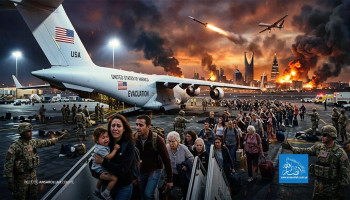
This year has become a year of reckoning, the harshest test, and a pivotal turning point measuring the ability of grand dreams to withstand the storm of Yemeni defensive operations. This dangerous turning point took shape when Riyadh found itself on the threshold of a deep and acute predicament following its reckless gamble on a military escalation campaign against Yemen. The campaign began with an act of arrogance, when Saudi Arabia deliberately bombed Sana’a International Airport to prevent Yemenis from landing there. Events then unfolded in ways its calculations had failed to anticipate: Yemen announced its broader equation of liberation, and the repercussions dealt a crushing blow to Saudi Arabia’s economic ambitions, turning sweeping development promises into a mirage worthy of contemplation.
This sudden crisis did not emerge from a vacuum or result from fluctuations in global energy markets. Rather, it was the inevitable outcome of a harsh and ongoing strategic confrontation, embodied in comprehensive Yemeni military operations backed by a highly effective deterrence system. These operations went beyond the limits of the “naval blockade,” penetrating Saudi Arabia’s vital strategic depth on an unprecedented scale and successively exposing signs of severe financial incapacity, declining foreign investment inflows, and a massive contraction in the scale of mega-projects.
Investment Drought and Planning Paralysis
Against this uncompromising military reality, the Yemeni front—with its military and strategic strength—imposed a constraining and tightly controlled security environment that made the continuation of grand plans virtually impossible. It transformed the anticipated financial surplus into a continuous daily drain to cover the costs of open-ended escalation.
After years of pouring hundreds of billions of petrodollars into building “smart cities and architectural cubes” spread across the coasts and inland areas, Yemeni operations imposed a firm and decisive rhythm, resulting in a worsening financial deficit documented in detail by successive international reports. Reuters revealed in an in-depth analytical report that Saudi Arabia’s budget deficit was widening and that Riyadh had been forced to freeze and postpone major financial packages allocated to long-term projects, specifically to secure the liquidity needed to meet the exorbitant costs of the security situation and the emergency military commitments imposed by the Yemeni front through overwhelming force.
In the same context, Middle East Eye confirmed that the economic vision had entered an unavoidable direct confrontation with fears over soaring operating costs. Successive Yemeni operations, including missile and drone attacks, had brought investment plans in tourism and logistics to an almost complete standstill, forcing Riyadh to reorder its priorities against its will in order to prevent its cash reserves from being eroded by continuous attrition.
Resetting the Ceiling of Expectations
The repercussions of Yemeni operations disrupted coastal projects and struck at the core of the assumption of “domestic and security stability” on which the philosophy of economic diversification and attracting capital had originally been built. The widening scope of these operations and their exceptional ability to reach Saudi Arabia’s strategic depth and vital flank triggered severe and alarming shocks to confidence in global investment markets.
Agence France-Presse (AFP) indicates that major projects and vast urban development schemes have come under sharp reductions and comprehensive, painful restructuring to accommodate the realities of an ongoing military threat. This followed the complete evaporation of hopes of transforming the country into a safe investment oasis isolated from the equations of a region engulfed in conflict.
Meanwhile, Russia’s Sputnik news agency quoted senior strategic experts as saying that Saudi Arabia now finds itself compelled to reshape its priorities and redirect resources from the Public Investment Fund toward addressing debt pressures and high borrowing requirements associated with security containment, rather than expanding the projects generated by its glittering vision plans.
In the same context, the British newspaper The Guardian highlighted the severe structural difficulties facing the implementation of major projects on the ground. It noted that the collision between ambitious development plans and ongoing military operations across a broad, multidimensional front had made “resetting the ceiling of expectations” the only compulsory option to avoid an economic and financial shock with potentially catastrophic and unpredictable consequences.
Widening Gap Between Revenues and Obligations
The critical importance of 2026 emerges as a narrow bottleneck that cannot be circumvented on the path toward the desired transformation. This is due not only to the accumulation of heavy debt, but also to the fact that project deadlines for major developments have coincided with the entrenchment of the comprehensive Yemeni military equation.
The operational plan had proceeded smoothly on the assumption that capital inflows would continue uninterrupted. However, sustained Yemeni military pressure has caused profound disruption that cannot be ignored or overcome. The exorbitant costs of insurance, protection for sensitive facilities, and shifts in global trade routes have dealt a crushing blow to revenues from ports and major logistics projects.
In an extensive report, The Wall Street Journal indicated that foreign companies and suppliers had already begun experiencing clear delays in collecting payments and undertaking sharp, fundamental reviews of existing contracts. These developments were attributed to the state of security and political uncertainty imposed by the open confrontation with Yemen, casting a dark and heavy shadow over Riyadh’s ability to meet previously announced project timelines.
Deep economic concerns have intensified further as the response of the banking sector and capital markets to the new reality comes under scrutiny. The Economist revealed that the Kingdom has increasingly—and alarmingly—turned to sovereign bonds and domestic borrowing from commercial banks to cover the widening gap between oil revenues and massive capital commitments, a gap exacerbated by the costs of widespread security tensions. This reliance is itself gradually and dangerously draining liquidity available to the domestic private sector.
This has been accompanied by a critical assessment published by the British newspaper The Telegraph, which explained that announced deadlines for mega-projects such as NEOM and The Line have increasingly begun slipping toward indefinite and ambiguous postponements. Yemeni operations, it said, have imposed a security reality in which international investors are entirely reluctant to inject capital into areas that could become conflict zones.
Attempts to Rescue Vision Projects
The difficulties in implementing these projects stem from a complex combination of three structural risks, primarily generated by the volatile geopolitical environment created by attacks carried out by the Yemeni Armed Forces.
The first risk is the clear gap in foreign direct investment. Despite all the legislative incentives and inducements offered, foreign capital inflows have remained far below announced targets because global capital, by its inherently timid nature, flees areas threatened militarily and strategically.
In this context, the Financial Times explained in a major investment report that Western investors are approaching Saudi projects with extreme caution and deep suspicion. They prefer to collect quick fees from services and consultancy contracts rather than commit long-term financial assets in an environment where Yemeni operations pose substantial risks to infrastructure.
The second challenge is the continued structural dependence on energy prices and export revenues to cover rising financial and security expenditures associated with the military repercussions. Bloomberg highlighted this issue, affirming that disruptions to routes and production caused by military operations had directly affected the government’s ability to provide the liquidity required for development spending.
The third challenge is the exorbitant financial cost of issuing external debt and rising global interest rates amid regional instability stemming from the raging Yemeni front.
The reassessment of capital flows has extended to attitudes toward global financial institutions. The New York Times reported that senior hedge fund managers in the United States and Europe are urgently demanding unprecedented sovereign guarantees before agreeing to provide direct financing for Vision projects, citing the direct military and strategic threats posed by Yemeni operations to the Saudi economy. This raises debt-servicing costs and increases the heavy burden on the state budget.
Western Desire to Exhaust Saudi Arabia
Amid these enormous financial challenges and major geopolitical shifts shaped by the Yemeni front, Saudi Arabia appears to be left alone to bear the costs of these major crises, while its Western strategic allies remain in the position of observers and beneficiaries.
Current developments and analytical assessments indicate that Western companies and American consultancy firms have treated the transformation vision as a purely profitable commercial opportunity, ensuring billions of dollars in revenue through design and management contracts without volunteering to assume any genuine investment risks in an insecure environment.
Foreign Policy magazine highlighted this deep strategic gap, asserting that Washington and its Western allies do not view the financial difficulties facing Saudi projects as a crisis warranting military or political intervention to protect them. Instead, they regard the plan as a domestic development undertaking governed by market rules and the purely military risks generated by the Yemeni front.
Foreign Affairs, in an analytical study, argues that Washington and European capitals prefer Saudi financial resources to remain under continuous strain as the Kingdom fulfills its modernization commitments and deals with the repercussions of Yemeni military escalation. This, the analysis suggests, prevents Riyadh from using its financial surplus to build independent strategic alliances or compete on equal terms in global technology markets, thereby preserving the gains of Western hegemony without direct investment in Saudi Arabia’s development vision, which is under threat on the ground.
Meanwhile, The National Interest states that Western allies are primarily focused on selling security and defense equipment to the Kingdom at exorbitant and astronomical prices, rather than taking serious, practical steps to end the military threats that have undermined the vision’s economic viability.
While the vision assumed a completely stable regional environment built around secure trade, tourism, and logistics connectivity, developments over recent months have demonstrated that this stability was a fragile illusion crushed by comprehensive Yemeni operations.
The continued disruption of Saudi maritime navigation has dealt a devastating blow to coastal tourism and logistics projects. Lloyd’s List, a publication specializing in maritime affairs, reports that rising maritime insurance costs and changes to global shipping routes caused by Yemeni operations have cast a dark and heavy shadow over the economic viability of ports and projects extending along the Kingdom’s western coast, transforming them from glittering gateways to the future into high-risk points of contact.