Ansar Allah website- Report
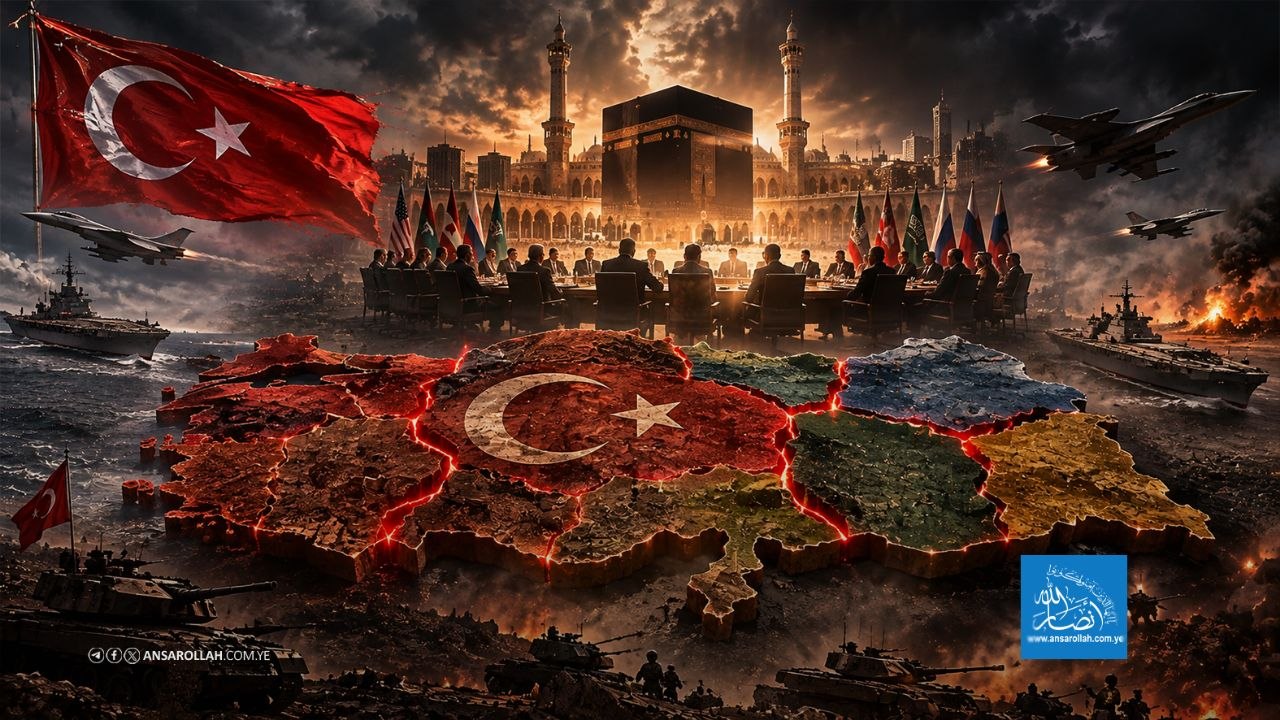
The joint defense agreement between Turkey, Saudi Arabia, and Pakistan has reignited domestic debate in Turkey over the limits of Ankara’s regional military role, with Yemen emerging at the center of this debate as the destination where opponents fear Turkish soldiers could be dragged.
While the government presents the agreement as a framework for deterrence and defense cooperation, opposition forces accuse it of burdening Turkey with foreign conflicts, while other groups link their rejection of the pact to solidarity with Palestine and Gaza, as well as opposition to imperialism and Zionism.
The Turkish Parliament approved the agreement on November 5, 2026, by a vote of 277 to 118, backed by the ruling, Islamist-leaning Justice and Development Party (AKP), the ultra-nationalist Nationalist Movement Party (MHP), and the secular, Kemalist, and social-democratic Republican People's Party (CHP).
Meanwhile, it was opposed by leftist, nationalist, and conservative Islamist forces, exposing divisions that transcend the usual government-opposition confrontation, as opposition parties themselves fractured over the agreement and the extent of its risks.
Yemen and Palestine in Turkish Political Consciousness
Dogu Perinçek, leader of the left-nationalist, Eurasianist, and anti-Atlanticist Patriotic Party, articulated one of the clearest positions linking the rejection of intervention in Yemen with solidarity with Palestine.
In a letter addressed to lawmakers on October 27, 2026, he argued that the alliance is moving toward protecting Saudi governance and countering what he described as the Yemeni War of Independence, warning that tying Turkish capabilities to this trajectory places them at the service of U.S. and Israeli interests.
The leader of the Patriotic Party linked the deployment of Turkish soldiers to the Yemeni front—or supporting the forces engaged there via Saudi Arabia—to inflicting harm on Palestine, Gaza, and Turkey's future.
He called for regional cooperation uniting the forces confronting U.S. and Israeli aggression, anchoring his discourse in a perception that views the Yemeni confrontation as part of a broader struggle for the region's independence.
The Patriotic Party had previously objected to framing the agreement as an anti-Israel arrangement, pointing to the conspicuous absence of Palestine, Yemen, and Iran from its signatories, as well as what it views as a convergence between the pact's functions and American interests.
From this standpoint, the pivotal question it raises concerns who the military force will be used against and what impact such deployment will have on the peoples confronting Israel.
Iskender Bayhan, a lawmaker from the Marxist-leaning Labor Party, expanded upon this linkage during the parliamentary debates, placing the agreement within the framework of U.S. efforts to reshape the region and viewing it as a parallel track to the Abraham Accords.
He argued that Palestinian steadfastness in Gaza and Iran's resistance have erected major obstacles to the U.S.-Israeli project, and that the new alliance serves, in his assessment, to distribute the burden of confrontation among other regional powers.
The Name of Mecca Does Not Bestow Sanctity on War
A vocal objection emerged regarding the weaponization of religious symbolism to market the agreement. Erkan Baş, leader of the socialist and Marxist Workers' Party of Turkey (TİP), accused the government of choosing the name "Mecca" to stifle debate, criticizing the exploitation of citizens' religious sentiments and sanctities to justify foreign military commitments.
The leader of the socialist Workers' Party posed a direct question concerning the nature of the dispute between Turkey and the Yemeni people, and regarding the Turkish national interest that Yemen has supposedly harmed to make confronting it a prospective option.
He tied this question to his accusation that the authorities are prepared to sacrifice the sons of workers and the poor in war to serve U.S., Israeli, and Saudi interests.
This objection faces a counter-narrative invoking the protection of holy sites to justify supporting Riyadh. İsmail Özdemir, deputy leader of the right-wing, ultra-nationalist Nationalist Movement Party (MHP), linked backing Saudi Arabia to the historical responsibility of protecting Mecca and Medina, defending the provision of military assistance within the framework of the alliance.
Consequently, the division extends to the very definition of the war and the limits of linking the security of the Saudi regime to the sanctity of the holy places.
The controversy over the name reveals a struggle over the legitimacy of political decision-making, as opponents reject the transference of Mecca's sanctity to a governmental agreement subject to scrutiny and accountability, demanding instead that its commitments be evaluated based on the intended use of force, its costs, and the interests of Turkish society.
The Poor Shoulder the Costs of War
Erkan Baş, leader of the socialist Workers' Party of Turkey (TİP), imbued his objection with a distinct social dimension, interweaving discussions of poverty, unemployment, housing crises, and pensioners' hardships with a critique of the government's foreign policy priorities.
He cautioned against driving the children of working-class families into a confrontation devoid of any justification in Turkey's interests.
The leader of the socialist Workers' Party had previously criticized the stark contradiction he perceives between the government's rhetoric on Palestine and its practical choices, declaring his refusal to expose Turkish youth to death in defense of Israel—alluding to the anticipated consequences of entanglement in the Yemeni war.
This stance derives its potency from connecting soldiers' lives and social backgrounds to the interests they may be ordered to fight for.
Iskender Bayhan, a lawmaker from the Marxist Labor Party, adopted a broader class-conscious perspective, tying the agreement to militaristic policies and the interests of capital.
He criticized the use of force to safeguard the survival of the Saudi monarchy and linked foreign policy to an economic agenda that diverts public resources toward monopolies and major corporations, while urging workers, youth, women, and democratic forces to broaden their mobilization against these policies.
This approach places the distribution of costs at the heart of the opposition. The gains touted by the authorities under the banners of regional influence and military cooperation are subjected, within the discourse of the leftist opposition, to the fundamental question of who truly benefits, while society bears the risks of entanglement and soldiers and their families pay the direct price.
Nationalist and Conservative Objections to the Alliance's Direction
The opposition extended well beyond leftist circles, Ozgur Ozel, leader of the center-left, secular party, cautioned against sending soldiers to Yemen, viewing such a move as serving the calculations of U.S. President Donald Trump alongside American and Israeli interests.
Murad Emir, deputy chairman of the party's social-democratic parliamentary bloc, similarly accused the government of paving the way for military commitments in the Yemeni war.
Meanwhile, Turhan Comez, deputy chairman of the parliamentary bloc of the Good Party (IYI Party)—a center-right, nationalist, and secular party—raised the prospect of Saudi Arabia normalizing relations with Israel, questioning Turkey's position and obligations should Riyadh pursue that path.
He also warned of the risk that a Saudi-Iranian dispute could escalate into a confrontation whose consequences Ankara would be forced to bear under the agreement.
Selçuk Ozdag, a lawmaker from the conservative Future Party and deputy leader of the New Way parliamentary bloc, which unites conservative and Islamist forces, confronted the government over its record on Gaza.
He accused it of contradicting its professed solidarity with the Palestinians while suppressing pro-Palestinian activities inside Turkey. Consequently, the Palestinian cause entered the debate from multiple angles, serving as a benchmark to question the alliance's credibility and underlying priorities.
Conclusion
The dissenting positions reveal that the parliamentary majority approving the Mecca Alliance failed to secure the Turkish government a political consensus regarding participation in the war on Yemen.
Leftist, nationalist, and conservative forces converged in rejecting the deployment of Turkish soldiers to a conflict they perceive as serving external interests, despite differing stances on Sana'a—with the left-nationalist Patriotic Party supporting its resistance to foreign intervention and describing it as a war of national independence, while other forces focus on safeguarding Turkish interests and preventing troop deployment.
Meanwhile, the labor left links its rejection of the war to defending the children of the poor and opposing imperialism and Zionism.
These objections place the government under direct scrutiny regarding any military support it extends to Saudi Arabia and the extent of its consistency with its professed backing for Palestine and Gaza.
Ultimately, the parliamentary vote on the agreement does not in itself signify the opposition's acceptance of deploying troops or providing military backing for the war, nor does the name of Mecca grant government decisions immunity from criticism and accountability.