Ansarollah Website Report | Ali Al-Darwani
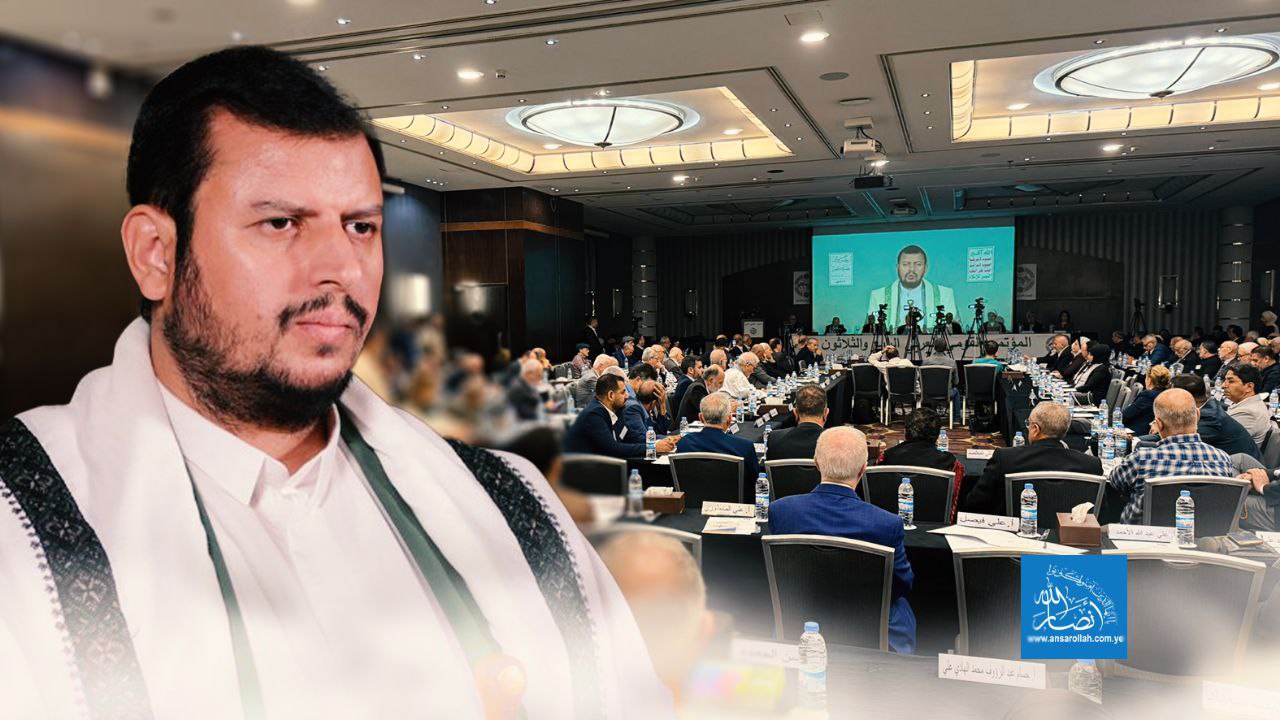
The speech delivered by Sayyed Abdul-Malik Badr al-Din al-Houthi at the Arab National Conference stands as a clear declaration of Yemen’s new position on the map of regional confrontation. Its significance lies in the fact that it comes from the heart of the battlefield — not from the chairs of observers, preachers, or pundits — but from a leader who advances at the head of his people in an open confrontation with the Israeli-American enemy. He portrays a region being remade by will even before it is remade by fire.
This was not a mere ceremonial participation in a political event. Rather, Sayyed — may Allah preserve him — redefined the nature of the challenge confronting the nation. He insisted it is neither a border dispute nor a simple struggle for spheres of influence between states, but an ongoing Zionist-American effort to forge a new Middle East in which Arab will is confiscated and the pillars of the nation’s strength are uprooted.
Facing these malicious schemes aimed at the Arab-Islamic nation, the Leader put forward his consistent position: there can be no protection of rights and no preservation of dignity without resistance that takes up arms and refuses submission. For him, the choice of resistance is not an empty ideological slogan; it is a condition for survival in an era when the enemy seeks to institutionalize a doctrine of pillage — one that violates the nation, exploits its resources and sovereignty, and strips away its will.
A Practical Stance Backed by Numbers
What gave the speech its strategic weight and practical value was that it was not mere rhetoric; it was anchored in figures that speak through action, not slogans. Yemen — once viewed for decades as a remote, marginal country known largely as a follower of regional and international powers, and in the last decade only as a victim of war and blockade — now emerges, as the speech reflects, as a decisive actor in the regional deterrence equation.
The numbers tell the story: 1,830 weapons — including ballistic missiles, cruise missiles, drones, and naval attack craft. At sea, 228 enemy-linked vessels were targeted, and the Israeli enemy was forced to shut down the Port of Umm al-Rashrash (Eilat) for two consecutive years.
Hundreds of military operations, strikes on vessels tied to the enemy, the downing of advanced American aircraft, and confrontations with aircraft carriers in the Red Sea — all carried out without the movement’s flag ever lowering or the pulse of the street fading. It is the language of deeds that needs little explanation: a nation that has chosen to pay for its dignity with blood, not silence.
Equally striking is that Sayyed did not present resistance as a purely military act. He defined it as a structure built first on awareness and then on popular participation. From this foundation, he addressed the assembled elites at this important conference, urging broad mobilization at all levels — with intellectual and societal leaders at the forefront — to awaken the peoples of the nation and expand public awareness of the sweeping conspiracies targeting everyone without exception. This comes as the Zionist enemy openly declares its pursuit of what it calls a reconfiguration of the Middle East — the creation of what it terms “Greater Israel.”
The Axis of the Nation — Not the Axis of Iran
Confronting the Western narrative that tries to frame the ongoing events as a confrontation between Iran and “Israel,” the speech reset the discourse to its proper context: the land is Arab, the wound is Arab, and the resistance is a defense of the nation’s identity — not an extension of any foreign influence. In doing so, the Palestinian cause is restored to its central place in our collective consciousness, not to absolve Iran, but to reaffirm that those who fight for Palestine are, in truth, fighting for the entire nation — including those who conspire against the supporting front, and perhaps even on behalf of some of them before others.
As the speech forcefully stated:
“The most absurd argument is the one that denies the plain facts — that the occupied lands are Arab lands, that the Israeli enemy kills Arabs, exterminates Arabs, and violates Arabs, while Iran’s role is one that supports the Arabs and stands with the causes that belong to the entire Islamic nation.”
A Ceasefire Imposed — Not Granted by Zionist Will
The speech underscores a central truth: the Zionist enemy did not move toward halting its aggression of its own free will. It was compelled — forced to bend — under the pressure of the resistance in Gaza and the supporting fronts, and under the awakening of global publics whose conscience could no longer be silenced. Yet this reluctant retreat in no way signals an abandonment of the “Greater Israel” project. For that reason, surrendering any element of strength would be a grave mistake that would drag the nation back to its earliest square of weakness.
In this sense, Sayyed’s address read like a document containing a far-sighted vision that extends beyond the current war — a vision of a new Arab role that transcends the era of defeat and dependency, placing popular will and resistance at the center of historical action. It is a speech that reflects Yemen’s shift from a country burdened by wounds to a country shaping outcomes and resetting the equations of security — at sea and on land alike.
A Comprehensive Project
In his address, Sayyed Abdul-Malik al-Houthi outlined the contours of a comprehensive project for the nation — one rooted in a deep awareness of the adversary’s nature and not content with merely diagnosing the threat. The project holds that Arab-Islamic unity on Palestine is the cornerstone of any genuine resurgence, and that the multiple arenas — from Yemen to Lebanon, Gaza and Iraq — must not remain isolated islands but a single, integrated front in which roles complement one another and wills unite on the path to liberation.
Within this framework, arms are neither an end in themselves nor a show of brute strength; they are one instrument among others of confrontation — a shield that protects land and honor, preserves peoples’ identities, and guarantees their right to self-determination. It envisages peoples who will not yield to storms, sustained by an unbreakable resolve in the face of siege or threat, whatever the cost. Ultimately, it is a project aimed at restoring the nation’s self-confidence and reclaiming its place as a central, active player in the equation of conflict — not a mere spectator to its outcomes