Ansarollah Website Official Report
Published: Rajab 4, 1447 AH
The acts of heroism being demonstrated today by the Yemeni people in confronting American-Zionist arrogance are a natural outcome of the deeply rooted identity that our people possess and act on the basis of. This identity is a comprehensive faith-based identity, summarized by the Prophet Muhammad—peace and blessings be upon him and his family—when he said: “Faith is Yemeni, and wisdom is Yemeni.” Because one of the foremost principles of this faith is liberation from subservience to tyrants, the Yemeni people have moved to support the oppressed Palestinian people, confronting some of the strongest armies in the world armed with the weapon of faith, relying on Allah Almighty, His assistance, and His guidance.
Just as the ancestors from the Aws and Khazraj tribes supported our Honorable Messenger—peace and blessings be upon him and his family—the Yemeni people today are following the same path, bearing the responsibility of supporting the oppressed and protecting the entity of the Muslim nation. This is set against a backdrop of Arab and Islamic deviation from identity, reaching its lowest level today, to the extent that Jews—upon whom humiliation and poverty were imposed—were able to subdue more than two billion Muslims. In contrast, the Yemeni people, when they embraced an Islamic identity, stood to confront the strongest armies, overcame them, and remained steadfast in the face of all challenges despite modest capabilities.
When Yemen rose in support of Gaza, this action was framed not as a departure from the norm but rather as a return to origins. Similarly, when the Yemeni street erupted in anger over the burning of the Holy Qur’an and insults against it, this was not viewed as a spontaneous or isolated act, but as an honest expression of an identity that considers the Qur’an its soul, faith its compass, and dignity its red line.
In Gaza, Yemenis saw their own image, and they saw the essence of their faith being targeted. Gaza, in Yemeni consciousness, is a faith-based cause defined by truth confronting falsehood and the oppressed confronting tyranny. Accordingly, Yemeni positions—both popular and official—were firm and clear, because a faith-based identity does not recognize neutrality when truth is slaughtered before the eyes of the world. Faith, in its essence, is portrayed as a stance, and faith-based belonging requires alignment with the oppressed rather than settling for cold sympathy or timid statements.
From this standpoint, Yemen moved on the basis that supporting Palestine is part of faith and humanity, that silence constitutes betrayal of identity, and that abandoning Gaza means abandoning the essence of “Faith is Yemeni.” This is presented as an equation unacceptable to a Yemeni whose awareness has been shaped by the belief that faith is action, not mere claim.
Anger for the Holy Qur’an
When the Holy Qur’an was burned, and hateful hands reached out to desecrate the most sacred sanctities of the Islamic Ummah, Yemenis did not view this as an isolated incident, but as a direct attack on their identity. In Yemeni consciousness, the Qur’an is described as the constitution of life, the source of values, and the foundation of identity. For this reason, Yemeni anger was characterized as conscious and profound, transcending superficial reactions. An attack on the Qur’an is framed as an attack on faith itself, and an attack on faith as an attack on dignity—dignity which, within Yemeni identity, is not subject to compromise.
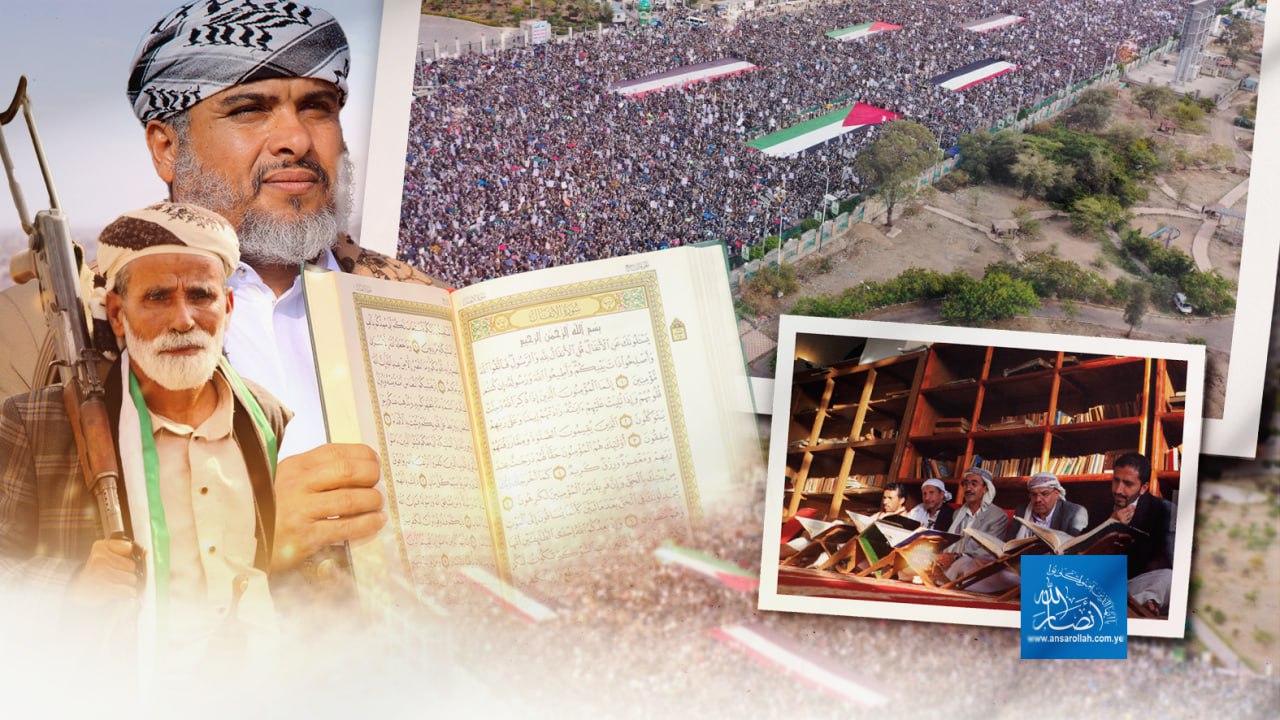
The Yemeni people’s mobilization in anger for the Qur’an began, with the leader Sayyed Abdulmalik Badruldeen al-Houthi, who issued a statement describing the heinous crime committed by an American candidate who burned the Qur’an as a step within the framework of the Zionist war against the identity and sanctities of the nation. This war is portrayed as seeking to erase the Islamic Ummah and dominate it spiritually, intellectually, economically, and territorially. In his statement, the leader called for widespread popular anger, which reportedly received an unprecedented response reflecting the deep-rooted reverence for sacred symbols among the Yemeni people. More than 1,500 large mass marches reportedly took place in the capital Sana’a and various provinces. Students in schools, universities, and institutes organized large-scale vigils, in addition to mass participation by employees of official institutions. This anger is an embodiment of living faith that refuses silence and refuses to turn the sacred into an object of mockery under the name of false freedom, created to protect hatred, rather than human dignity.
Faith-Based Identity When It Produces a Non-Negotiable Stance
What distinguishes the Yemeni’s position today is its internal consistency. Yemen, which voluntarily chose Islam and embraced faith with awareness, is the same Yemen that now refuses submission to tyranny—whether manifested in aggression against Gaza, desecration of the Qur’an, or projects of enslavement and domination. When faith-based identity is alive, it does not remain confined to slogans, but transforms into a stance, into anger in the face of falsehood, into support for the oppressed, and into steadfastness unshaken by pressure or siege.
Pressure or siege. This is how the episodes connect from the Friday of Rajab, on which Yemenis entered Islam without a sword, to the squares of anger in defense of the Qur’an, to the positions of support declared for Gaza. These are one chain, one root, and one identity: the identity of faith, wisdom, and dignity. In this sense, the contemporary Yemeni positions are presented as renewed confirmation that when faith settles in hearts, it turns into action, and when it is deeply rooted in identity, it becomes a stance that cannot be bought or broken.
Why Do Yemenis Commemorate Jum‘at Rajab?
Jum‘at Rajab, also known as “al-Rajabiyyah,” is an occasion commemorated by the Yemeni people, who take pride in the description given by the Messenger of Allah, peace and blessings be upon him and his family, when he said: “Faith is Yemeni, and wisdom is Yemeni.” Yemenis regard this as a badge of honor coming from the Seal of the Messengers, and as a clear indication of the level of faith and wisdom with which Allah Almighty distinguished the Yemeni people above other peoples of the Islamic world.
Yemenis commemorate this occasion on the first Friday of the month of Rajab each year because of its great importance and because it represents a bright and honorable page in their history. On the first Friday of Rajab, a large number of Yemenis embraced Islam voluntarily, without the strike of a sword or the thrust of a spear. Subsequently, delegations from Yemen came in large numbers to enter Islam and pledge allegiance to the Prophet, peace and blessings be upon him and his family.
Jum‘at Rajab as a Historical Milestone in Yemenis’ Affiliation with Islam
Jum‘at Rajab is a historic occasion and a great memory for Yemenis, constituting a fundamental milestone in the history of this people’s affiliation to Islam. The Prophet Muhammad—peace and blessings be upon him and his family—sent Imam Ali, peace be upon him, with a message to Yemen inviting its people to Islam. The response was swift, and the acceptance voluntary, with full desire and conviction. On that day, a large number of Yemenis entered Islam and declared their faith. Imam Ali wrote to the Prophet informing him of this in some detail, upon which the Prophet prostrated in gratitude to Allah and was filled with great joy.
Historically, Yemenis are described as having distinguished themselves by supporting Islam and defending its sanctities. At the beginning of the prophetic mission, when the Prophet—peace and blessings be upon him and his family—began calling to Islam in Mecca on an individual level, only a small number believed in him. Among the most prominent of these were individuals of Yemeni origin, such as Ammar ibn Yasir and his parents, as well as al-Miqdad, known as al-Miqdad ibn al-Aswad al-Kindi. Ammar and al-Miqdad are presented as among the great and virtuous companions of the Prophet who believed, endured, struggled, combined jihad with migration and faith, and possessed great awareness, insight, and elevated status in their belief and precedence.
On a collective level, the faith of the Aws and Khazraj tribes—the Ansar—is highlighted. They are described as having the honor of early belief and support, hosting the Messenger of Allah, supporting him, and entering Islam. The Aws and Khazraj are identified as being of Yemeni origin.
This was followed by further individual and group conversions, but the broad and significant transformation occurred on Jum‘at Rajab. At the end of the eighth year and the beginning of the ninth year after Hijrah, the Prophet—prayers and blessings be upon him and his family—sent Imam Ali ibn Abi Talib, peace be upon him, as his first envoy to Yemen, to Sana’a and the tribes of Hamdan. Sana’a and the entire region of Hamdan embraced Islam at his hands on the first Friday of Rajab. Imam Ali wrote to the Prophet informing him of this, and when the Prophet read the letter, he fell in prostration to Allah, then raised his head and said: “Peace be upon Hamdan, peace be upon Hamdan, peace be upon Hamdan.” In another narration, he is reported to have said: “Hamdan is an excellent tribe—swift to support, patient in hardship; among them are substitutes and among them are pillars.”
The widespread acceptance of Islam by the people of Yemen on the first Friday of Rajab established this occasion firmly in Yemeni collective memory and historical consciousness. It became a cherished occasion celebrated by Yemenis every year on the first Friday of Rajab, known in popular memory as al-Rajabiyyah.
The Identity of the Yemeni People
No nation on earth exists without an identity—whether correct, flawed, or mixed, sometimes even blending truth with falsehood or superstition. Some nations, peoples, and entities are said to rely heavily on superstition in their beliefs, concepts, customs, and traditions. Yet what binds such peoples together remains those customs, traditions, beliefs, and patterns of life upon which they rely.
Identity is thus defined as the totality of cultural, social, and personal characteristics that define an individual or group and distinguish it from others. It represents a sense of self and belonging that encompasses values, beliefs, and history.
From this perspective, the identity of the Yemeni people is presented as a faith-based identity, most clearly expressed in the saying of the Prophet, peace and blessings be upon him and his family: “Faith is Yemeni.” This is described as the greatest, most sacred, and most honorable identity, with no identity surpassing it.
Faith-based identity, as defined here, consists of principles, values, morals, and concepts that descend into real life and upon which life is built. Faith is portrayed as a stance and as an integrated system of principles, values, ethics, behaviors, actions, positions, and a comprehensive life path and project.
Accordingly, the distinctiveness of the Yemeni people among the peoples of the Ummah in their heroic stances is presented as a practical embodiment of faith-based identity and a fruit of their connection to Qur’anic culture and the guides of righteousness. For this reason, it is argued, the Yemeni people have merited Allah’s bestowal of victory upon them throughout all stages of conflict.