Published: Rajab 25, 1447 AH
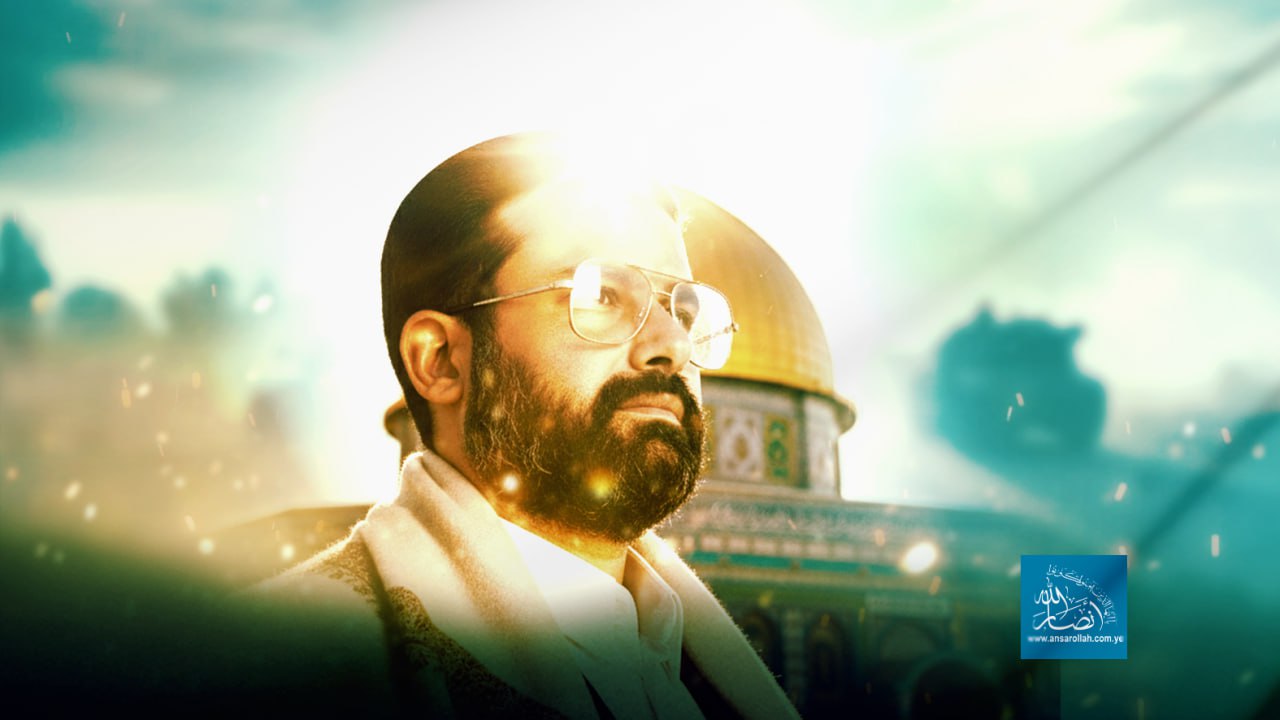
The anniversary of the martyrdom of the Martyr of the Qur’an, Sayyid Hussein Badruddin al-Houthi (may Allah be pleased with him), evokes a pivotal phase in the history of Yemeni and Islamic awareness—a phase in which Qur’anic thought underwent a qualitative transformation, moving from the realm of mere recitation into the sphere of action and change, and from purely exhortative discourse into an integrated project confronting hegemony and arrogance.
This anniversary comes amid a turbulent regional and international reality, in which the truth of the American-Zionist project targeting the Ummah’s creed, culture, independence of decision-making, and economic resources is being rapidly unveiled. This context grants the Qur’anic project founded by the Martyr of the Qur’an a renewed contemporary relevance, affirming the soundness of the vision he carried and his advanced, profound reading of the trajectory of the conflict and its governing universal laws.
The Martyr of the Qur’an, Sayyid Hussein Badruddin al-Houthi, embodied an exceptional state of awareness at a time dominated by silence, the marginalization of fundamental questions, and the promotion of misleading narratives by hegemonic powers under the banners of democracy, human rights, and counterterrorism. In the midst of this, the voice of the Martyr of the Qur’an rose to redefine the enemy, expose the nature of the battle, and link it to its doctrinal and human roots.
The significance of commemorating the martyrdom of the Martyr of the Qur’an lies in its role as a moment of inspiration for a Qur’anic project that remains alive—renewing its presence in the field, in popular consciousness, and in political positioning—affirming that the Holy Qur’an is a book of guidance, construction, and liberation.
Within this framework, this report examines aspects of the early forward-looking vision presented by the Martyr of the Qur’an regarding the danger posed by America and “Israel,” through intellectual readings rooted in the depth of the Qur’anic project. These readings reveal how that awareness became a fundamental lever for confronting arrogance and shaping a free, independent stance.
The Early Vision of the Martyr-Leader
Professor Mohsen Al-Shami, one of those engaged with the Qur’anic project since its earliest launch, explains that the Martyr of the Qur’an, Sayyid Hussein Badruddin al-Houthi (may God be pleased with him), was distinguished by his reading of international political reality from a conscious Qur’anic perspective. In this reading, creed is inseparable from politics, and the text is not isolated from reality; rather, the Qur’an is invoked as a criterion for understanding the dynamics of tyranny and oppression throughout history.
In a special interview with the Ansar Allah website, Al-Shami affirms that the awareness of the Martyr of the Qur’an crystallized at a stage characterized by an almost complete absence of collective awareness of the danger of American hegemony. At that time, the United States was portrayed as a force safeguarding stability, while the true nature of its project was obscured. However, the martyr-leader, through deep contemplation of the Qur’an, realized that the enmity described in the Qur’anic text is enduring and deeply rooted, taking multiple forms depending on time and place.
Al-Shami explains that the Martyr of the Qur’an’s reading of major events—most notably the events of September 11—revealed an early awareness of how such events were used as pretexts to reshape the region politically, militarily, and culturally under misleading slogans, while the real objective was to impose comprehensive control over the Ummah and its resources.
He points out that the Martyr of the Qur’an relied on clear indicators in his reading of the American-Zionist project, foremost among them the extensive military presence, attempts to control maritime corridors, the relentless pursuit of dominance over energy sources, and cultural and educational targeting aimed at emptying the Muslim mind of its identity and transforming it into a submissive, compliant follower.
Al-Shami emphasizes that the Martyr of the Qur’an insisted on the organic inseparability between America and “Israel,” rejecting any attempt to separate them. He viewed the Zionist project as an instrument of execution, with the United States as its supporter, protector, and financier, asserting that confrontation with one is, in essence, confrontation with the other.
The Practical Impact of the Qur’anic Project on Awareness and Confrontation
In a related context, the profound practical impact of the Qur’anic project founded by the Martyr of the Qur’an becomes evident in the trajectory of awareness and confrontation. Its influence extended from theoretical diagnosis of the enemy’s nature to the establishment of a new phase of Qur’anic understanding of the conflict—a phase that redefined the relationship between text and reality, faith and stance, awareness and action. The early pioneers of the Qur’anic project witnessed major transformations that carried it from a stage of weakness to one of influence, and from a limited discourse to a broad project whose resonance extends across different parts of the world.
Within this framework, Professor Abdul Salam Al-Talbi, advisor to the Chairman of the General Authority for the Families of Martyrs, offers an in-depth reading of the experience of the Martyr of the Qur’an, clarifying how the Qur’an became a foundation for understanding political conflict, and how Qur’anic awareness was transformed into an instrument of confrontation and practical decision-making.
In his remarks to the Ansar Allah website, Al-Talbi affirms that the Martyr of the Qur’an, Sayyid Hussein Badruddin al-Houthi (may Allah be pleased with him), possessed a unique ability to read international political reality on the basis of the Holy Qur’an as a comprehensive way of life that organizes human affairs, defines the nature of conflict, and exposes the features of the enemy.
He states: “The Martyr of the Qur’an realized that Western hegemony is an integrated project targeting Islamic identity from within, by emptying the Ummah of its awareness, severing it from its Qur’an, and transforming it into a dependent entity devoid of will.” He notes that the project of the Martyr of the Qur’an is distinguished by its ability to directly link Qur’anic texts with political reality, offering precise interpretations of verses and connecting them to the Ummah’s duty to confront forces of arrogance.
According to the vision of the Martyr of the Qur’an, he called for practical confrontation through reviving the obligation of jihad in its comprehensive sense, building faith-based awareness, and launching the slogan “The Shout in the Face of the Arrogant” as a means of breaking the barrier of silence and fear, transforming rejection from an internal feeling into a declared position.
Al-Talbi adds: “The martyr relied on practical tools, most notably economic boycott, to become an effective weapon in the battle of will and a clear message of the Ummah’s ability to confront those who target it.”
He stresses that developments following the martyrdom of the martyr-leader have proven the accuracy of his reading of reality, and that the Qur’anic project rests on a solid methodology that continues to maintain its presence and influence at the level of Yemen and the Ummah as a whole.
The Annual Anniversary and Renewing the Covenant with the Qur’anic Project
Overall, current events affirm the correctness of the Qur’anic project whose foundations were laid by the Martyr of the Qur’an, Sayyid Hussein Badruddin al-Houthi (may Allah be pleased with him). The project has become a compass for all who seek truth and victory in confronting falsehood, representing a contemporary Qur’anic miracle and the optimal means for challenging the forces of global arrogance and overcoming them.
Commemorating the annual anniversary of the Martyr of the Qur’an represents a renewal of the covenant with the Qur’anic project and an affirmation of the Ummah’s responsibility to adopt a position of action, confrontation, and bearing witness over humanity. It places everyone before a clear challenge: preserving the dignity of the Ummah, safeguarding the independence of its decision-making, and confronting hegemony regardless of the magnitude of the challenges.
Accordingly, the Martyr of the Qur’an remains present through his thought, methodology, and blood—bearing witness that an Ummah which returns to its Qur’an, understands its enemy, and assumes its responsibility is capable of breaking hegemony, shaping its future, and achieving victory despite all difficulties and challenges.