Published: Rajab 29, 1447 AH
Gaza has emerged today as the most prominent symbol of the exposure of the international system, and as a sharp moral benchmark that separates positions and reveals the true nature of slogans long raised in the name of values, humanity, and the rights of peoples.
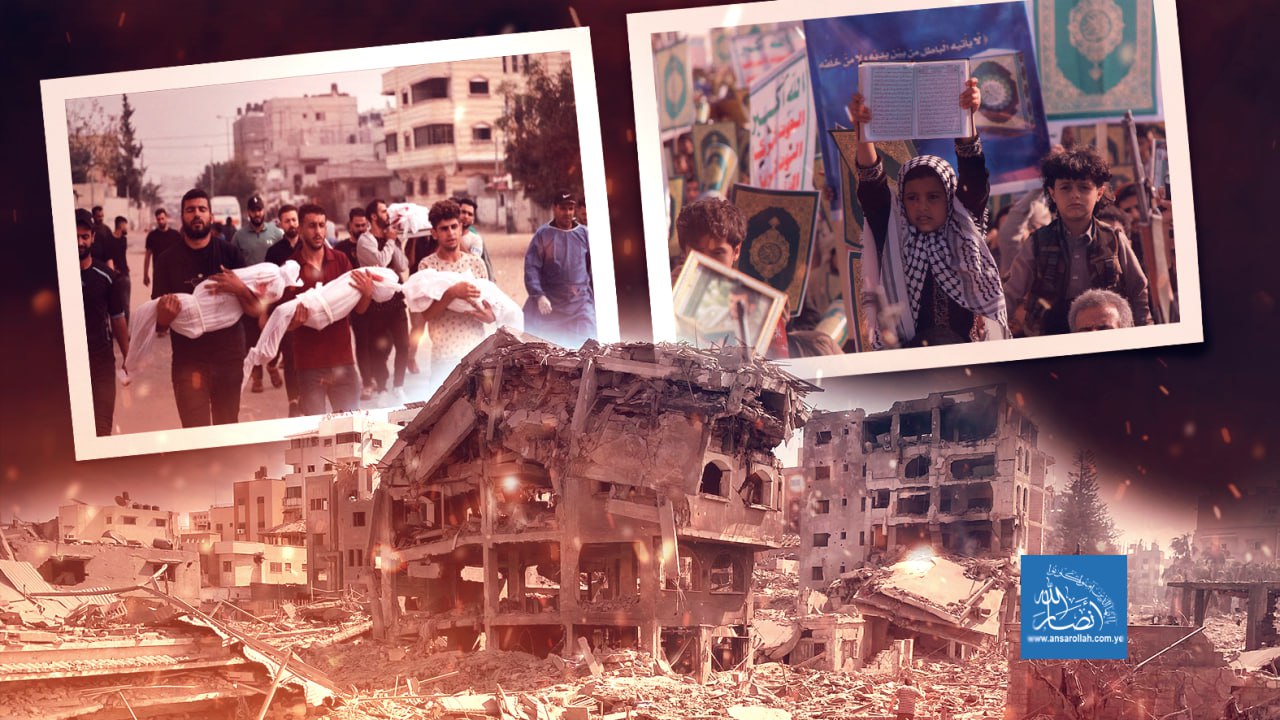
Amid an open war of extermination waged by the Zionist enemy, the world stands before a bloody scene documented by sound and image, yet this unprecedented clarity has not translated into responsible positions capable of stopping the aggression or holding the perpetrators accountable. International silence—along with political and media complicity—has itself become part of the crime, while Gaza is left to face its fate alone.
This abandonment extends to regional powers and Arab and Islamic regimes that have adopted silence or neutrality, limiting themselves to weak verbal positions. As a result, the battle of Gaza has become a decisive turning point that exposed the gap between declared rhetoric and actual practice, effectively toppling many slogans that failed to withstand the test of reality.
In contrast to this scene, Yemen’s position stands out as a striking exception. Despite siege and aggression, Yemen continues its support for Gaza, translating the sincerity of its faith-based and principled slogans into concrete action, embodying—both in word and deed—the statement of the martyr Abu Ubaida: “The true brothers are Ansar Allah.”
This Yemeni stance is read as a direct outcome of the Qur’anic Project founded by the martyred leader Sayyid Hussein Badruddin Al-Houthi. That project rebuilt awareness on a liberating Qur’anic foundation, viewing the confrontation of tyranny and arrogance as a religious and moral duty that does not expire with time or shift with changing power balances. From this perspective, Yemeni support for Gaza represents a practical translation of a living Qur’anic methodology that links faith to stance, and awareness to action.
Gaza as a Moral Standard: Exposing the Falsehood of the International System
In this context, Algerian researcher and thinker Dr. Nour Al-Din Abu Lahya links what Gaza is enduring today to the moral and political exposure afflicting the world, arguing that what is taking place is not merely a military assault, but a divine test and a Qur’anic standard that distinguishes between projects, currents, and positions.
In remarks to the Ansar Allah website, Abu Lahya explains that the crimes committed in Gaza are documented in an unprecedented manner, stripping away any justification for silence or claims of ignorance, and turning inaction into a deliberate stance rather than a momentary failure. He notes that the Qur’anic Project advocated by the martyred leader is rooted in an understanding of the Qur’an as a book of confrontation, liberation, and dignity—not a book of detached preaching severed from real-world context.
He believes the Yemeni position toward Gaza represents the practical application of this understanding, where the Qur’an transforms from a text merely recited into an awareness that moves people and produces courageous positions at decisive moments. He refers here to the Qur’anic Project launched by the martyred leader Sayyid Hussein Badruddin Al-Houthi, may Allah be pleased with him.
Abu Lahya also points out that many religious and activist discourses collapsed in the test of Gaza after emptying religion of its liberating dimension and offering appeasing interpretations that justify submission and promote silence.
By contrast, he stresses that the Qur’anic Project has proven its unique capacity to build a nation that stands with the oppressed and confronts the arrogant without fear or opportunistic calculations. He cites Yemen’s historic stance in confronting the United States and “Israel,” overcoming them despite the imbalance of capabilities, and considers Yemen’s support for Gaza an irrefutable indictment of the entire Arab and Islamic nation without exception.
Reading the Nation’s Betrayal and the Yemeni Exception
Despite the magnitude of injustice inflicted upon Gaza by the brutal Zionist aggression, the situation has become a pivotal moment that practically dismantled many claims raised for decades by political and religious currents and regimes in the name of supporting Palestine. The battle of Gaza has turned into a revealing standard of sincerity, clearly distinguishing between those who possessed a project capable of action and those who remained confined to slogans and rhetoric.
On this point, Lebanese political researcher Dr. Ismail Al-Najjar states: “What has happened and continues to happen in Gaza has exposed the state of schizophrenia between rhetoric and practice among a wide range of regimes and movements that raised slogans of resistance and defending holy sites, yet were unable to take any practical stance when faced with a real test.”
In a special statement to the Ansar Allah website, he adds: “This failure cannot be separated from a deep crisis of awareness, fueled by narrow political calculations and a religious discourse stripped of its liberating dimension, which has been employed to justify silence or neutrality in the face of the Zionist enemy’s crimes.” He affirms that the events of Gaza have exposed the disgraceful reality of the Islamic nation, revealing its weakness and humiliation.
In contrast to the shame, humiliation, and submission displayed by much of the Islamic world toward the events in Gaza, the Yemeni position supporting Gaza stands out as an exceptional case in the Arab and Islamic reality. Al-Najjar presents it as a living model of transforming awareness into action and moral stance into practical engagement. He links this support to the Qur’anic Project founded by the martyred leader, describing it as a project that restored the Qur’an as a reference that shapes positions and reinforces the principle that supporting the causes of the nation is not a temporary political option, but a religious and moral obligation.
Al-Najjar believes this model provides a practical answer to a fundamental question: how can the nation reclaim its role? He emphasizes that possessing a clear Qur’anic Project and a living religious discourse connected to liberation and resistance to injustice is the essential condition for breaking free from the cycle of abandonment and for forging positions capable of confronting major challenges.
Gaza Exposes, and Yemen Provides the Answer
In conclusion, Gaza has transformed from a battlefield into a revealing mirror of the international system and a moral scale that exposes double standards and strips away the falsehood of discourses long adorned with slogans of humanity and the rights of peoples.
The scale and clarity of the crimes committed have eliminated any pretext for silence or claims of helplessness, rendering positions—or the absence thereof—a calculated political and moral act.
In this light, Gaza stands as a historic moment of differentiation for the nation, revealing who possesses a project capable of action and who remains captive to rhetoric and slogans. While the positions of many regimes and religious and political currents collapsed at the first real test, the Yemeni model emerged to break the equation of abandonment and redefine the meaning of responsibility and alignment with the nation’s causes.
It can therefore be said that Yemen’s support for Gaza is the fruit of a long cultural, educational, and faith-based path established by the Qur’anic Project launched by the martyred leader Hussein Badruddin Al-Houthi—a project that restored the Qur’an as a living reference that shapes awareness and positions, links faith to action, and rejects any separation between values and reality.
Thus, Gaza remains an open arena of testing, while Yemen offers living proof that possessing a clear Qur’anic Project and a firm will to act are capable of reshaping the equation of struggle and entrenching the truth that dignity is not measured by the size of capabilities, but by the sincerity of alignment and steadfastness of position.