Ansarollah Website Official Report
Published: Shaʻban 1, 1447 AH
Even those with a basic understanding recognize that the United Nations is an organization established through international agreement, with a charter designed to regulate international relations and defend societies around the world from violations they may face. Accordingly, the decisions issued by this organization carry weight and are considered a legal reference when confronting abuses committed by any member of the international system.
Reaching such a conclusion does not require exceptional insight or extraordinary analysis. A review of the structure of the United Nations and of the decisions issued through the Security Council shows that the American military has often moved to implement them. At times, it has relied on what it calls its own “rules” to justify killing and destruction against people, under the pretext that they had violated rights, principles, and United Nations resolutions.
The Israeli Entity's Contempt for the United Nations and Its Decisions
In normal international practice, bypassing United Nations resolutions constitutes a clear violation of the organization and of the international community as a whole, and silence in the face of such behavior amounts to open and condemnable complicity. Here, the United States and the Zionist entity stand out for openly violating resolutions and refusing to comply with them—an undeniable reality acknowledged worldwide. Yet no action is taken in response, because their protector is the very actor practicing intimidation and presenting itself as a power above international decisions and laws.
Throughout decades of Israeli occupation of Palestinian territories, the indigenous population has endured countless violations. The illegitimate entity—despite considering itself a United Nations member like other states—has not only carried out killing and repression against the Palestinian people, but has also shown blatant contempt for the UN Charter and for UN resolutions that condemn these acts as violations of international law and human rights.
The "Israeli" Enemy Sheds Blood with Impunity
In the latest ongoing aggression against Gaza, Zionist lawlessness reached its peak. The occupying entity waged a widely documented campaign of genocide, aimed at emptying the Gaza Strip of its population.
The world’s response went no further than statements. Even when decisions emerged, such as those hinted at by international judicial bodies, no meaningful action followed. The enemy continued its brutality without restraint. While voices from “some” parts of the world grew louder as horrifying scenes of atrocities surfaced, these reactions remained confined to rhetoric and failed to create any real deterrence.
Even the American military, which presents itself as the guardian and enforcer of UN resolutions, does not act when the Israeli entity is involved. This is because it constitutes a core part of the problem. All rounds of aggression carried out by the Israeli entity have taken place with American coordination and support, a fact hidden from no one.
As Palestinian casualty figures continued to rise, Zionist forces conducted their aggression freely. No one dared to play the role of defender of the value system so often proclaimed and repeated in UN corridors and before the world.
At that point, action against this brutality became imperative. Allowing the occupier to single-handedly kill the indigenous population—by weapons or starvation—without restraint was unacceptable. Children, women, the elderly, and civilians with no connection to fighting were killed with reckless disregard, under the pretext that resistance existed within the Strip.
Under United Nations resolutions, Gaza is considered occupied territory under the control of a brutal occupying power. Any attack against it, therefore, constitutes a clear act of aggression in violation of Article 2 of the UN Charter, which prohibits the use of force against the territorial integrity of any people under occupation. UN General Assembly Resolution 37/43 of 1982 affirms the legitimacy of liberation struggles against foreign occupation and all forms of violations of land and sovereignty. These legal formulations find no acceptance by the occupying entity or its American umbrella, as though both were exempt from compliance.
Yemen’s Support Is Legal, Humanitarian, and Moral
When Yemen moved with conviction and faith to support the people of Gaza, its motivations were legal, moral, and humanitarian. It did not arbitrarily target shipping linked to the Zionists, but rather exercised its right to political and field pressure in defense of the Palestinian cause and in rejection of the genocide perpetrated by the occupying entity. This practical stance came after the failure of the United Nations and its administrative inability to stop the aggression and genocidal war on Gaza—an inability viewed as a legal betrayal of the very principles of the UN Charter.
According to legal experts, the enemy’s actions constituted a clear departure from and violation of all legal norms and constants. Consequently, no one was able to mount the American pretext to prove, with legal arguments, that Yemen’s support operations violated international law.
When American officials attempted to market a falsehood crafted by the Zionist lobby—claiming that Yemen’s blockade of enemy-linked shipping threatened international navigation—there were no legal justifications to support this claim.
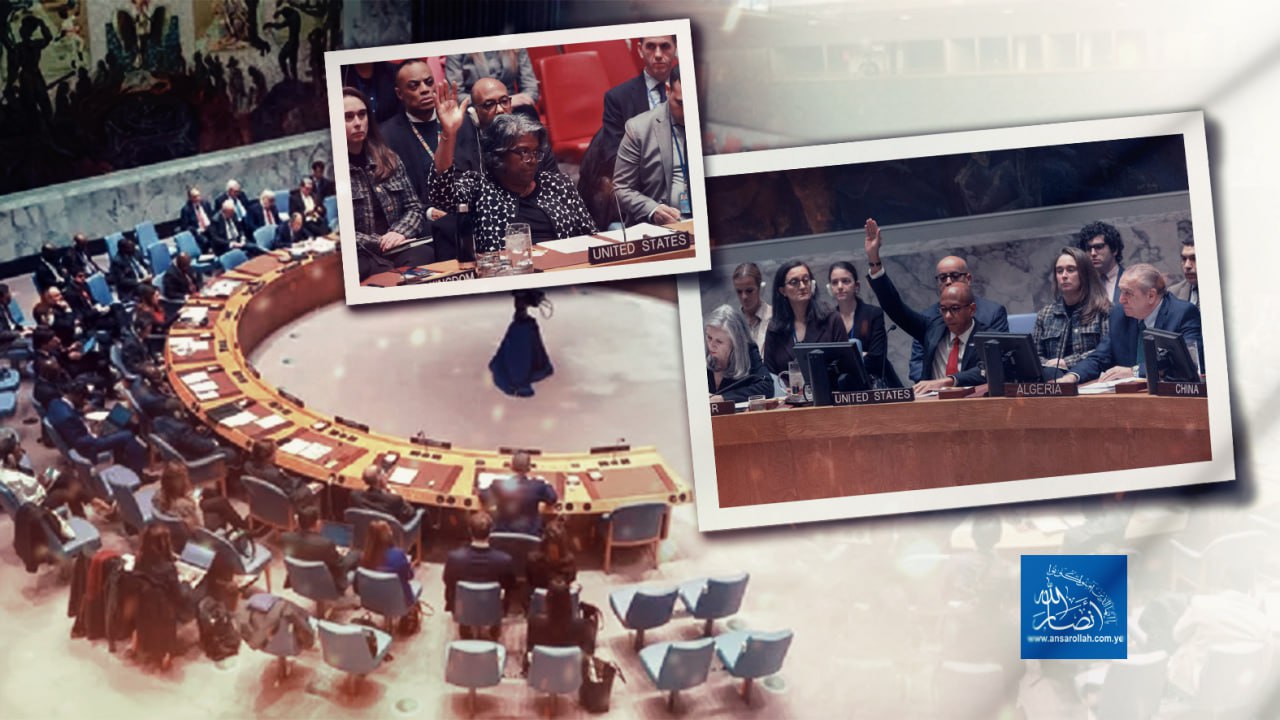
Today, the Security Council has entered the details of this conspiracy, presenting itself as the sole Zionist-facing body adopting this approach. This is the same council that failed to act against the mass killing of innocents in Palestine, or even against violations of the principle of proportionality during two years of massacres and inhumane conduct marked by killing and siege.
Yemen Exposes the Security Council
The Republic of Yemen did not merely condemn the recent outcomes of the Security Council; it openly mocked them, particularly as they clearly indicate conspiratorial activity within the Council aimed at preparing to target the Yemeni people.
The Ministry of Foreign Affairs refuted the latest Security Council resolution, No. 2812 of 2026, concerning alleged “attacks” on commercial vessels in the Red Sea. It described the resolution as reflecting complete subservience to the will of the United States and its tools within the Council, and as a failed attempt to distort Yemen’s honorable role in supporting Palestine and resisting the Zionist project. The ministry exposed the resolution’s connection to efforts aimed at deterring Yemen from its religious, moral, and ethical duty toward a people being subjected to mass extermination before the eyes and ears of the world without finding any defender.
The ministry also addressed points that silence the hypocrites, noting that Yemen’s use of the Red Sea card came within a legitimate and clear context directly linked to stopping the Zionist aggression on Gaza. This was confirmed by the fact that Yemeni naval operations ceased immediately upon reaching an agreement to halt the aggression, demonstrating unequivocally that Yemen does not target navigation arbitrarily, but rather exercises its right to political and field pressure in defense of the Palestinian cause and rejection of the genocide carried out by the occupying entity.
A Direct Threat to Regional and International Peace
The principle of the “Responsibility to Protect,” adopted by the international community in 2005, obliges states and nations to act to prevent genocide and war crimes when the concerned state or the Security Council fails to provide protection.
Additionally, Article 51 of the UN Charter states that nothing in the Charter impairs the inherent right of states—individually or collectively—to self-defense if an armed attack occurs against them.
Since the Israeli aggression against the Gaza Strip constitutes a direct threat to regional and international peace, and given that the United States participates in it through support, arms, and political cover, Yemen’s action falls within the framework of collective self-defense. It is undertaken as part of the axis of the targeted nation and as an extension of a single front confronting a shared aggression—what the United Nations refers to as “international humanitarian intervention.”
Furthermore, UN General Assembly Resolution 377 of 1950, known as “Uniting for Peace,” grants member states the right to take collective action when the Security Council fails due to the use of the veto.


