
Published: 22 Ramadan 1447 AH
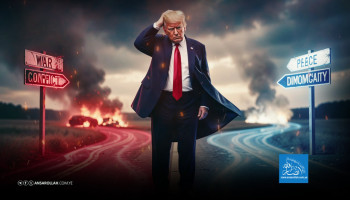
Trump has been the only unique person in history whom everyone agreed excelled in delirium and jumping over reality to fabricate contexts that exist only in his troubled mind. Despite frequent exposure and criticism of such remarks, he has continued to repeat similar claims.
In his latest "farcical" stunt, he claimed - in public statements - that the Islamic Republic of Iran was suffering a “crushing defeat,” claiming that Tehran had issued an official apology and surrendered to neighboring countries. He further declared that Washington had already achieved its objectives in the war within a short period of time, insisting that Iran “no longer has a navy, no communications, and no air power.”
Although many observers say Trump’s statements no longer carry significant credibility or weight, critics argue that they still reflect the nature of American policy and its willingness to contribute to global insecurity and economic instability without any sense of responsibility.
Trump’s remarks were widely met with ridicule, especially in light of developments on the ground and the disruption Iranian strikes have reportedly caused to U.S. military calculations, along with the regional and global repercussions of the escalating conflict. Polish Prime Minister Donald Tusk publicly questioned Trump’s assertion that Iran had lost the war, emphasizing that fighting in the Middle East remains ongoing.
“Where is the victory Trump is talking about?” Tusk asked. “Oil prices have risen.”
“The Enemy Will Take His Dream to the Grave”
In another theatrical statement, Trump insisted he would not halt what he called his operation against the Islamic Republic unless Iran announced an unconditional surrender.
Such a demand, observers note, appears more limited than the previously stated goals often associated with the U.S. campaign, which included:
-
Ending Iran’s nuclear program
-
Overthrowing the Islamic government
-
Destroying Iran’s missile capabilities
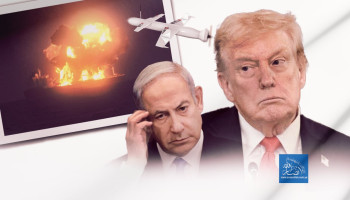
However, discussion of an Iranian surrender has been widely dismissed by many analysts as unrealistic, particularly as Tehran continues escalating waves of retaliatory measures against both the United States and "Israel".
Iranian President Masoud Pezeshkian responded directly to Trump’s remarks, stating that “the enemy will take the dream of Iran’s unconditional surrender to the grave.”
In the same statement, Pezeshkian urged neighboring countries not to become “tools in the hands of imperialism.” He added that "working with arrogant America and the Zionist entity would represent a lack of dignity and a cause for eternal shame.”
Furthermore, what is being discussed within the corridors of American power is a growing and troubling conviction that with every Trumpian tweet that deviates from the established order, America sinks deeper. CIA Director John Brennan said "the war was not unfolding as Trump had intended."
Brennan remarked:
“Raising the issue of Iran’s unconditional surrender is pure nonsense. It shows that Trump realizes the situation on the ground has become chaotic and extremely complicated.”
He added that Trump’s increasingly dramatic language often intensifies when developments fail to align with his expectations.
U.S. Military Concerns Over a Prolonged War
Trump’s policies risk leading the United States into a costly and potentially damaging conflict. This conclusion is confirmed by opinion polls within the United States, which showed - in light of the initial results of the terrorist operation, the deaths of American soldiers, and the indicators of energy crises generated by this operation - polling results indicate that a majority of Americans oppose the conflict, while only 38 percent support the strikes against Iran.
Commenting on these figures in an interview with the New York Post, Trump said:
“I’m not worried. I think the polls are very good, but I don’t care about them. I have to do the right thing.”
Concerns surrounding the American–Israeli operation against Iran extend beyond the casualties among U.S. troops. Analysts also point to declining American capacity to sustain a prolonged campaign and the rapid depletion of air-defense stockpiles.
According to The Washington Post, senior U.S. military leaders have expressed increasing concern that continued fighting over several weeks could place additional pressure on already limited American air-defense resources.
The same concern has reportedly reached the U.S. House of Representatives, where Representative Adam Smith, a senior Democrat on the House Armed Services Committee, warned:
“We can’t say: ‘Wait, Iran, we’ve run out of missile defense systems, so we need to pause for a moment.’ Is that acceptable? This would drain our ability to defend everything we need to protect.”
Global Economic Disruption
Developments on the battlefield and their economic consequences reinforce Tehran’s argument that American capabilities are under growing strain, even as Trump attempts to maintain a narrative of control.
Economic circles have already begun discussing about the the financial implications of this a Trumpian adventure that will have negative repercussions not only on the American economy, but also on the global economy. According to The Wall Street Journal, the cost of the first four days of the military operation against Iran reached approximately $11 billion, indicating significant financial pressure on the U.S. treasury.
The expenses reportedly include: Air and naval operations, Launching advanced missiles and munitions, Deployment of aircraft carriers and defense systems, and Logistical and intelligence support.
Meanwhile, Reuters reported that the U.S. Department of Defense is seeking an additional $50 billion budget request to replenish depleted weapons stocks.
At the same time, tensions around the Strait of Hormuz have disrupted global trade routes and energy markets. Shipping activity has been affected, with some oil tankers damaged and others remaining offshore due to security concerns. As a result, energy prices, shipping costs, and maritime insurance rates have surged to unprecedented levels, contributing to a growing wave of economic instability worldwide.
Trump Appears the Weakest Link
Observers argue that Iran’s military performance contradicts Trump’s claims about conditions for ending the conflict. Tehran’s ability to deploy a wide range of weapons systems—including ballistic missiles, cruise missiles, hypersonic missiles, cluster munitions, and attack drones—has strengthened its capacity to impose deterrence.
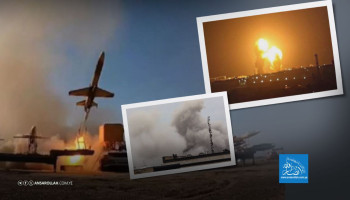
The Islamic Revolutionary Guard Corps (IRGC) has stated that its forces succeeded in “paralyzing the defensive and intelligence infrastructure of the United States and the Zionist entity in a highly precise and advanced operation.”
According to The New York Times, U.S. military officials have acknowledged that the scale of losses revealed Iran to be more prepared than the Trump administration had anticipated.
Parallel to this, analysts increasingly warn that the United States may be facing growing economic and political exhaustion as the conflict continues.
Observers also point to the early stages of Iran’s “True Promise 4” operation, whose defensive and offensive waves reshaped the deterrence equation and contributed to a new strategic balance.
In that emerging framework, critics suggest that Trump increasingly appears as the weakest link—facing mounting political and economic costs tied to the escalation.
A Turning Point for American Power
Trump’s controversial statements, critics say, reflect the shock experienced by the United States and Israel after initial assumptions predicted a swift and decisive outcome to the campaign.
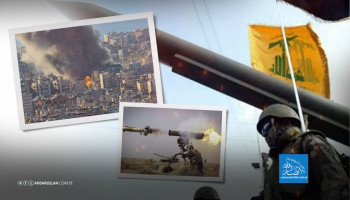
Instead, the conflict has expanded beyond Iran’s borders, reaching deeper into territories considered strategic or sensitive by the Zionist entity and its allies. Iranian responses have targeted key military assets, including American bases and naval vessels such as destroyers and aircraft carriers.
International reactions have also reflected concern. Some global powers have interpreted the conflict as serving Israeli interests more than American ones.
-
China expressed support for Iran’s sovereignty.
-
Russia described the attack as a threat to regional and global security.
-
Italy criticized the strike as a violation of international law.
-
France stated it would not participate in any operation against Iran.
-
Spain rejected the use of its bases for military action.
Taken together, these responses highlight a growing perception that the conflict may represent a significant turning point—one that could reshape geopolitical balances and challenge long-standing assumptions about American power and influence in the region.