Published: 15 Shawwal 1447 AH
In a dramatic escalation of transatlantic tensions, Iran’s sustained and calculated resistance has succeeded in pushing relations between long-standing allies—traditionally compliant Europe and historically dominant United States—to their lowest point in modern history.
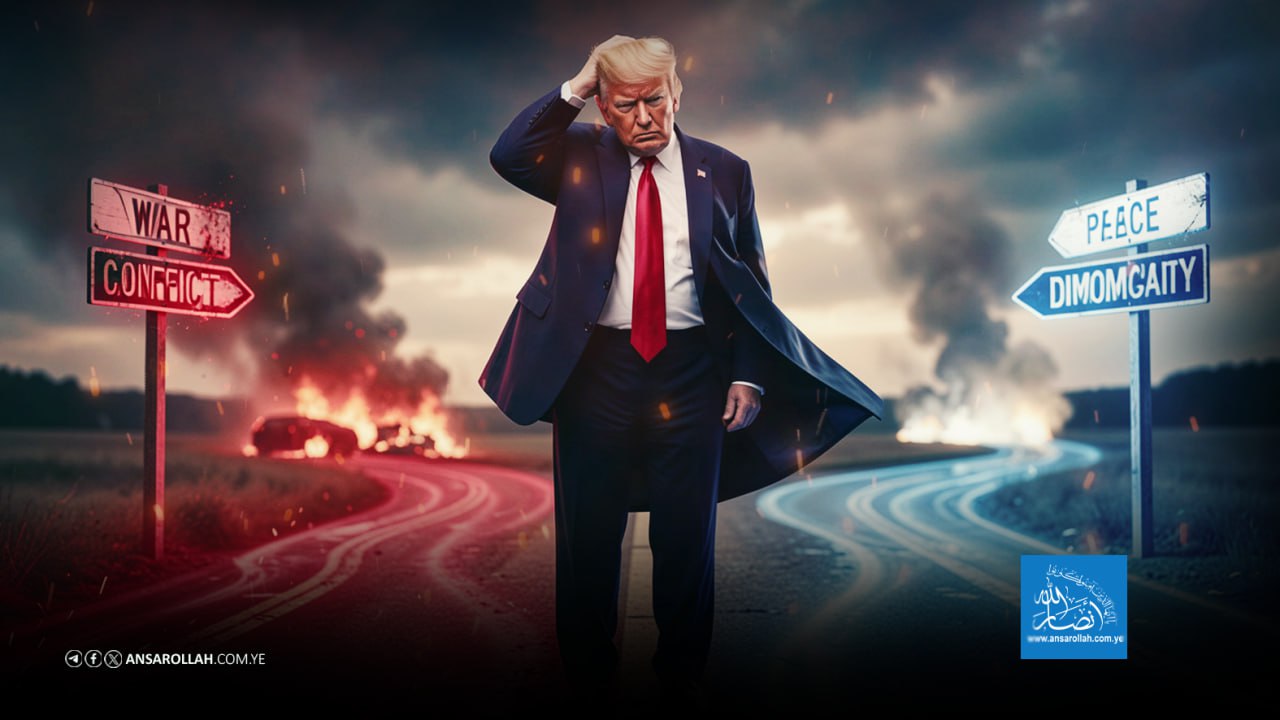
Today, the crisis reached a new peak following statements by Trump in an interview with the The Daily Telegraph, where he described NATO as a “paper tiger” and confirmed he is “very seriously” considering withdrawing America from the alliance, noting that the matter has gone “beyond mere reconsideration.”
American Secretary of State Marco Rubio stated that Washington would be “forced to reassess its relationship with NATO” after the conflict concludes. Meanwhile, American Defense Secretary Pete Hegseth remarked that “many things have been revealed” about allies’ willingness to act on behalf of the United States “when we undertake an effort of this scale on behalf of the world.”
These remarks reflect deep American frustration over Washington’s failure to assemble a broad “international coalition” as it has in previous wars, and its inability to do so in the current campaign against Iran. The situation echoes the failure of the administration of Joe Biden to establish what it termed a “crisis coalition” to protect navigation in the Red Sea in early 2024.
A Widening Transatlantic Rift
As the US-led offensive against Iran enters its second month, the divide across the Atlantic has reached unprecedented levels. The historic alliance has shifted from a “unified military bloc” into an arena of open political confrontation. Major European capitals are increasingly refusing to comply with Washington’s directives, marking a historic departure from Europe’s traditional alignment.
Tehran, in an unexpected strategic success, has deepened the rift between Washington and its longtime allies, stripping the US position—typically backed by broad coalitions—of its international cover. This deterioration has manifested in a bold and growing European “veto” emerging across decision-making capitals, reshaping Western alliances beyond temporary diplomatic disagreements.
In a moment likely to be recorded in history, NATO no longer serves as the unshakable fortress behind which the United States rallies support for its wars. Instead, it has become a stage for direct confrontation between an assertive Washington and a defiant Europe, signaling that Western military decision-making is no longer exclusively dictated by the White House.
Spain: The Firmest Opposition
Spain has unexpectedly taken the lead in European resistance, adopting the most direct stance against the Trump administration. Madrid initially blocked the use of joint military bases in Rota and Morón—long-standing American-Spanish installations in Andalusia—and escalated its position by closing Spanish airspace entirely to any American military activity involving the war on Iran.
Prime Minister Pedro Sánchez described the US offensive in parliament as “absurd, brutal, and illegitimate,” warning that it represents a scenario “far worse” than the 2003 invasion of Iraq. This position was enforced operationally by rejecting all flight plans tied to the Iran operation, including aerial refueling missions.
The bold Spanish stance prompted Trump to escalate trade threats against Madrid, highlighting the extent of disruption in traditional bilateral relations.
Italy: A Close Ally Takes a Surprising Stand
Despite close ties between the right-wing government of Giorgia Meloni and Trump, American aircraft encountered closed doors in Sicily. According to Reuters, Italy refused to allow American bombers to land at the strategic Sigonella base, one of NATO’s most important installations in the Mediterranean.
Rome justified the refusal by citing the absence of a formal request from Washington and a lack of consultation with Italian military leadership—violations of bilateral agreements governing American base usage. However, sources suggest the decision reflects deeper political concerns about being drawn into a broader regional conflict, amid domestic opposition warnings against involvement in “a war that does not concern Italy.”
France: Strategic Alignment Without Submission
In Paris, the French leadership opted for a calculated approach, restricting the transit of American weapons bound for the Israeli entity without officially closing its airspace. This delicate balance between Atlantic commitments and avoiding direct involvement prompted Trump to label France a “non-cooperative state” on his platform Truth Social.
French officials have seized the moment as an opportunity to break free from from American dependency as a historic opportunity to rid Europe of its historical "dependency complex" to Washington. The French Minister of State for the Armed Forces emphasized that NATO is “an alliance for the security of Europe and the Atlantic—not for conducting operations in the Strait of Hormuz that violate international law,” clearly signaling that the American campaign against Iran falls outside collective defense obligations.
Poland: The Closest Ally Breaks Rank
In a major surprise, Poland—widely regarded as NATO’s eastern anchor and one of Washington's closest allies—refused an American request to deploy Patriot missile systems to the Middle East.
Defense Minister Władysław Kosiniak-Kamysz stated that “Poland’s security is an absolute priority,” choosing to safeguard national airspace and NATO’s eastern flank over supporting Washington’s efforts.
This unprecedented move is described as a “political earthquake” in NATO-Pentagon relations, marking the first time a traditional Eastern European ally has rejected a major US military request—raising serious questions about the alliance’s future.
Britain and Germany: Quiet Distance
On the British side, Prime Minister Keir Starmer reaffirmed London’s commitment to NATO but stated clearly: “This is not our war, and we will not be dragged into it,” a position widely interpreted as a refusal to engage despite increasing American pressure.
Germany, which initially supported the offensive, has shifted to cautious diplomatic silence. Berlin now emphasizes that NATO is a defensive alliance intended to protect member territories, implying that Article 5 does not extend to preemptive operations in the Middle East.
The Collapse of International Cover?
Beyond the individual positions of each state, a central truth emerges: Washington is facing a diplomatic failure parallel to its military challenges. America has been unable to assemble a coalition comparable to those formed in previous conflicts, leaving it increasingly isolated in a war lacking international legitimacy or UN authorization.
This failure recalls historical precedents, including European refusals to allow airspace use during the 1986 bombing of Libya, opposition by Paris and Berlin to the 2003 Iraq invasion, and Turkey’s refusal to permit American troop deployments during that war.
However, the current moment is distinct, unfolding amid a structural fracture in transatlantic relations that began during Trump’s first term, deepened during the Ukraine war, and intensified with disputes such as the attempted acquisition of Greenland—culminating now in Europe’s open resistance to the war on Iran.
A Turning Point in Global Alliances
As the American offensive enters its second month, Europe appears to be undergoing a stage of “unprecedented tension” that may redefine its relationship with Washington. The war on Iran has evolved from a military confrontation into a testing of the limits of European compliance—and an opportunity, as French analysts suggest, to overcome a “historical dependency complex.”
While Trump threatens to withdraw from NATO and dismisses it as a “paper tiger,” European capitals are increasingly asserting sovereign decision-making. The emerging picture suggests the beginning of a new alliance system—one in which Washington may no longer hold unquestioned central authority.
Conclusion
The conflict with Iran is no longer merely a military confrontation in the gulf. It represents a decisive moment in which Europe has chosen to say “enough is enough.” A defensive alliance, European leaders argue, cannot be used as a platform for American dominance. This transformation may well mark the beginning of the end of what critics describe as “Atlantic arrogance.”