As the US-Israeli war on Iran unfolds with unexpected developments, questions are mounting in the United States and beyond regarding who bears responsibility for the escalation, political scientist Stephen M. Walt wrote on Foreign Policy.
Observers note that the conflict has not followed anticipated trajectories, prompting renewed scrutiny of political decision-making in Washington. Walt cautions, however, that it remains too early to draw definitive conclusions, as further evidence is expected to emerge over the coming months.
Walt also points out that, unlike the lead-up to the 2003 Iraq War, the current war on Iran was not preceded by a prolonged public campaign to justify military action, complicating efforts to trace clear lines of responsibility.
Defining the “'Israel' lobby” and political framing
Central to the debate, he notes, is the role of what is commonly referred to as the “Israel lobby” in shaping US foreign policy.
Citing John Mearsheimer, Walt explains that the term refers to a broad coalition of individuals and organizations that advocate for maintaining a “special relationship” between the United States and "Israel".
This framework emphasizes that lobbying efforts aim to secure continued US military and diplomatic support for "Israel" across administrations, regardless of specific policy decisions.
Trump and Netanyahu at center of decision-making
Responsibility, according to Walt, primarily lies with political leadership, particularly US President Donald Trump and Israeli Prime Minister Benjamin Netanyahu.
The columnist draws parallels to George W. Bush in 2003, noting that Trump ultimately made the decision to engage in military action and, therefore, bears direct responsibility for its consequences.
Netanyahu is described as playing a central role as well, having long advocated for confrontation with Iran while relying on US backing to advance his strategy.
Influence of pro-'Israel' figures in US policy circles
Walt highlights the role of Trump’s inner circle in shaping US policy direction. Officials such as Marco Rubio, Jared Kushner, and Mike Huckabee are identified as consistent proponents of strong US-"Israel" ties.
He also points to Trump’s acknowledgment of influential, pro-"Israel" donors, including Miriam Adelson and the late Sheldon Adelson, suggesting that both financial and political support reinforced policy alignment in favor of close US-"Israel" coordination.
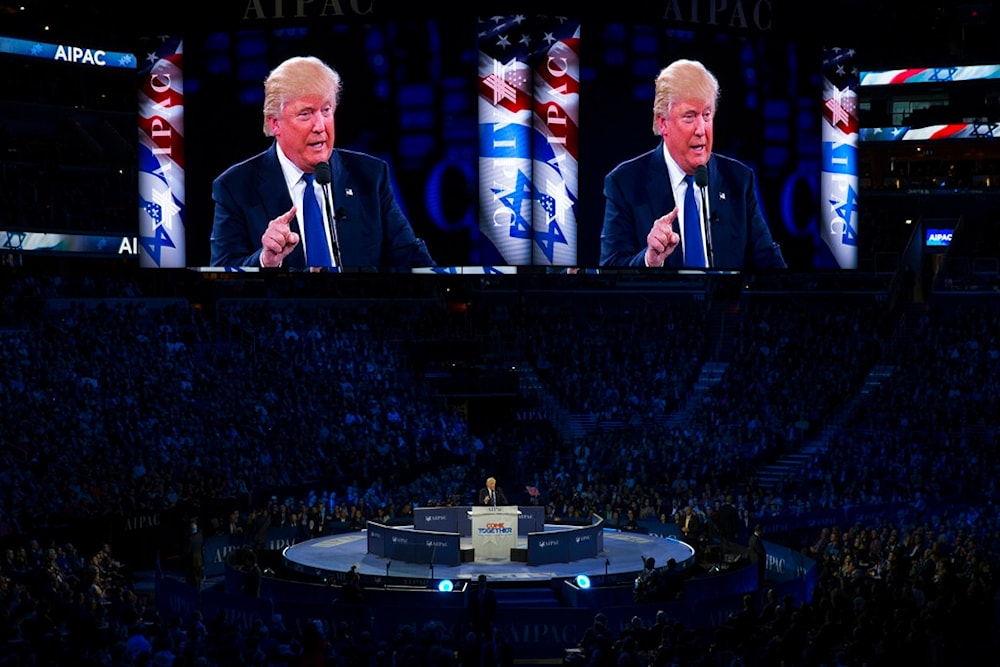
Several organizations, Walt notes, have actively sought to influence US policy on Iran. These include AIPAC, United Against Nuclear Iran, Foundation for Defense of Democracies, and Zionist Organization of America.
According to reporting and research cited by The Nation, these groups have conducted public campaigns, lobbied elected officials, and sought to influence discourse around Iran’s nuclear program and regional policies, including opposition to the Joint Comprehensive Plan of Action.
Source:Websites