Ansarollah Website Official Report
The Islamic Resistance in Iraq was quick to enter a battle for dignity and sovereignty against the U.S.-Israeli axis of evil, adopting a steadily escalating tempo of operations that has sown clear disruption and stretched Washington’s capacity to manage its campaign against Iran.
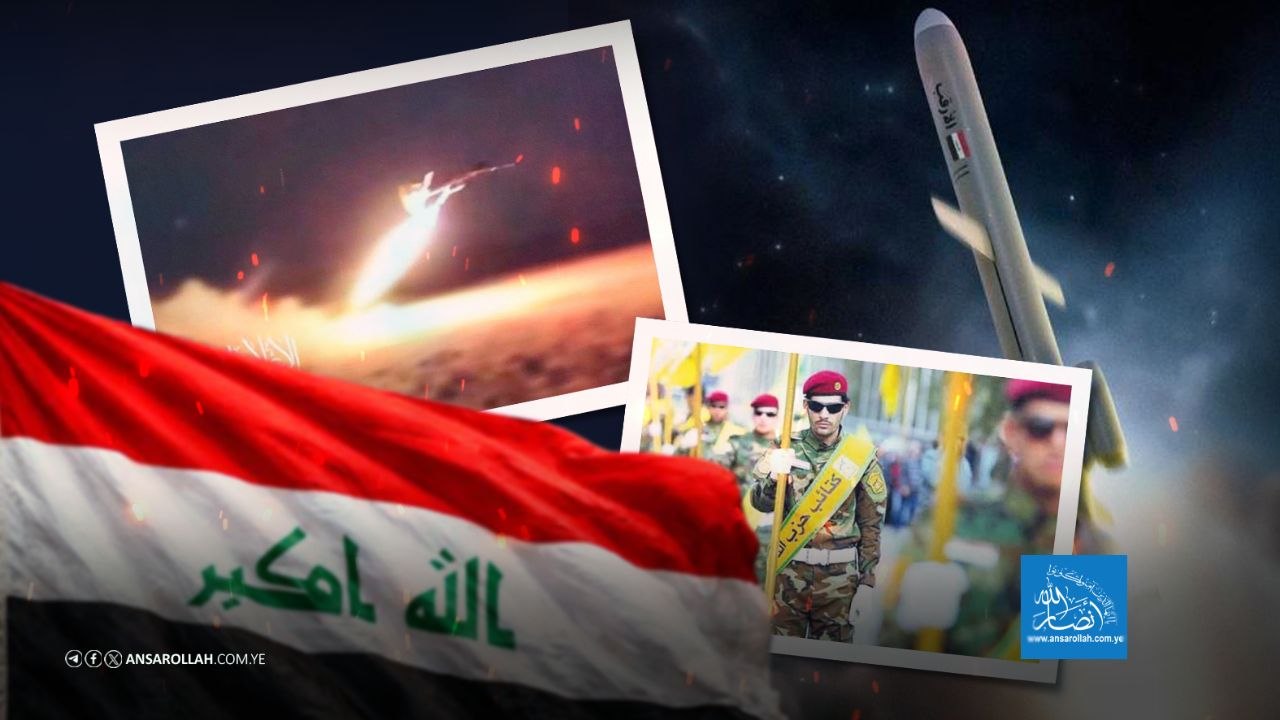
The group has sharply intensified strikes on American military bases, both in scale and sophistication, with waves of rockets and drones becoming an almost daily occurrence across multiple theaters. Targets have included sites in Erbil, Al-Harir Air Base, Victoria Base, as well as installations beyond Iraq’s borders.
A striking example of the campaign’s impact came in mid-March, when six U.S. servicemen were killed in a high-impact operation. At the time, United States Central Command confirmed the deaths in western Iraq, attributing them to “the crash of a refueling aircraft carrying them.”
The resistance, however, maintained that it had downed a U.S. KC-135 Stratotanker and struck a second aircraft in western Iraq using what it termed “appropriate weaponry.” In a statement, it added that the second plane “was forced to make an emergency landing at one of the enemy’s airfields, while its crew managed to escape.”
Attrition and Disruption of Base Operations
Operations carried out by factions aligned with the Islamic Resistance in Iraq—mirroring the broader “axis” they are part of—have emerged as a sustained drain on U.S. military capacity.
Military experts say the group has deliberately pursued a strategy of attrition against American forces. Its arsenal of short- and medium-range missiles has enabled it to conduct “repeated, relatively low-cost attacks capable of keeping U.S. bases in a constant state of alert while disrupting their operational effectiveness.”
In the early phase of the confrontation, the resistance said it had carried out 291 operations, resulting in the deaths of 13 Americans and injuries to dozens more, some critically, according to its statements.
On March 24, Saraya Awliya al-Dam—one of the resistance factions—reported carrying out 136 attacks within the first 12 days alone, averaging roughly 11 strikes per day. These operations targeted sites in Saudi Arabia, Syria, Jordan, and Kuwait, in addition to 55 attacks in Iraq’s Kurdistan Region and 31 strikes on Victoria Base in Baghdad, adjacent to the international airport.
Regional Governments on High Alert
The expanding role of the Islamic Resistance in Iraq has stirred palpable unease across parts of the region.
Its support operations for Lebanon and Iran, its success in tying down Iranian Kurdish opposition factions, and its sustained pressure on U.S. military installations—particularly in Erbil—aimed at forcing an American withdrawal from Iraq and halting what it portrays as ongoing regional aggression, have all raised alarms in neighboring capitals.
This coordinated escalation—carried out alongside allied (axis) forces under the banner of “unity of arenas”—has pushed several neighboring governments into a state of heightened alert, with officials branding the developments as “dangerous” for their national security.
On March 25, Saudi Arabia, Qatar, Kuwait, Jordan, the UAE, and Bahrain said in a joint statement that attacks targeting “countries in the region,” launched by factions operating from Iraqi territory, constitute a “flagrant violation of international norms.”
The escalation has been matched by intensified diplomatic activity, including consultations, high-level contacts, and reported efforts to pressure Baghdad.
Media reports indicated that “advanced-level communications” were initiated by neighboring Arab states with Iraq’s current leadership, in an attempt to rein in the cross-border activities of Iraqi factions.
By late March, Riyadh hosted a trilateral summit attended by Mohammed bin Salman, the Emir of Qatar, and the King of Jordan. Its outcomes were warnings over what participants described as the “risks and repercussions” of the unfolding situation in Iraq for neighboring states—particularly Jordan and Syria.
“Enemy Positions Are the Target”
Jordan had already issued explicit warnings, with Foreign Minister Ayman Safadi condemning what he described as “attacks by Iraqi factions on neighboring countries, including Jordan, Kuwait, and Bahrain.”
In response, the Iraqi resistance’s coordination body said in a Thursday statement that its operations are directed exclusively at U.S. forces, stressing that economic interests in host countries are deliberately avoided. A spokesperson for Saraya Awliya al-Dam reiterated that “the Islamic Resistance in Iraq targets only the American presence in Gulf states and Jordan.”
Some observers argue that these positions align with narratives circulating in certain Western diplomatic circles, where claims have surfaced that “Iraqi armed factions—numbering more than 250,000 fighters—are emerging as a tangible threat to the national security of neighboring Arab states.”
While such assessments frame the situation as a direct consequence of what they describe as Iraq’s deteriorating security environment, early developments instead pointed to what RT described as “a comprehensive state of alert, alongside measures to evacuate diplomatic personnel and American nationals from the country” during the opening phase of the confrontation.
Positions Unlikely to Deter the Resistance
Amid intensifying regional tensions, factions aligned with the Islamic Resistance in Iraq speak of a deep sense of betrayal felt by “free Iraqis” toward certain actors within the broader Arab and Islamic world.
In statements addressing the issue, they asserted that “positions aligned with the enemy will not deter the resistance from fulfilling its responsibilities toward religion and the nation, and that malicious intent will ultimately rebound upon them”
The Iraqi resistance’s coordination body also denounced the “appeasement of the U.S.-Israeli forces of arrogance—enemies of Islam and humanity.”
In sharply worded remarks reflecting the depth of perceived disillusionment with some regional governments—accused of aligning with Washington and Tel Aviv in the aggression against the Islamic Republic and resistance movements—it argued that these movements constitute a strategic safeguard against what it portrays as an expansionist project aimed at absorbing the region under the banner of what it frames as “Greater Israel.”
In a statement issued last week, the coordination body said: “The alignment of the rulers of Jordan, Saudi Arabia, and the UAE with the crimes of the U.S.-Israeli enemy against the Islamic Republic—and their betrayal of Iraq’s free people—represents the height of baseness and moral depravity.”
It went further, calling on the Iraqi government to take punitive measures—particularly against Jordan, which it described as a launch point for hostile aircraft targeting fighters of the Popular Mobilization Forces and Iraqi security units.
The proposed measures included the complete closure of land crossings and the suspension of Iraqi oil grants. The statement also warned states aligned with the adversary of the consequences of allowing their territories to be used in attacks against Iran.
Before the close of March, Saraya Awliya al-Dam issued a strongly worded warning to the UAE, branding it a “fragile, glass state that has normalized ties,” and urging it to halt what it described as coordinated efforts with Israel to draw Gulf countries into a “direct confrontation” with the Islamic Republic of Iran.
The group’s military spokesperson, Abu Mahdi al-Jaafari, warned that any expansion of the confrontation against Iran could “accelerate the UAE’s disappearance from the map,” adding pointedly: “Those who live in glass houses should not throw stones.”
Expansion of Targets Remains a Possibility
Last Thursday, Saraya Awliya al-Dam called on resistance factions to prepare for a prolonged confrontation, urging daily strikes against foreign interests tied to the U.S.-Israeli enemy and their occupying presence in the region.
In a statement, the group said, “The series of consecutive defeats suffered by the enemy is escalating, and a new and certain defeat awaits the criminal Trump and his party in the midterm elections, amid a notable decline in his popularity in the United States after the steadfastness of our peoples humbled him and the courage of our fighters destroyed his plans.”
The statement added that “the mujahideen have prepared themselves for a war that could extend for months or even years, not just weeks.”
Reassuring supporters with the promise of Allah, Saraya Awliya al-Dam urged the resistance communities to “ready themselves for the great victory that their hearts have trusted since the first spark of the war, whose good tidings have been secured by the arms of the mujahideen (‘And Allah will surely aid those who aid Him; indeed, Allah is Powerful and Almighty’).”
The Islamic Resistance in Iraq also emphasized that expanding the scope of targets remains a possibility if other parties join the ranks of the U.S. and Israel. The warning was directed primarily at European countries and their interests in the region.
In its statement, the group said: “The criminal U.S.-Israeli enemy continues to mobilize its allies against the free peoples in the Islamic Republic and the region, seeking support from certain European states to involve them in this unjust war.
Accordingly, anyone from those countries participating in this battle is considered an enemy of our peoples and our sanctities, and their forces and interests in Iraq and across the region will become legitimate targets, as punishment for their involvement in this aggression.”